Integrating Industry-Specific AI Solutions into Your Existing SaaS Stack
Stop treating AI like a shiny hood ornament you bolt onto a clunky engine. If you’re still using the same bloated, generic tools for niche business problems, you’re losing. Badly.
For years, we’ve been force-fed "horizontal" AI—general-purpose models that try to do everything for everyone. They’re a mile wide and an inch deep. As SaaS Trends 2026: AI & Vertical Platforms highlights, that era is hitting a wall. If your stack is still built on monolithic, one-size-fits-all software, you’re paying a "generalist tax." You’re bleeding accuracy, drowning in manual oversight, and ignoring the regulatory nuances that actually matter in your industry.
The future isn't about bigger models. It’s about composable architecture. It’s about swapping out static, brittle automations for autonomous, industry-tuned agents that actually know what they’re doing.
Why Move Toward a Composable SaaS Architecture?
The monolithic suite was the "safe" play of the 2010s. It was tidy. One login, one bill, one vendor to yell at when things broke. But that simplicity came with a heavy price tag: total loss of agility.
When you chain yourself to a single vendor, you’re a hostage to their roadmap. If their AI engine isn’t built for, say, medical coding or complex legal discovery, you’re stuck waiting for an update that might never arrive. You’re essentially locked in a room while the rest of the market evolves.
Composable architecture flips the script. You treat your stack like a set of modular blocks. Need a better AI for contract analysis? Swap it in. Need a more precise FinTech compliance engine? Plug it into your orchestration layer. This is the only way to kill vendor lock-in and stay competitive.

By decoupling your core operations from the AI engines, you create a system that can actually grow. If a superior agent hits the market tomorrow, you don’t have to rip and replace your entire CRM to use it. You just plug it into your bus. It’s that simple.
How Do You Transition to Agentic Workflows?
"If-This-Then-That" logic is dead. It’s too rigid. It breaks the second a variable shifts.
True agentic systems change the game. You stop programming every single step and start defining the objective. Think of it like hiring a specialist rather than writing a macro. For instance, instead of building a thousand triggers for an email campaign, you use AI-Powered Content Marketing Tools to empower an agent that understands your brand voice, your history, and your industry’s unique constraints.
The magic happens in the coordination. Imagine a Sales agent closing a deal. Suddenly, it signals a Marketing agent to draft a custom case study while simultaneously pinging a Compliance agent to audit the documentation against specific sector regulations. That’s not just automation. That’s high-level orchestration. When you leverage Business Automation Solutions built for this kind of agent-to-agent talk, you stop managing tasks and start managing outcomes. You’re no longer a task-master; you’re an architect.
What Is the "Integration Debt" and How Do You Manage It?
Integration debt is the silent killer of the modern stack. Every time you wire up a new API, you add a potential point of failure. Ten specialized agents? Now you have ten endpoints to babysit, ten auth protocols, and ten different data formats to wrestle into submission.
To keep your system from collapsing under the weight of its own complexity, you need a strategy. As outlined in SaaS Integration Best Practices: The Ultimate 2026 Guide, you have to kill the point-to-point "spaghetti" integrations.
Build a centralized middleware layer—an "AI-native bus." This layer handles your data normalization and error logging before the info ever touches your core systems. Treat your API connections like critical infrastructure, not an afterthought you cobble together on a Friday afternoon.
Build vs. Buy: When Should You Develop Your Own AI?
The "Build vs. Buy" debate is usually framed as a cost question. It’s not. It’s a strategy question.
Does your AI provide a unique, proprietary advantage? If you have a secret algorithm for predictive maintenance that no one else has, build it. Protect it. That’s your competitive moat.
But for 90% of business functions? Building is a trap.
Custom LLM wrappers are money pits. They are a nightmare to maintain, impossible to keep updated with the base models, and a massive drain on your best engineering talent. As noted in industry discussions on how to build AI solutions for scalable SaaS in 2026, the secret to scaling isn't reinventing the wheel—it’s integrating proven, vertical-specific APIs that handle the heavy lifting. Only build when something is your "secret sauce." Buy everything else.
How Do You Ensure Data Governance in a Distributed AI Stack?
When you spread your AI across a dozen specialized agents, your data governance cannot stay centralized. Stop relying on one firewall to save you. It won't.
Implement a Zero-Trust security model. Every agent, whether internal or third-party, needs to be strictly scoped.
Data lineage is the real monster here. If a marketing agent pulls data from your clinical trial database, you need an immutable record of that access. Ensure your orchestration layer does more than just move data—it must enforce policy. Log every interaction in a way that satisfies HIPAA, GDPR, or whatever industry-specific compliance hoops you have to jump through.
The Implementation Roadmap: From Audit to Scale
Transitioning to a composable AI stack isn't an overnight sprint. It’s a phased approach. If you try to do it all at once, you’ll break your business.
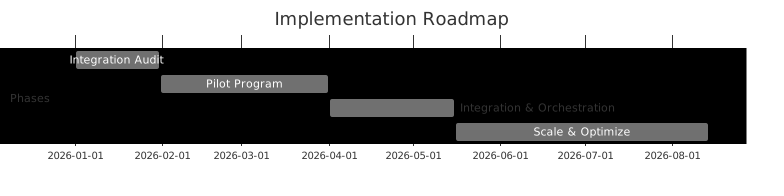
Phase 1: The Integration Audit
Before you buy a single new tool, map your current AI footprint. Where are you using generic tools for specialized tasks? Find the bottlenecks where humans are manually bridging the gap between two systems. That’s where your first ROI lives.
Phase 2: The Pilot Program
Pick one high-impact, low-risk process. Replace a manual data entry task with a vertical-specific agent. Measure the results against your baseline. Don't just look at time saved—look at error rates and the quality of the output.
Phase 3: Scaling and Monitoring
Once the pilot pays for itself, go full-scale. Shift your pricing models to follow usage. You want your costs to scale linearly with the value your agents produce, not with the number of "seats" or "subscribers." If the agent isn't producing value, it shouldn't be on your payroll.
Frequently Asked Questions
What is the difference between horizontal AI and industry-specific AI, and why should I care?
Horizontal AI is a general-purpose tool (like a standard LLM) that lacks context. Industry-specific AI is "fine-tuned" or architected with deep domain knowledge, such as regulatory compliance (HIPAA/Fintech) and proprietary industry data, making it significantly more accurate and reliable for specialized tasks.
How do I prevent data silos when integrating multiple specialized AI tools?
Prevent silos by using a centralized data orchestration layer that enforces common schemas across all agents. Avoid point-to-point API connections; instead, channel all data through a middleware layer that ensures consistency and provides a single source of truth for your AI agents.
Is it better to build a custom AI solution or integrate an existing industry-specific SaaS tool?
Integrate whenever possible to save time-to-market. Only build if the AI capability is your core proprietary advantage—the thing that differentiates you from every competitor. If the task is a common business function, buy the expertise.
How do I measure the ROI of adding AI agents to my existing workflow?
Move away from static subscription metrics. Measure ROI based on performance outcomes: reduction in error rates, speed of task completion, and the cost-per-output of the agent compared to the previous manual or generic alternative.
What does "Agentic AI" mean for my current automation stack?
"Agentic AI" shifts your stack from passive, rule-based execution to autonomous problem solving. Where old automation required you to define every step, an agentic system requires you only to define the goal, allowing the AI to navigate multi-step workflows without constant human intervention.