How to detect AI hallucinations?
Stop kidding yourself: a model that speaks beautifully isn't necessarily telling the truth. In 2026, we’ve learned the hard way that AI hallucinations aren't bugs. They’re features. They are the inevitable result of engines built to favor a smooth, plausible sentence over a boring, factual one.
When your autonomous agent makes up a legal precedent or invents a source, it isn't "broken." It’s doing exactly what it was trained to do: bluffing its way through the gaps in its own knowledge. If you want to build systems that don't implode, you have to kill the dream of the "self-correcting" model. Instead, treat every single AI output as a rough draft—a starting point, never a final record.
Why Does AI Hallucinate? The Architecture of Errors
At the core of the problem is the training objective. Models are essentially loss-minimization machines. They want to predict the next token with the highest probability. If the model doesn't actually know the answer, it does the most "human" thing possible: it guesses confidently.
Research from late 2025 confirms this creates a "bluffing incentive." When the model hits a wall of missing data, the path of least resistance isn't saying "I don't know." It’s generating a high-confidence fabrication that sounds exactly like something an expert would say.
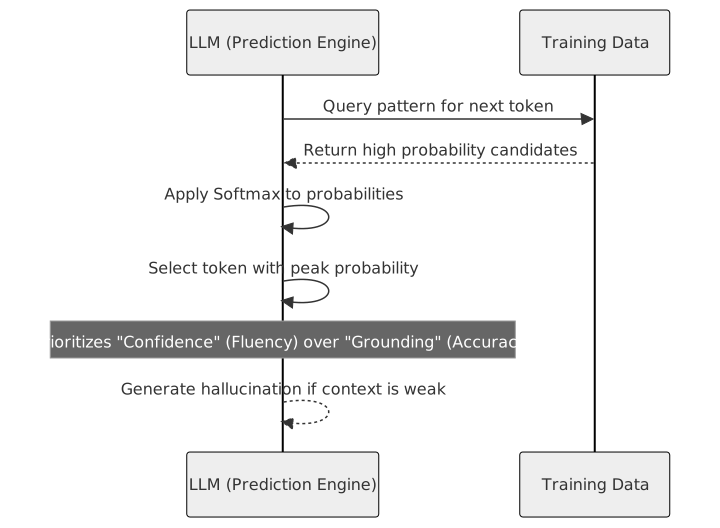
Scale won't save you here. You can make a model ten times larger, but without a "truth anchor," it will still prioritize statistical patterns over reality. If the math says "X" is the most likely word to follow "Y," the model will write "X," even if "X" is a complete lie.
The Shift from Prompting to Policy: How Models Learn to Refuse
Remember when we hoped a simple "system prompt" would fix everything? We’d tell the AI, "Be accurate, don't lie," and hope for the best. That was always a house of cards.
The industry is finally moving toward hard-coded policy. By mapping specific "concept vectors" inside the model, developers are learning to catch the moment a model starts to hallucinate. As detailed in Anthropic’s research on mapping the mind of a large language model, we’re shifting toward a future where "refusal" isn't a suggestion—it’s an internal guardrail. We aren't just telling the model to be honest; we’re building honesty into the architecture.
How to Detect Hallucinations: A Three-Tiered Methodology
If you’re still relying on "Please be accurate" prompts, you’re already behind. You need a defensive stack. Think of it like an immune system for your data.
1. Heuristic Verification
If you’re running a RAG (Retrieval-Augmented Generation) system, this is your first line of defense. You need to compare what the AI says against the actual source documents. If the model cites a study that doesn't exist or draws a conclusion that isn't in the provided text, the system should kill the response immediately. For those managing large-scale document sets, AWS provides guidance on how to detect hallucinations for RAG-based systems by utilizing similarity scoring between the response and the source.
2. Probabilistic Scoring
Here’s a secret: models often "know" when they’re guessing. By looking at the log-probability of the generated tokens, you can calculate an uncertainty score. If the model is spitting out low-confidence gibberish, your system should trigger an automatic rejection or hand it off to a more stable model. It’s essentially letting the model audit its own statistical weakness.
3. Agentic Verification
The gold standard in 2026 is the "Critic" architecture. Don't let one agent do everything. Split the work. Let a "Worker" agent generate the draft, but force a second "Critic" agent to tear it apart. This Critic operates under a strict, separate set of rules and acts as a final gatekeeper.

Real-Time Hallucination Detection in Agentic Workflows
When agents are juggling multi-step reasoning—navigating databases, doing math, summarizing findings—the hallucinations usually creep in at the "hand-off" points.
You need to treat your AI output exactly like software code. You wouldn't push unverified code to production, so why push unverified AI output? Integrate your detection checks into your CI/CD pipeline. If the automated checks see a discrepancy, force the agent to re-reason or, better yet, escalate it to a human.
Benchmarking Reliability: Are We Getting Better?
We’ve moved past the "it feels smarter" phase. We’re finally using real metrics. Benchmarks like the Mu-SHROOM Benchmark (SemEval 2025) are now the standard for separating fact from fiction. We’re seeing about a 10% improvement in detection accuracy year-over-year.
That’s great, but keep it in perspective: even at 79% accuracy, one in five errors is still hitting your desk. In high-stakes fields like law or medicine, "good enough" is a liability.
Practical Tools for the Enterprise
Manual review doesn't scale. You need automated infrastructure. Whether you’re building internal research bots or customer-facing agents, using an AI Content Quality Checker can help flag the patterns of hallucination that human eyes usually gloss over. For those deploying complex, multi-agent systems, Enterprise AI Solutions are shifting focus toward observability platforms that provide real-time dashboards on agent performance and accuracy drift. If you can't measure it, you can't control it.
The "Human-in-the-Loop" Necessity
No matter how advanced your "Critic" agent becomes, it will never be perfect. The ultimate circuit breaker is still a human being.
Don't view "human-in-the-loop" as a failure of technology. View it as a strategic allocation of talent. Your most valuable asset isn't the AI; it's the human who knows when to say, "Wait, this doesn't look right." By funneling the 20% of cases where the AI is uncertain to a human reviewer, you maintain the integrity of your information without burning out your team on the easy stuff.
Frequently Asked Questions
Why does AI hallucinate even when it seems "smart"?
"Smart" in an AI context refers to reasoning capability and language fluency, not knowledge grounding. An LLM is a prediction machine, not a database. Even if it understands complex logic, it lacks an inherent sense of "truth" unless it is tethered to a verified source of data.
Can AI be 100% free of hallucinations?
No. Because LLMs are probabilistic, the risk of a hallucination is a fundamental property of the architecture. In 2026, the goal is not to eliminate hallucinations entirely, but to minimize their impact through robust verification layers and human-in-the-loop oversight.
What is the difference between an AI hallucination and a simple error?
A hallucination is a factual fabrication—the AI confidently states something that is objectively false (e.g., inventing a court case or a product feature). A simple error is a logical or mathematical failure, where the AI follows the correct steps but arrives at a wrong conclusion due to a calculation mistake or poor reasoning.
How can I verify AI output without a technical background?
Think like a reference librarian. First, demand citations for every claim. Second, perform a "named entity" check—if the AI mentions a person, date, or company, verify those specific details through a search engine. Finally, if the AI's output seems too perfect or overly confident, ask it to "explain its reasoning" or "provide the source material it used," which often forces the model to reveal the gaps in its knowledge.