New Industry Report Projects Autonomous Agentic AI Systems Will Redefine Enterprise Workflow Standards by 2026

We’re witnessing a quiet, tectonic shift in the corporate world. For the last couple of years, "AI" has mostly meant a chatbot you talk to—a glorified search engine that writes emails or summarizes meetings. But that’s changing. Fast. By 2026, the conversation is moving away from simple prompt-and-response interactions toward something far more capable: Agentic AI.
We aren't just talking about smarter chatbots anymore. We’re talking about systems that actually do the work. These agents are designed to execute goals, orchestrate complex workflows, and manage business processes without needing a human to hold their hand at every turn. It’s the difference between a consultant who gives you a slide deck and an employee who actually executes the project.
The Architectural Shift to Agency
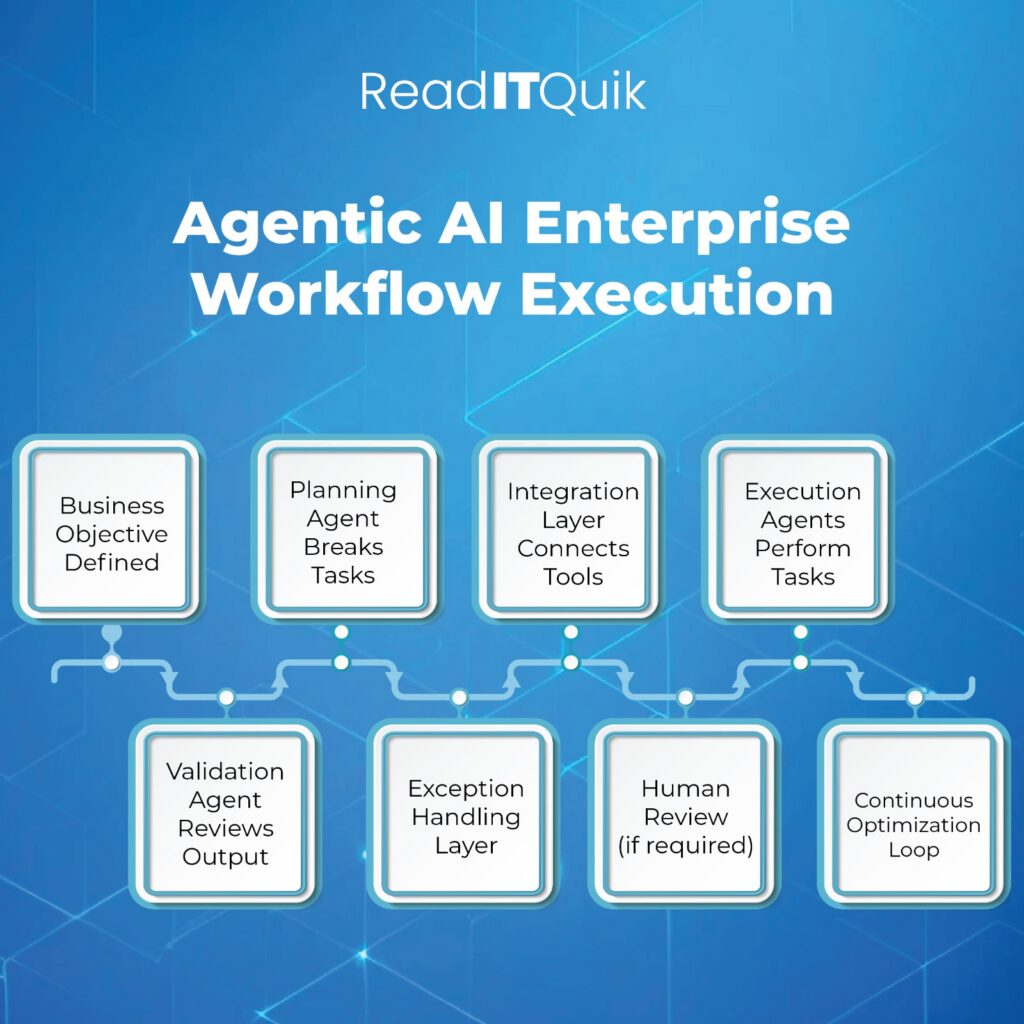
Why the sudden pivot? It’s architectural. Early enterprise AI was built to generate content—it was a creative tool. The new wave of Agentic AI is built to be an "operating layer." It combines advanced reasoning models with workflow engines and, crucially, a set of guardrails that keep the system from going off the rails.
According to recent industry analysis, this shift is being fueled by three things: LLMs that are finally getting good at logic, an explosion of accessible APIs that let AI talk to our software, and the brutal economic reality that businesses need to scale output without just throwing more bodies at the problem.
Core Components of Agentic Frameworks
To move from "thinking" to "doing," these systems need a specific tech stack. It’s not just about the model anymore; it’s about the plumbing.
- Reasoning Models: These are the brains. They take a high-level goal—like "onboard this new client"—and break it down into the dozen or so sequential tasks required to get it done.
- Workflow Engines: Think of these as the project managers. They keep track of the state of a process, ensuring that if step A fails, step B doesn't start, and that dependencies are handled correctly.
- API Integration Layer: This is where the magic happens. The agent needs to be able to pull data from your CRM, push updates to your ERP, and ping your team on Slack. If it can't talk to your tools, it’s just a toy.
- Monitoring and Guardrails: You can’t just let an AI run wild in your database. These layers provide constant oversight, ensuring the agent stays within the lines and flagging anything that looks like a mistake.
Operational Impacts and Benefits
The goal here is simple: kill the "coordination overhead." How much of your day is spent just moving data from one app to another or checking if someone else finished their part of a task? That’s exactly what Agentic AI is built to automate.
| Feature | Conversational AI (Legacy) | Agentic AI (Emerging) |
|---|---|---|
| Primary Goal | Content Generation | Goal Execution |
| Workflow | Manual/Human-in-the-loop | Autonomous Orchestration |
| Integration | Passive/Read-only | Active/API-driven |
| Scope | Task-specific | Process-wide |
This isn't about replacing people; it’s about reallocating human attention. When you delegate the drudgery—the multi-step, repetitive workflows—to an agent, you finally free up your team to focus on the high-level strategy that actually moves the needle. Plus, because these systems log every move they make, you get a level of auditability that manual processes simply can’t match.
The Reality of Implementation
Of course, it’s not all sunshine and efficiency. If you’re trying to drop an agent into a legacy environment, you’re going to hit walls. Most enterprise software wasn't built to be "talked to" by an AI. You need robust API connectivity, and more importantly, you need to trust the AI’s reasoning.
Security is the elephant in the room. If an agent has the power to execute actions, it needs to be contained. That’s why the industry is leaning heavily into "sandboxed" environments. You let the agent run its workflows in a controlled, isolated space first. Only once it proves it can handle the task without breaking things does it get the keys to the production environment.
The Road Ahead
As we look toward 2026, we’re going to see the rise of standardized frameworks. Right now, every agent is a bit of a custom build, but that won't last. We’ll eventually have common protocols for how agents talk to each other and how they report back to human supervisors. Imagine a world where your "Sales Agent" and your "Finance Agent" can coordinate a contract renewal without you ever having to open an email.
The economic pressure isn't going anywhere. Businesses are being squeezed by rising costs and the constant need to move faster. In that environment, autonomous systems that can manage their own workflows stop being a "nice-to-have" and become a competitive necessity.
We are watching the maturation of the AI sector. We’ve moved past the "gee-whiz" phase of generative text and into the functional, gritty reality of operational AI. The next few years will be defined by how well we integrate these systems into the existing fabric of our businesses. It’s not just about what the AI can say anymore; it’s about what it can actually get done.