
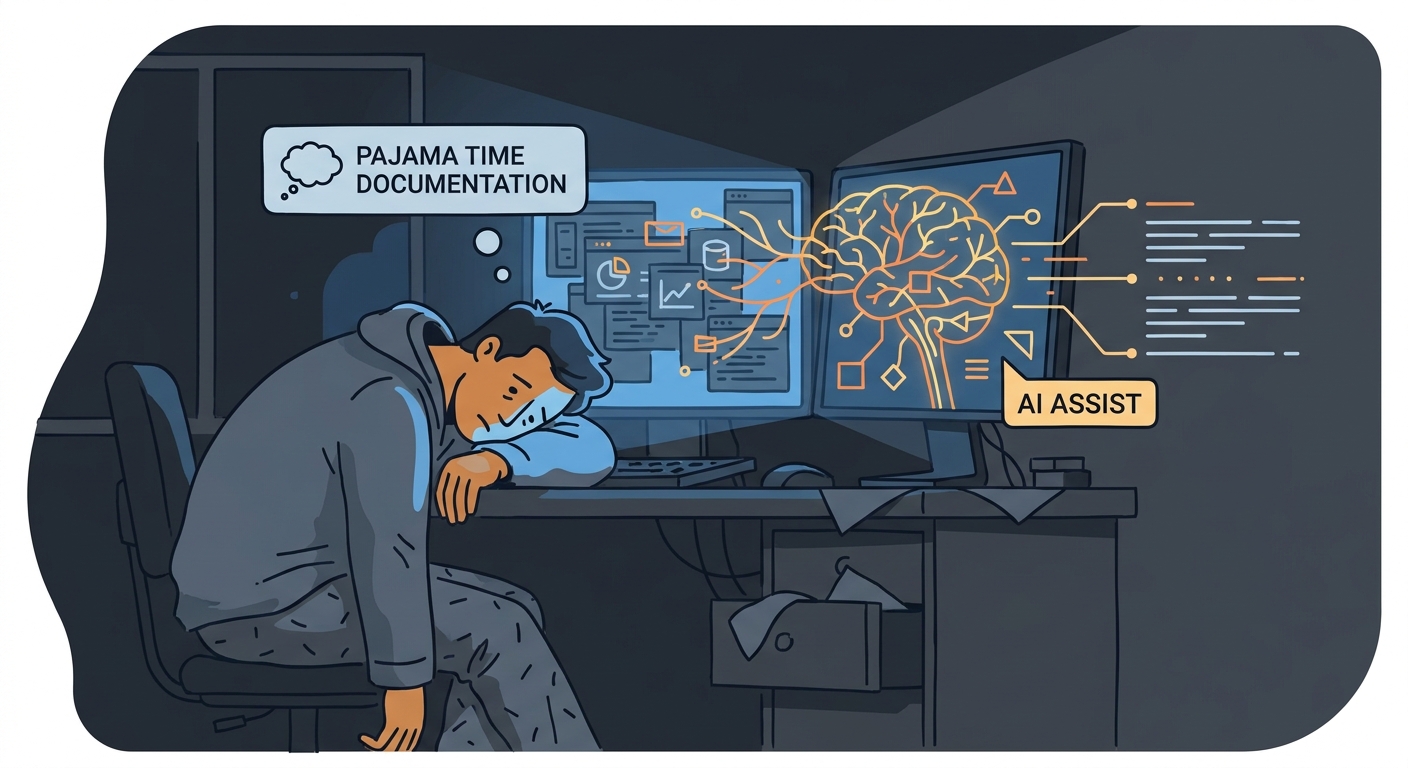
The documentation crisis isn’t some distant, looming threat. It’s the anchor dragging down our entire healthcare system right now. Physicians are shackled to their monitors, trapped in the soul-crushing nightly ritual of "pajama time." They spend hours grinding through EHR entries long after the last patient has walked out the door. Administrative burden is one of several drivers the AMA identifies. Its national physician comparison report found that "in 2025, 41.9% of physicians reported experiencing at least one symptom of burnout—down from 43.2% in 2024 and 48.2% in 2023," and describes burnout as "driven by differences in workload, administrative burden, clinical environment, staffing support, and the day-to-day realities of practice" (AMA, Physician burnout rates are falling, specialty gaps remain, retrieved 2026-09-02). SOURCED Note the plural: administrative burden sits alongside four other drivers, not above them. It strips them of the very thing that brought them into medicine: the actual connection with a human being.
The future of medical scribing isn’t about hiring more staff or training doctors to type faster. It’s about Ambient Clinical Intelligence (ACI). Think of it as a silent, invisible partner that stops the physician from being a glorified data entry clerk and lets them return to being a healer.
How Ambient Clinical Intelligence Actually Works
To really get what’s happening, we have to stop comparing this to the old-school dictation tools. Traditional transcription was a clunky, manual process. The doctor had to stop the exam, summarize the visit, and dictate notes—it was a constant interruption to the clinical flow.
ACI is different. It lives in the background. It listens to the natural, messy dialogue between provider and patient and distills that conversation into a structured, clinical note in real-time.
Ambient documentation tools shift the work from manual typing to automated synthesis. ANALYSIS — an earlier version of this article linked that point to a named federal publication that does not exist; the citation has been removed rather than replaced. By using Natural Language Processing and Large Language Models, the tech actually understands the context. It knows the difference between a casual comment about the weather and a critical symptom description. It maps that data directly into the right fields of the EHR. Crucially, the physician stays in the driver's seat. They review the draft, tweak what needs tweaking, and sign off. The AI is a high-fidelity assistant, not the boss.
Why Clinics Are Prioritizing AI Adoption in 2026
The rush toward AI isn't just about chasing the latest shiny object; it’s a survival tactic. It’s a pragmatic response to the economic and psychological exhaustion defining clinical practice today.
The biggest win is the burnout factor. The scale of after-hours charting is smaller than it is often described, which matters when sizing the benefit. Family physicians average 86 minutes of after-hours EHR work — "pajama time" — within a 5.9-hour daily total in the record (AMA, Family doctors spend 86 minutes of 'pajama time' with EHRs nightly, retrieved 2026-09-02). SOURCED ANALYSIS — an earlier version of this article spoke of saving "three hours of charting every night," which exceeds the total available to save. There is real evidence on burnout itself: in a study of 263 clinicians, "after 30 days with the ambient AI scribe, the proportion of participants experiencing burnout decreased significantly from 51.9% to 38.8%" (JAMA Network Open, 2025, retrieved 2026-09-02). SOURCED That study measured burnout and self-reported workload only — it did not measure diagnostic error, and this article no longer claims a link to it.
Then there is the revenue case, which the evidence does not currently support at the scale vendors suggest. A study of 1,547 clinicians using ambient AI between July 2023 and March 2025 found no statistically significant association with appointments per day, concluding that ambient AI can "modestly reduce documentation burden" while cautioning that "expectations regarding improvement should be metered" (JAMA Network Open, Ambient Artificial Intelligence Use and Clinician Documentation Burden, Productivity, and Efficiency, retrieved 2026-09-02). SOURCED ANALYSIS — an earlier version of this article claimed 15–25% jumps in patient capacity. That figure traces to a vendor's own ROI calculator rather than to research, and it has been removed. When you cut through the documentation bottleneck, the clinic’s "throughput" naturally expands. Plus, structured data means notes are consistent, audit-ready, and compliant with coding standards. In a world of razor-thin margins, producing high-quality, compliant notes at scale isn't an advantage—it's a requirement.
A Day in the Life: The Return of Presence
Most primary care physicians live in a fragmented hell. Their 10-hour day is punctuated by the rhythmic, soul-deadening click-clack of a keyboard while the patient stares at the back of their doctor’s head. By 5:00 PM, the doctor is spent. The patient feels like a checkbox, not a person.
Now, imagine the AI-integrated 8-hour day. The physician walks into the room, makes eye contact, and has a conversation. They focus on the patient’s non-verbal cues and their real concerns. The ambient sensor, secure and out of the way, handles the heavy lifting. By the time the doctor moves to the next room, a draft note is waiting for review. ANALYSIS — treat that review as clinical work, not a formality: the physician attests to the note's accuracy regardless of what drafted it. Measured per-note time savings in the largest study available are fractions of a minute, so an earlier version of this article overstated the effect by describing clinicians finishing their day on time as a general outcome. They’re less exhausted. Most importantly, they’ve finally regained the "presence" that makes medicine a calling rather than just a job.
Addressing the Skeptics: Is AI Just a "Black Box"?
A good clinician should be a skeptic. Questioning the "black box" nature of AI is smart. But the answer to that skepticism is the "human-in-the-loop" requirement. No AI should ever be allowed to finalize a chart without a doctor’s eyes on it. The technology is there to suggest, not to dictate.
Security is the bedrock here. Modern ACI platforms are built with privacy as the core architecture, adhering to HIPAA compliance guidelines. Data is encrypted, locked down, and handled with a "Shield and Scale" philosophy. We protect the data (the shield) so we can improve the clinical workflow (the scale). Patient trust is non-negotiable.
Future Outlook: Beyond 2027
If 2026 is the year of getting note-taking off the doctor’s desk, 2027 is the year of autonomous clinical support. We’re moving toward deep EHR integration. The AI won't just write the note; it will start suggesting follow-ups based on history. If a patient’s blood pressure has been creeping up over three visits, the AI will proactively flag it, suggesting a medication adjustment or a specific test in the next encounter.
We’re also seeing massive strides in multilingual support. We’re moving toward a future where the AI observes, synthesizes, and updates the record with such precision that the physician’s role shifts from "scribe" to "editor-in-chief." They spend their time on the nuanced, human parts of care that machines will never be able to replicate.
How Can Your Clinic Successfully Pilot AI Scribes?
Adopting AI isn't a light switch; it’s a culture shift. If you want to succeed, follow this framework:
- Workflow Audit: Before you buy anything, map your bottlenecks. Is the delay in intake? The exam room? The billing handoff? AI is only as good as the problem it solves.
- The Pilot Group Strategy: Don't roll it out to the whole clinic at once. Pick a tech-forward department or a group of early adopters. Let them break it, fix it, and show the rest of the team that it actually works.
- Measuring ROI: Define success early. Are you tracking charting time saved? Patient throughput? Staff satisfaction? Having hard data makes the full-scale rollout much easier to sell to your partners.
If your clinic is ready to see how these tools fit into your workflow, contact our team to discuss a strategy that doesn't just add more tech, but actually solves your problems.
Frequently Asked Questions
Is AI-generated clinical documentation HIPAA compliant?
Compliance is not a property you can buy from a vendor. HIPAA obligations attach to the covered entity — your practice or health system — through your own safeguards, risk analysis and an executed Business Associate Agreement with the vendor. Vendor features such as encryption, data isolation and contractual limits on model training support compliance, but no product tier confers it. ANALYSIS — an earlier version of this answer said "yes, provided you utilize enterprise-grade solutions," which misplaced the obligation. Consult your privacy officer or counsel; this is not legal advice.
How does an AI scribe differ from traditional medical transcription services?
Traditional transcription is a deferred, manual process where a human listens to a recording hours later. AI scribing is real-time, ambient, and automated, integrating directly into the clinical encounter to provide a draft before the patient even leaves the room.
What is the learning curve for a clinic adopting AI scribing?
The learning curve is surprisingly shallow. Because the technology works ambiently, physicians do not need to learn new "commands" or change their conversational style. Most providers report feeling comfortable with the system within the first week of use.
Does AI replace the physician's clinical judgment?
Absolutely not. AI is an administrative assistant, not a clinician. The physician retains full control over the clinical narrative, diagnostic reasoning, and final sign-off. The technology exists to handle the data, leaving the doctor free to handle the medicine.
Related reading
- Innovations in AI Scribing Technology
- Leading AI Medical Scribes Trusted by Healthcare Professionals
- Understanding Artificial Intelligence in Scribing and Language Processing
- The Future of Content Marketing: Predictions Powered by AI
How This Guide Was Sourced
Written and maintained by the LogicBalls editorial team (logicballs.com). This is not clinical, legal or compliance advice.
Sources, retrieved 2026-09-02:
- JAMA Network Open, Ambient Artificial Intelligence Use and Clinician Documentation Burden, Productivity, and Efficiency — 1,547 clinicians, July 2023 to March 2025.
- JAMA Network Open, Use of Ambient AI Scribes to Reduce Administrative Burden and Professional Burnout — 263 clinicians, burnout measures.
- AMA, Physician burnout rates are falling, specialty gaps remain — national physician comparison report.
- AMA, Family doctors spend 86 minutes of 'pajama time' with EHRs nightly — after-hours EHR time, Annals of Family Medicine data.
Corrections to an earlier version. This article linked a named federal publication that does not exist, claimed patient-capacity gains of 15–25% that trace to a vendor ROI calculator and are contradicted by the study above, described saving three hours of nightly charting when the measured average is 86 minutes, asserted a link between AI scribes and fewer diagnostic errors that no study we found measures, and answered a HIPAA question in a way that placed compliance on the vendor rather than the covered entity. Each has been corrected above.
No LogicBalls telemetry is used in this guide.