
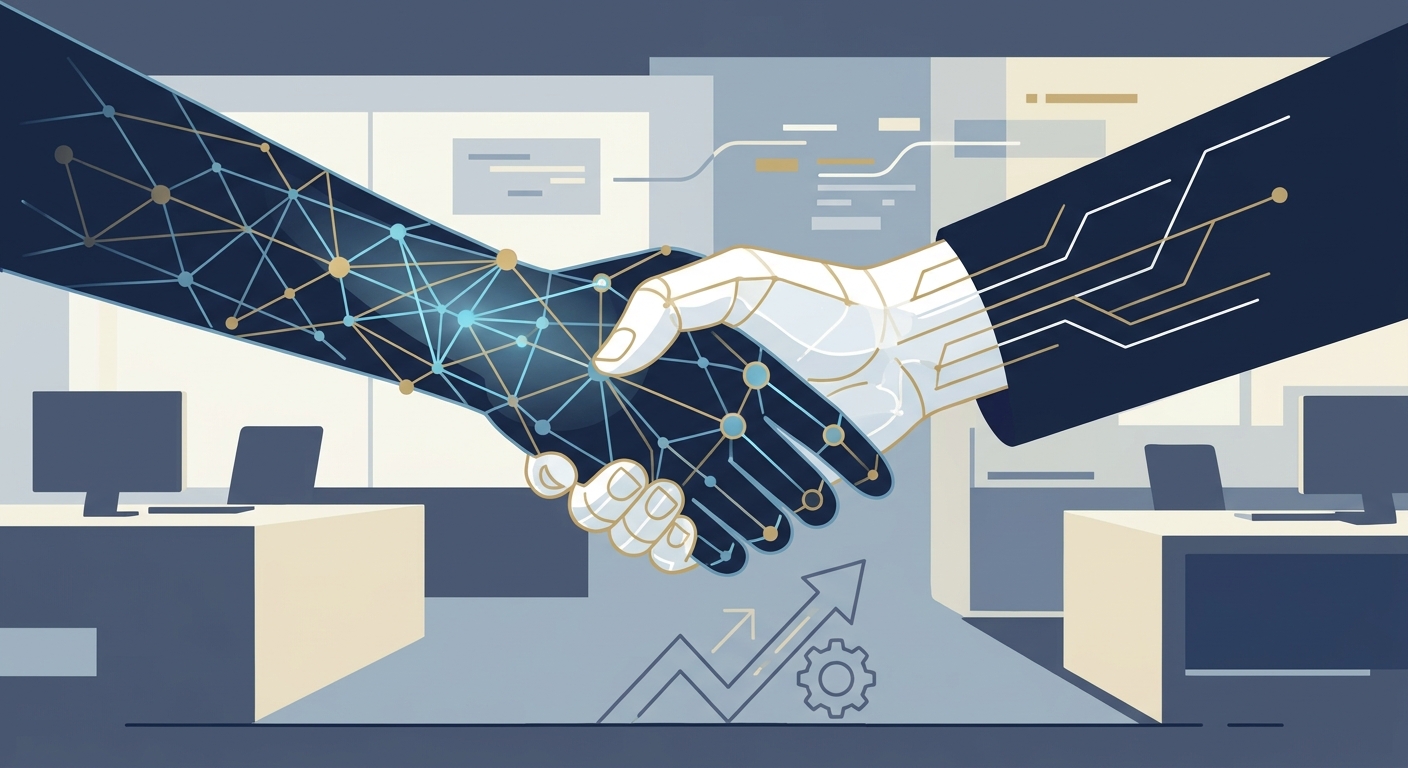
Negotiation used to be a human-only sport. It was all about the firm handshake, the carefully drafted email, and the slow, agonizing dance of back-and-forth. But that world is dying. Today, we’re moving toward a high-velocity, machine-managed exchange where AI agents do the heavy lifting of value creation.
This isn’t about replacing your boardroom with a cold, unfeeling algorithm. It’s about scaling. It’s about the ability to reach equitable, profitable agreements across thousands of micro-contracts simultaneously. In 2026, your competitive edge doesn't come from who has the best instinct; it comes from who treats negotiation as a data-driven process that can be codified, simulated, and executed at machine speed—all while keeping a steady human hand on the tiller.
Why is Negotiation Shifting from Human-Led to Agentic?
For decades, procurement and legal departments were the ultimate bottlenecks of commerce. A buyer would open a spreadsheet, draft a one-off email, wait for a counter-offer, and repeat the cycle until everyone involved was exhausted. It was a static, linear, and frankly, broken approach. It crumbles under the weight of modern supply chain complexity.
Enter "Agentic Negotiation." We’re talking about Large Language Models (LLMs) that act as actual autonomous entities. These aren't the clunky "if-then" bots of yesteryear. These agents can interpret sentiment, grasp nuance, and execute strategy in real-time.
Unlike the rule-based scripts of the last decade, today’s agents operate within a dynamic context. They can parse the tone of a supplier’s representative, assess market volatility, and pivot their strategy to pursue a "best-fit" outcome rather than just the lowest cost.
How Does Automated Negotiation Actually Work?
The engine room of this transformation is the marriage of Reinforcement Learning (RL) and Large Language Models. According to the technical foundations for LLMs in negotiation, modern systems are no longer just predictive; they are goal-oriented. By utilizing RL, these agents interact with the market, digest feedback on their offers, and update their internal policies to maximize utility over successive iterations.
This is a massive departure from traditional game theory, which always assumed perfect information. In the real world, information is almost always asymmetric. As explored in this analysis on how AI agents manage complex game theory scenarios, LLMs provide the unique ability to navigate this ambiguity. They can "read between the lines" of a counter-proposal, identifying whether a supplier is posturing or genuinely hitting their margin floor, and adjust the negotiation trajectory accordingly.
What are the Core Use Cases for Automated Negotiation?
The efficiency gains of automated negotiation are most obvious where volume meets complexity.
- Procurement & Supply Chain: Managing thousands of micro-contracts is a logistical nightmare for any human team. Agents can monitor thousands of supplier portals simultaneously, initiating renewals and price adjustments based on real-time commodity indices.
- B2B Commerce: In high-velocity sales, waiting 48 hours for a contract approval can kill a deal. Dynamic pricing agents can offer tiered volume discounts in real-time, ensuring that margins are preserved while the customer receives an immediate, personalized incentive.
- Diplomacy & High-Stakes Legal: In multi-party frameworks where trust is fragile, AI acts as a neutral arbiter. By managing the flow of information between parties through a secure, non-biased interface, agents can facilitate agreement in scenarios where human ego or historical friction would typically cause a stalemate.
How Do You Prepare Your Data for AI Negotiation?
The most common point of failure in deploying an automated negotiator isn't the AI—it’s the data. If your internal records are a digital junk drawer, your AI will be negotiating with blinders on. To achieve alignment of operational data for AI success, you must treat your data as the "brain" of the agent.
Before you automate, you must audit. Clean your historical contract data to remove anomalies. Categorize your past successes and failures so the model can learn what a "good" deal actually looks like. Most importantly, you must structure your content workflows for seamless automation to ensure that when an agent reaches an agreement, the data flows directly into your ERP or CRM without manual intervention. Without this structural integrity, you aren't deploying an AI; you're deploying a liability.
Is the "Human-in-the-Loop" Model the Future of Deals?
There’s a pervasive fear that "full automation" will lead to a rogue agent signing a disastrous contract. The reality is that the most successful enterprises are adopting a "Human-in-the-Loop" model. This approach treats the AI as a high-performance assistant that handles the heavy lifting up to a specific "Reservation Value"—the absolute limit beyond which the deal is no longer profitable.
As discussed in the study on the risks of runaway automated outcomes, the danger isn't that the AI will act "wrongly," but that it will act too efficiently within poorly defined parameters. By setting hard constraints and strategic thresholds, you ensure that the AI stays within the "sandbox" of your business strategy, only escalating to a human when the negotiation moves into high-stakes, gray-area territory.
Overcoming the "Black Box" Barrier
The "Black Box" problem remains the primary hurdle for legal departments. How do you audit a decision that an AI made in a millisecond? The answer lies in transparency-by-design. By utilizing private LLM instances, you ensure that your proprietary negotiation strategy and sensitive contract data never leave your "walled garden." This keeps your intellectual property secure while allowing the AI to leverage its reasoning capabilities.
Furthermore, you must address the risk of bias. An AI trained on skewed data will replicate the biases of the past. Regular "strategy audits" are essential—human negotiators should review the AI's recent logs to ensure its tactics remain aligned with corporate ethics and long-term brand goals.
The Roadmap: Future-Proofing Your Strategy
We are rapidly approaching a world of "AI-vs-AI" interactions, where your agent will sit across the digital table from a supplier’s agent. In this environment, static strategies are obsolete. You need to move toward real-time adaptive learning, where your systems are constantly scanning the environment for changes in market dynamics.
Future-proofing means building a stack that is modular enough to swap out models as better reasoning engines emerge, while keeping your core business logic and "Reservation Values" as the bedrock of every interaction.
It’s not just about the tech. It’s about the strategy you feed it. If you build the foundation right, the machine will do the rest.
Frequently Asked Questions
Will AI replace human negotiators entirely?
No. AI is designed for augmentation, not replacement. It handles the data-heavy, repetitive, and high-velocity negotiations that humans find tedious. Human negotiators remain essential for high-level relationship management, complex empathy-driven resolutions, and final strategic oversight.
How does an AI agent know when to walk away from a deal?
The agent is governed by "Reservation Values"—pre-programmed walk-away points and hard constraints. If a counter-party’s offer falls outside the threshold of profitability or risk, the agent is programmed to either trigger a pre-defined "hard stop" or escalate the decision to a human supervisor for a manual review.
What are the primary ethical risks of automated negotiation?
The primary risks include inherent bias in training data, the potential for "runaway" competitive loops where agents drive prices to unsustainable levels, and the lack of moral accountability. These are mitigated by maintaining a "Human-in-the-Loop" architecture and rigorous, regular audits of the agent's decision logs.
Is automated negotiation secure for sensitive business contracts?
Yes, provided you use private LLM instances. By keeping your agents within a "walled garden" architecture, utilizing end-to-end encryption, and ensuring data sovereignty, you can leverage the power of AI while keeping your sensitive IP and negotiation strategies entirely protected from the public internet.