The Role of Artificial Intelligence in IoT
TL;DR
- AIoT evolves connected devices into autonomous, thinking systems for real-time action.
- Predictive Maintenance 2.0 automates the entire repair lifecycle without human intervention.
- Edge AI replaces slow cloud-only architectures to reduce latency and improve safety.
- Moving intelligence to the edge transforms raw data into actionable business insights.
For the last decade, the Internet of Things (IoT) has functioned like a global nervous system. It’s been busy—collecting trillions of data points across our factories, our cities, and our living rooms. But here’s the rub: for all that connectivity, these systems have been effectively lobotomized. They could tell you a machine was running hot, sure. But they couldn't decide what to do about it.
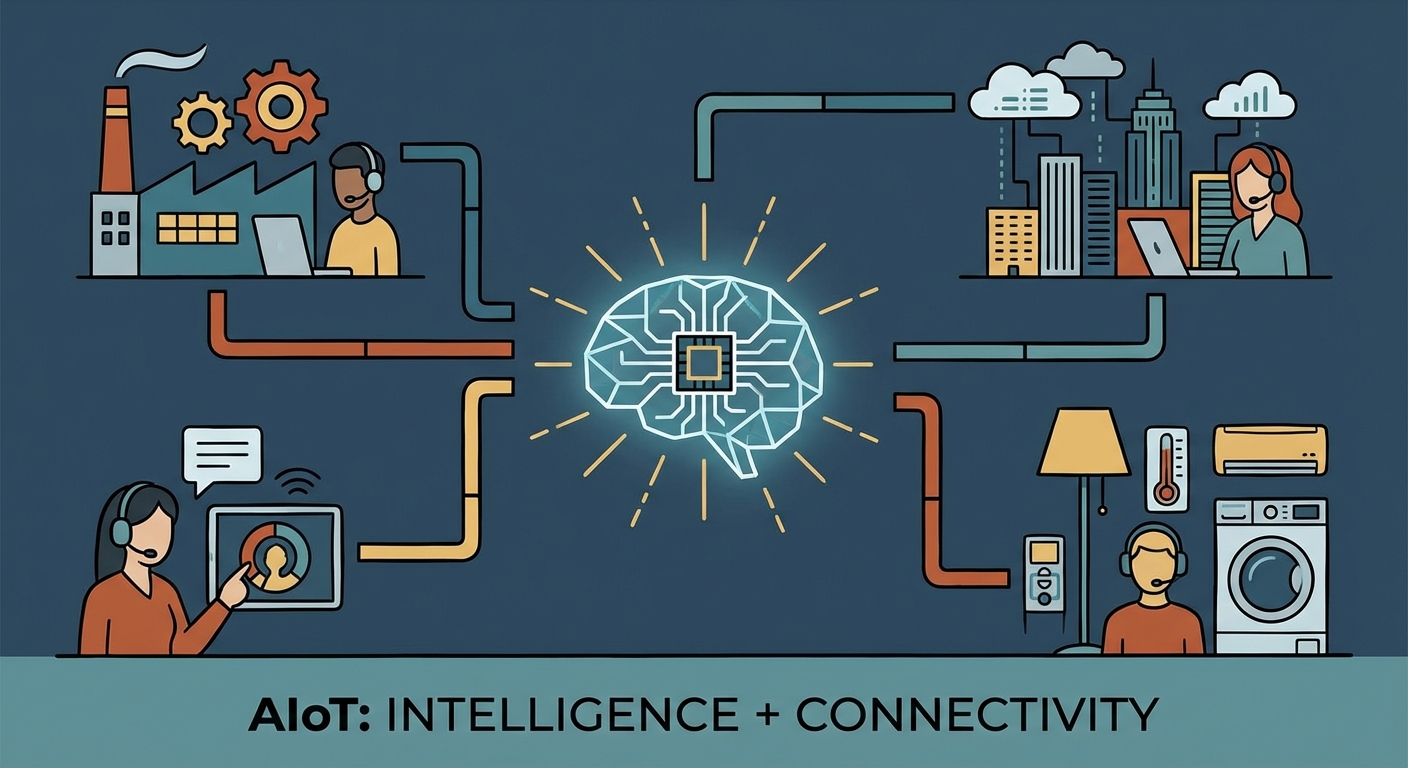
That’s where the marriage of AI and IoT—AIoT—changes the game. We are finally leaving the era of "connected things" and stumbling into the age of "thinking things." In 2026, it’s not the company with the most data that wins. It’s the company with the architectural maturity to process that data at the edge, turning raw, noisy telemetry into autonomous, real-time action.
Redefining Operational Efficiency Through Autonomy
For years, industrial efficiency was a reactive game. You waited for a sensor to trip, sent a frantic alert to a human operator, and prayed they could intervene before something expensive exploded.
AIoT renders this model obsolete. We’re seeing a shift toward Predictive Maintenance 2.0. The system doesn't just predict a failure anymore; it manages the entire remediation lifecycle.
As noted in recent Predictive Maintenance Research, machine learning helps systems spot the tiny, subtle patterns in vibration or power draw that signal mechanical fatigue long before a human would notice. But the real leap? The autonomous workflow. When a bearing starts to fail, the AIoT platform doesn't just ping a dashboard. It checks the inventory, places the order for a replacement part, and puts a work order on a technician’s calendar—all without a human ever touching a keyboard. That is the difference between a dashboard that reports the past and an engine that secures its own future.
The Shift from Cloud-Only to Edge AI
The old "Sensor-to-Cloud" architecture is becoming a liability. Sending every byte of raw data to a central cloud server is slow, expensive, and risky. If your factory floor depends on a round-trip to the cloud to make a split-second safety decision, you’re living on borrowed time.
The industry standard for 2026 is moving intelligence to the edge. Edge AI lets devices perform high-fidelity analysis locally. They filter out the noise and ship only the "actionable intelligence" to the cloud. This drops latency from seconds to milliseconds, which is the difference between a robotic arm stopping in time and a multi-thousand-dollar collision.
This transition isn't just about speed. It’s about privacy and scalability. By processing the bulk of your data locally, you aren’t shipping sensitive proprietary data across the public internet. You’re shipping distilled, anonymized insights. You stay compliant, and you stay secure.
Securing the Intelligent Perimeter
Traditional firewalls are like screen doors in a hurricane when it comes to modern IoT. Because IoT devices are often lightweight and low-power, they’re the "soft underbelly" of your enterprise network. Hackers don't target the heavily guarded server; they target the unsecured smart thermostat or a sensor in the warehouse to get a foothold.
AI changes the security calculus by moving from static, rule-based defense to behavioral analysis. By building a "baseline" of normal traffic for every device, an AI-driven security layer knows exactly when something smells fishy. If a sensor that usually transmits 5KB of data per hour suddenly tries to ping a foreign IP address, the system doesn't just alert IT—it isolates the device in a virtual sandbox automatically. This proactive mitigation is critical, especially as IoT Market Trends 2026 point toward sophisticated, AI-enhanced botnets that can bypass standard protocols in seconds.
Solving the Sustainability Puzzle
Sustainability isn't just a marketing buzzword anymore; it’s a financial imperative for 2026. Global ESG goals require granular reporting and radical energy efficiency that human operators simply can’t manage on their own. AIoT is the primary tool for this.
Consider the modern "Smart Building." An AI-integrated HVAC system doesn't just follow a static schedule. It learns the building’s thermal personality. It watches occupancy, checks weather forecasts, and looks at energy pricing to optimize heating and cooling in real-time. Organizations can shave double-digit percentages off their energy bills just by letting the system think for itself. The same logic applies to industrial grids, where AIoT balances load distribution to ensure the lowest possible carbon footprint.
Implementing AIoT: From Theory to Deployment
The biggest mistake businesses make? Assuming "off-the-shelf" models will solve their specific problems. Your sensor data is unique. Your environment is idiosyncratic. Successful implementations rely on bespoke models tailored to the specific mechanical or behavioral nuances of your infrastructure. If you want a strategy that moves beyond generic, cookie-cutter deployments, exploring Custom AI Solutions is the logical first step to ensuring your models actually understand the data they are processing.
Additionally, the documentation burden of these systems is massive. As you scale, the technical workflows behind your AIoT deployments can become as complex as the hardware itself. Leveraging tools for AI Content Generation can bridge this gap, turning raw technical logs and system configurations into readable, actionable operational reports for stakeholders. This democratizes the intelligence, ensuring the insights aren't just trapped in the minds of a few specialized engineers.
The Future of Autonomous Ecosystems
Looking toward 2027 and 2028, the industry is gravitating toward the "Digital Twin" as the hub of all AIoT activity. A Digital Twin is a virtual replica of your physical system, updated in real-time and powered by AI simulations. It allows you to run "what-if" scenarios without risking a single piece of physical equipment. What happens if we crank production by 15%? What if the local power grid ripples?
As discussed during the Davos AI Transformation, the transition from hype to tangible economic impact is being driven by this convergence of simulation and real-time execution. We’re moving toward a future where autonomous ecosystems do more than report status; they negotiate their own resources, predict their own failures, and evolve their own performance benchmarks. The companies that thrive in this era will be the ones that stop viewing their physical infrastructure as static hardware and start seeing it as a living, learning, and self-optimizing asset.
Frequently Asked Questions
What is the fundamental difference between IoT and AIoT?
IoT acts as the connective "plumbing" that gathers data, while AIoT introduces a layer of cognitive intelligence, allowing devices to analyze that data and take autonomous action without human intervention.
Why is AI necessary for modern IoT deployments?
The sheer volume of data generated by modern sensor arrays is too large for manual human analysis. AI is required to process, filter, and extract actionable insights from this data in real-time.
Is Edge AI always superior to Cloud AI?
Not necessarily. Edge AI is superior for low-latency, privacy-sensitive tasks, while Cloud AI is essential for training global, complex models that require massive compute power beyond the capability of local hardware.
What are the primary barriers to implementing AIoT in 2026?
The biggest challenges remain data silos, interoperability between legacy hardware, and the technical limitations of processing power on low-energy edge devices.
How does AIoT improve security compared to traditional IoT?
Traditional IoT relies on static rules that are easily bypassed. AI-driven security monitors behavior patterns in real-time, allowing systems to flag and isolate compromised devices the moment anomalous traffic is detected.