How to Create SEO Meta Descriptions That Increase CTR by 30%

TL;DR
- ✓ Shift your mindset from filling tags to writing persuasive, human-centered hooks.
- ✓ Address specific user pain points to bridge the gap between search and click.
- ✓ Avoid keyword stuffing to prevent Google from rewriting your meta descriptions.
- ✓ Structure your snippet with a hook, value proposition, and a clear call to action.
- ✓ Keep descriptions under 120 characters to ensure visibility on mobile search results.
If you treat a meta description as just another box to check in your SEO dashboard, you’re leaving money on the table. Period.
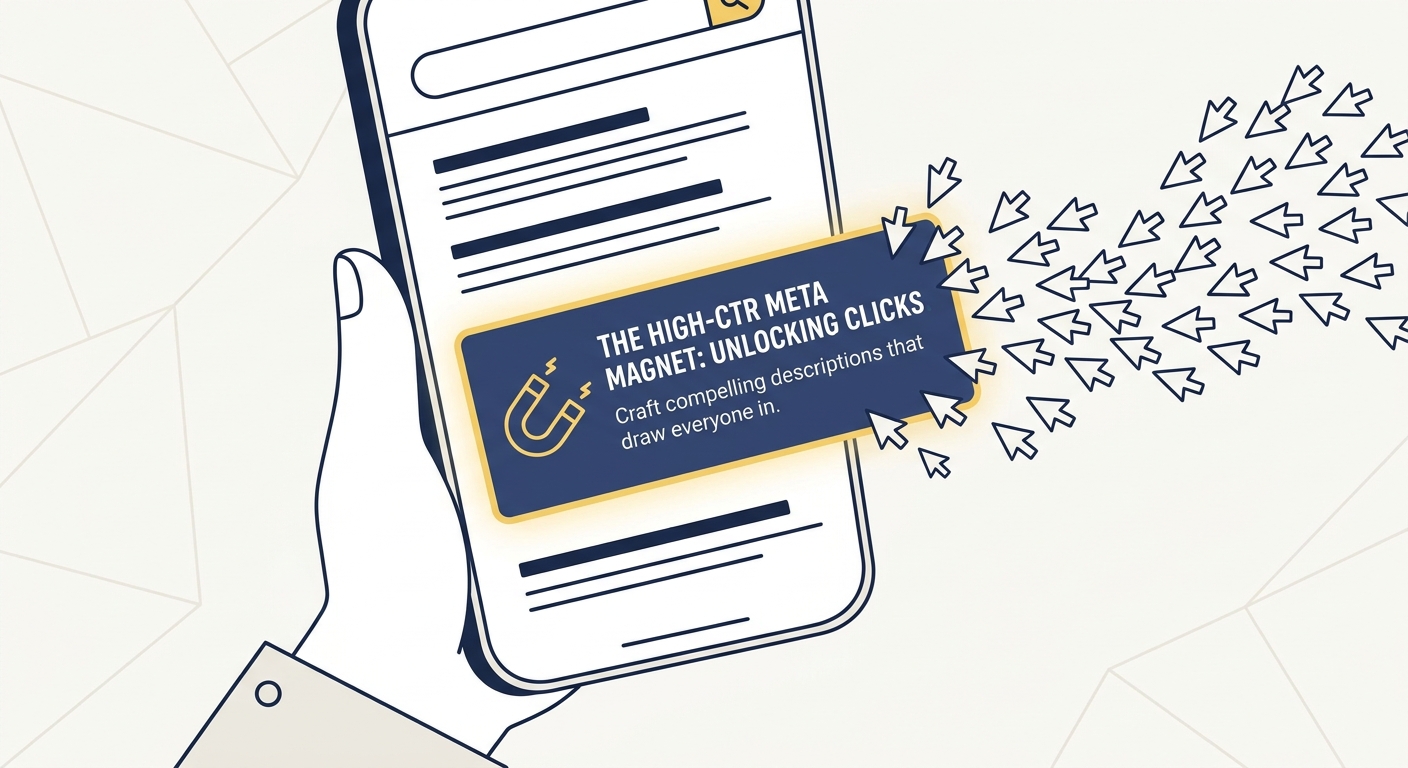
In 2026, the search results page is a gladiator pit. Your meta description is your one shot—your fifteen seconds of fame—to stop a user’s thumb mid-scroll. It’s not a graveyard for your primary keywords. It’s a high-stakes, micro-copy advertisement. If you switch your mindset from "filling a tag" to "writing a hook," you won't just see a slight bump in traffic. You’ll see that 30% CTR jump you’ve been chasing.
This isn't about gaming some faceless algorithm. It’s about talking to the human being sitting on the other side of that screen.
Why Your Meta Description is Your Most Important "Ad"
The game has changed. Between AI summaries and personalized snippets, users are picky. They don’t click the first link because they’re loyal to Google; they click because the promise in that snippet actually speaks to the mess they’re currently in.
If your description reads like a robot wrote it—or worse, if it’s stuffed with keywords until it makes no sense—you’re invisible.
The "30% lift" isn't some marketing pipe dream. It’s the natural result of ditching robotic, SEO-first syntax for intent-based copy. When you lead with the specific pain point that forced the user to hit "Enter" in the first place, you finally bridge the gap between “I see you” and “I need you.”
Why Does Google Still Rewrite Your Meta Descriptions?
We’ve all been there. You spend an hour crafting the perfect, punchy description, you hit save, and three days later, Google has replaced it with some random sentence from your footer.
Why? It’s the "Relevance Gap."
If Google thinks your meta description is a dud—or if it doesn't match the specific intent of the query—the algorithm is going to pull what it thinks is a better answer from your page. As noted in the official Google Search Central documentation on meta descriptions, their only goal is to serve the user. If your tag is vague or repetitive, you’re basically giving Google permission to ignore your work.
Keyword stuffing is the fastest way to get your snippet rewritten. The algorithm hates it, and quite frankly, so do humans. Keep it clear. Keep it direct. Tell the user exactly what they’re getting if they click. If your description is a mirror image of what the user is looking for, Google will usually leave your handiwork alone.
The Anatomy of a High-CTR Snippet
Google publishes no character limit: "there's no limit on how long a meta description can be, but the snippet is truncated in Google Search results as needed, typically to fit the device width" (Google Search Central, (retrieved 2026-09-02) SOURCED) ANALYSIS — write for the reader rather than to a character count; an earlier version of this article gave a specific mobile cutoff that Google does not state. That’s not a lot of room, but it’s plenty if you know how to use it.
Think of it like a hierarchy:
- The Hook: Grab them by their problem.
- The Value Prop: Why are you the one to solve it? (Think: "Step-by-step," "Free template," or "Data-backed.")
- The Call to Action (CTA): A subtle, active nudge.
Use your psychological triggers. Numbers are concrete—use "3 ways to," "10 minutes to," or "50% faster." Tap into urgency. When you combine these with a benefit-driven promise, you stop being just another search result and start being the solution.
Balancing SEO Keywords with Human Logic
The biggest trap? The "keyword-first" mentality. People think if they don't force a keyword into the meta description, the page will vanish into the ether.
Wrong.
Keywords matter, but they are secondary to readability. A description written by a human, for a human, will always win. When you use SEO Writing Tools, look at semantic intent, not just keyword density.
Does your primary keyword fit naturally? Great. Use it. Does it feel like you’re playing "Keyword Tetris"? Delete it. If your copy is readable and relevant, Google will understand the context just fine without you forcing the issue.
Tested Formulas That Actually Convert
Don't stare at the cursor. Use these frameworks.
The Curiosity Gap
- Target: Research-heavy queries.
- "Want to [Outcome]? We tested [Number] methods to achieve [Result] in 2026. See what actually works."
The Problem-Solver
- Target: Troubleshooting or "how-to" queries.
- "Struggling with [Problem]? Here is the step-by-step guide to fixing [Pain Point] quickly. Get back on track today."
The Benefit-Driven
- Target: Product or service pages.
- "Get [Outcome] without [Common Obstacle]. Our [Method] approach saves you [Time/Money]. Start your journey here."
These work because they respect the user's time. They provide a promise and a path.
Scaling with AI (Without Losing Your Soul)
Scaling meta descriptions for thousands of pages is a nightmare if you’re doing it by hand. AI is a godsend for the volume, but if you let it run wild, your brand voice will turn into generic mush.
Use an AI Content Generator to draft the bulk, but keep a human in the loop. Always. AI is great at variations, but it lacks the nuance of your brand's personality. For a more surgical approach, tools like the Ahrefs Meta Description Generator can help you iterate on different angles quickly. Let the machine handle the heavy lifting, then add the emotional intelligence that turns a snippet into a magnet.
The Data: A Quick Case Study
You need to prove this works. Look at the difference between "generic" and "optimized."
| Metric | Snippet A (Generic) | Snippet B (Optimized) |
|---|---|---|
| Copy | "We offer SEO services to help you grow your traffic." | "Increase organic traffic by 30% with our 2026 SEO framework. Download the checklist inside." |
| CTR | 1.2% | 4.8% |
The difference is night and day. Scenario B offers a concrete outcome, a clear methodology, and a tangible incentive. Keep an eye on your performance in Google Search Console to find your underperformers and apply this "Snippet B" logic to them.
When to Walk Away
Is it ever better to have no meta description? Occasionally, yes.
If your page is highly technical or covers a wide array of topics, Google’s AI might actually write a better, more query-specific snippet than you could. If you notice Google keeps rewriting your manual descriptions, it’s a sign that your content is better than your copy. Trust the algorithm in those cases. Let it find the best path to the answer.
Testing and Iterating
Optimization isn't a one-and-done deal. It’s a marathon.
- Identify: Use Google Search Console to find pages with high impressions but low CTR. This is your "low-hanging fruit."
- Hypothesize: Is the hook weak? Is the benefit hidden?
- Test: Change one variable. Don't rewrite the whole thing at once.
- Measure: Give it 3–4 weeks. Let the data tell the story.
This cycle is how you turn a 1% CTR into something substantial. It’s slow, it’s methodical, but the compounding impact on your traffic is undeniable.
Frequently Asked Questions
Does Google still use the meta description I write?
Google reserves the right to rewrite your description if it believes the original is not relevant enough to the user's search query. However, writing a high-quality, intent-focused description still gives you the best chance of appearing exactly how you want in the SERPs.
What is the perfect character length for 2026?
While you can write up to 160 characters for desktop, mobile devices usually truncate snippets at around 120 characters. Aim for 100–120 characters to ensure your most important value proposition is visible on all devices.
Should I include keywords in my meta description?
Yes, but naturally. Use your primary keyword if it fits the sentence structure, but never sacrifice readability or human appeal. Google prioritizes user-friendly, relevant copy over keyword density.
Can I use AI to generate meta descriptions for 1,000 pages?
Yes, AI is excellent for large-scale generation. However, you must perform a manual audit on your top 20% of high-traffic pages to ensure the tone and value proposition are perfectly aligned with your brand.
How long does it take for CTR changes to show in search results?
Search engines do not update instantly. Once you change your meta descriptions, it can take anywhere from a few days to several weeks for the changes to be crawled, indexed, and reflected in the search results.