Free FAQ Schema Generator (And Why Google Removed the FAQ Rich Result)
structured dataSEOschema

On this page
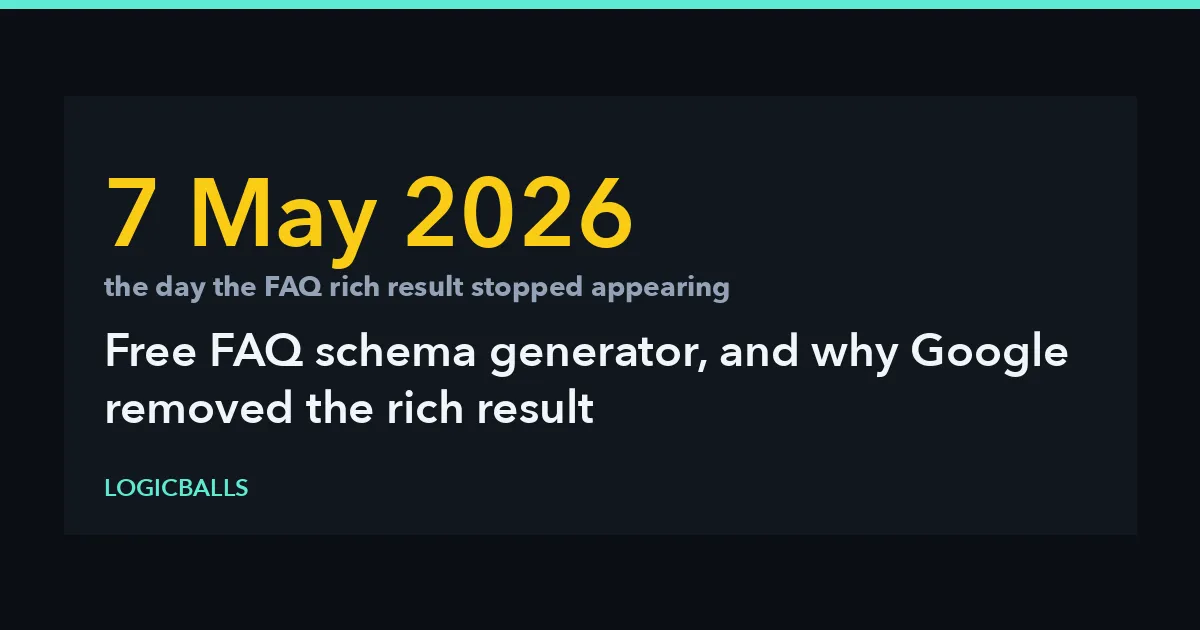
The markup is below, free and copy-pasteable, along with a script that builds it from a list of questions. Read this first, though: Google stopped showing the FAQ rich result in Search on 7 May 2026 and removed the documentation for it in June 2026. FAQPage is still valid schema.org vocabulary and adding it does no harm — but if you are adding it expecting expanded question-and-answer listings in Google results, that outcome no longer exists, and most guides recommending it have not been updated.
Verified against Google's own changelog on 2026-09-06. Here is the timeline, the markup, and an honest account of what it is still worth.
Key Takeaways
- Google's changelog states the FAQ rich result "will no longer appear in Google Search starting May 7, 2026" (SOURCED).
- The documentation is gone. The old
structured-data/faqpageURL now redirects to the changelog entry announcing its removal.- It was already restricted long before that — from 2023 the feature was shown only for "well-known, authoritative government and health websites".
- No special markup is needed for Google's AI features. Google states it directly, and says the same about
llms.txtfiles: they "won't negatively or positively impact your visibility or rankings".- The markup is still valid and still harmless. Add it for consumers other than Google Search, or skip it. Just do not buy it as a ranking or AI-visibility tactic.
What actually happened, with dates
2023 — restricted. Google's changelog records updating the FAQ documentation "to state that the feature is only shown for well-known, authoritative government and health websites". For most sites, the rich result stopped appearing then.
8 May 2026 — deprecated. "Deprecating the FAQ rich result feature… Added a deprecation notice to the FAQ rich result documentation. Why: This feature will no longer appear in Google Search starting May 7, 2026."
June 2026 — documentation removed. "Removing documentation for the FAQ rich result feature… The FAQ rich result feature is no longer shown in Google Search results, as announced in the changelog entry in May 2026."
All three entries are in Google Search Central's documentation updates log, retrieved 2026-09-06, SOURCED. The old FAQ structured-data URL now redirects to that log's removal entry rather than to a feature page — which is a fast way to check the current status of any Google Search feature yourself.
The markup
FAQPage remains valid schema.org vocabulary. Wrap the object below in a JSON-LD script element — type="application/ld+json" — and put it in your page's head or body, replacing the questions and answers.
{
  "@context": "https://schema.org",
  "@type": "FAQPage",
  "mainEntity": [
    {
      "@type": "Question",
      "name": "What is the refund window?",
      "acceptedAnswer": {
        "@type": "Answer",
        "text": "Thirty days from purchase, no conditions."
      }
    },
    {
      "@type": "Question",
      "name": "Do you offer a free plan?",
      "acceptedAnswer": {
        "@type": "Answer",
        "text": "No. There is a 14-day trial and no free tier."
      }
    }
  ]
}
Three rules that have not changed:
- The answer text must match what is visible on the page. Marking up an answer the reader cannot see is misrepresentation, not optimisation.
textaccepts limited HTML — links, lists and basic formatting. Escape it properly or keep it plain.- One
FAQPageper page. A page is not an FAQ page because it has a question in it.
The generator
No form, no email, no upload. Paste your questions and answers into this script and run it.
#!/usr/bin/env python3
"""Build FAQPage JSON-LD from a list of (question, answer) pairs."""
import json

FAQS = [
    ("What is the refund window?", "Thirty days from purchase, no conditions."),
    ("Do you offer a free plan?", "No. There is a 14-day trial and no free tier."),
]

doc = {
    "@context": "https://schema.org",
    "@type": "FAQPage",
    "mainEntity": [
        {
            "@type": "Question",
            "name": q,
            "acceptedAnswer": {"@type": "Answer", "text": a},
        }
        for q, a in FAQS
    ],
}

print(json.dumps(doc, indent=2, ensure_ascii=False))
Run it with python3 faq.py, then paste the output into a JSON-LD script element in your template. It is stdlib only, so there is nothing to install.
Check the output before shipping it. Google's Rich Results Test and the Schema Markup Validator both parse JSON-LD and report syntax errors. Note what a green validation result means now: your markup is well-formed. It is not a prediction that anything will be displayed.
So is it worth adding?
Reasons to add it: it is valid vocabulary, it costs one block of JSON, it makes your question-and-answer content machine-readable for consumers other than Google Search, and it forces you to write your answers as answers.
Reasons not to oversell it: Google will not show a FAQ rich result from it. And Google is explicit that its AI features need no special markup at all — "You don't need to create new machine readable files, AI text files, or markup to appear in these features. There's also no special schema.org structured data that you need to add" (AI features and your website, retrieved 2026-09-06, SOURCED).
The same guidance says the same thing about llms.txt: those files "aren't needed for Google Search (and won't negatively or positively impact your visibility or rankings)", though "it's fine if you want to maintain these files for other services or systems that use them" (Google Search Central changelog, 15 June 2026, retrieved 2026-09-06, SOURCED).
Two widely-sold technical tactics, both documented by the vendor as having no effect on visibility. That is worth knowing before anyone quotes you for either.
What to do instead
Answer the question in visible text, in the first sentence of the section. That has always been what works, it is what Google's own guidance points at, and it does not depend on a feature that can be withdrawn.
Keep the answers accurate across every page. The failure mode we keep finding is not missing markup, it is three different answers to the same question in three places on one site.
Do not restate a spec you did not check. This post exists partly because a plan we were executing called for an "FAQ schema generator" as a lead magnet, and checking the platform documentation before writing it turned up a feature that had been removed four months earlier. That is gate 9 of our 42-check fact-check checklist doing its job on our own plan.
How This Guide Was Sourced
Written and maintained by the LogicBalls editorial team (logicballs.com). Disclosure: LogicBalls builds AI writing tools. This post was commissioned as a lead magnet for FAQ schema and turned into a correction, because that is what the documentation said when we opened it.
Sources. All three FAQ timeline entries — the 2023 restriction, the 8 May 2026 deprecation and the June 2026 documentation removal — are quoted from Google Search Central's documentation updates log. AI-feature markup guidance from Google's AI features and your website. Vocabulary reference: schema.org/FAQPage. All retrieved 2026-09-06.
What changed under us, stated plainly. The URL developers.google.com/search/docs/appearance/structured-data/faqpage no longer serves a feature page; it redirects to the changelog entry announcing the removal. Any guide still linking it as live documentation has not been rechecked since June 2026.
What is not claimed. We publish no measurement of what FAQPage markup does for any non-Google consumer. Google's documentation is explicit that no special markup is needed for its AI features; what other systems do with it is not documented by anyone we could cite, so we make no claim about it.
No LogicBalls telemetry is used in this guide.
Frequently Asked Questions
Should I remove FAQ schema I already have?
No need. It is valid vocabulary and it does no harm. Just stop counting on it for a Search feature that no longer renders.
Does FAQ schema help with AI Overviews or AI Mode?
Google says no special structured data is needed for those features. Anyone claiming a specific markup gets you into them is going beyond what the vendor documents.
What about llms.txt?
Google's own guidance says such files are not needed for Google Search and will not affect visibility or rankings either way, while noting it is fine to maintain one for other systems.
Is there any structured data still worth adding?
Yes — types tied to features that still render, such as Organization, Article, Product and Breadcrumb. Check each against the current documentation before you invest, because that is exactly the check this post is the result of.
How do I check whether a Google feature still exists?
Open its documentation URL. If it redirects to the updates log, the feature has been removed, and the entry you land on says when and why.
Related reading
Related Articles
 Schema MarkupHow to Make Schema Markup Less ComplicatedDiscover how schema markup generators simplify structured data creation, boost rich results, and improve search visibility without complex coding.Nikita Shekhawat5 min read
 AI OverviewsAI Overviews (AIO): How to Rank in Google's AI AnswersLearn how to optimize your website for Google's AI Overviews (AIO). Discover ranking strategies for ai writing tools and content creation platforms.Ankit Agarwal9 min read
 brand reputationThe Canonical Facts Page: One Page That Gives AI Something to CiteThe 14 fields that belong on a canonical facts page, how to date and maintain it, where to link it from, and the one thing it cannot do.Ankit Agarwal12 min read
 brand reputationAI Misinformation About Your Brand: How to Find It and Fix ItNo AI provider publishes a process for correcting a wrong fact about your company. Here is what you can actually control, what is only a hint, and how to check what the systems are saying.Ankit Agarwal10 min read