Exploring the Different Types of AI Technology

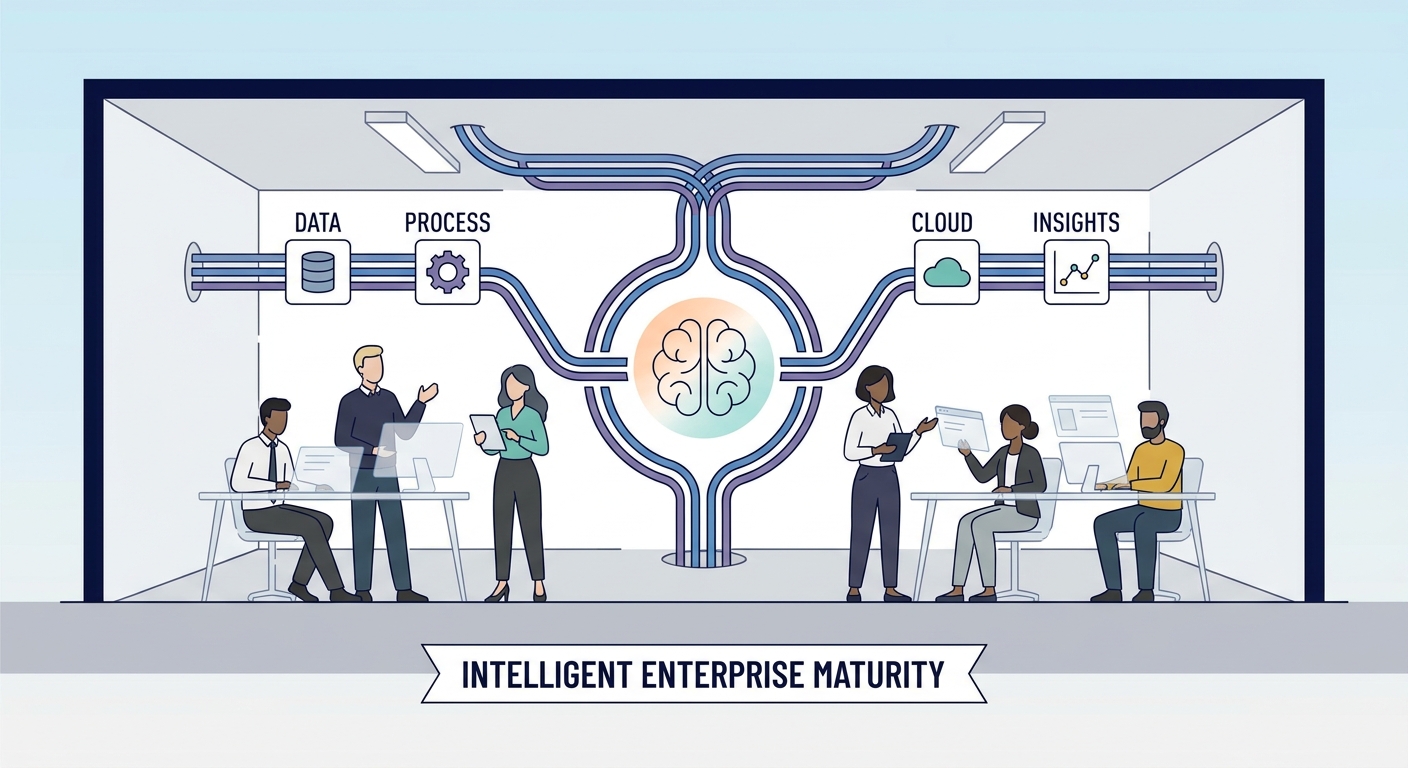
The era of the "magic chatbot"—that awkward phase where businesses treated AI like a parlor trick to spice up emails—is officially dead. In 2026, we’ve crossed the threshold. AI isn't a novelty anymore; it’s the digital backbone of the modern enterprise.
If you’re still bragging that your organization "uses AI," you’re behind. That’s like saying your office uses electricity. The real question today isn't if you use it, but how well you map specific operational bottlenecks to the architectural tools built to solve them. If you’re still treating AI as a monolithic "smart box" that does everything, you aren’t just missing out on efficiency. You are actively setting your capital on fire.
The Theoretical Baseline: Why the "4 Types" Still Matter
Before we get into the weeds of deployment, let’s look at the blueprint. Computer scientists have long categorized AI into four distinct stages: Reactive Machines, Limited Memory, Theory of Mind, and Self-Awareness.
Most of the tools in your current tech stack—and nearly every advanced model on the market right now—fall squarely into the Limited Memory category. These systems are clever. They ingest massive datasets to inform their decisions, but they lack a true, evolving understanding of the world.
Understanding this is vital. It’s why models "hallucinate" and why they can feel so rigid. They are brilliant at pattern recognition within a sandbox, but they aren't conscious, and they certainly aren't omniscient. Recognizing this "Limited Memory" DNA allows business leaders to stop treating AI like a sentient teammate and start treating it like the high-powered, high-maintenance calculator it actually is.
The Modern Taxonomy: Functional AI for Business
When we strip away the academic theory, we are left with four functional categories that actually move the needle in an enterprise environment.
- Generative AI: The engine behind text, image, and code synthesis. This is your creative force. It’s best suited for drafting, summarizing, and ideating.
- Predictive AI: The engine of foresight. These models chew through historical data to provide probability-based outcomes. It’s the bread and butter of supply chain management and financial forecasting.
- Agentic AI: The engine of execution. Unlike GenAI, which stops at the output, Agentic AI uses tools and feedback loops to finish multi-step tasks without someone holding its hand.
- Computer Vision: The engine of perception. By turning visual data into actionable insights, this is changing everything from quality control on assembly lines to automated security monitoring.
Agentic AI vs. Generative AI: What’s the Real Difference?
The difference between Generative AI and Agentic AI is the most critical pivot point for operations managers in 2026.
Generative AI is a creator. It produces an artifact: a paragraph, a design, a script. But it stops there. It requires a human to review, verify, and actually move the needle.
Agentic AI, by contrast, is an executor. As highlighted in the Microsoft AI Trends Report, the industry has shifted toward systems that can navigate complex software environments to hit a goal. If you ask a GenAI tool to "plan a project," you’ll get a pretty list of tasks. If you task an Agentic AI system, it will draft the plan, send the calendar invites, assign tasks in your project management dashboard, and email the stakeholders. Early adopters are reporting that these autonomous agents cut manual overhead by over 30%. They turn hours of administrative toil into seconds of compute time.
The Shift Toward Domain-Specific Models
We are witnessing a mass migration away from "one-size-fits-all" foundational models. While general-purpose LLMs are great for broad strokes, they often lack the nuance required for high-stakes industries. According to Capgemini 2026 Tech Trends, the real value is being built on domain-specific models trained on your proprietary, verified data.
Data sovereignty is the primary driver here. A law firm or a healthcare provider cannot risk passing sensitive, proprietary documentation through a public, "black box" model. By fine-tuning models on internal data, organizations ensure compliance, boost accuracy, and build a competitive moat that general-purpose AI simply can't touch. The "value layer" of AI in 2026 is proprietary, private, and deeply specialized.
How Do You Choose the Right AI for Your Workflow?
It is tempting to chase the newest, flashiest model out there. Don't. Your priority should be integration, not experimentation. As you navigate the complex landscape of AI technologies, the goal shouldn't just be to understand the theory, but to find tools that actually stick to your existing workflows.
At LogicBalls, we focus on bridging the gap between sophisticated AI models and actionable, day-to-day productivity. Whether your team needs to leverage AI Writing Tools to clear a massive content backlog or deploy AI Productivity Solutions to automate cross-platform data synchronization, the "best" AI is the one that disappears into your workflow. It does the heavy lifting, then gets out of your way.
Measuring Success: Moving Beyond Hype to ROAI (Return on AI)
The 2026 business climate has no room for vanity metrics like "number of prompts run." As detailed in the IBM AI Trends 2026, the focus has shifted entirely to ROAI—Return on AI.
To measure your success, track these three KPIs:
- Cost-per-task reduction: How much has the labor cost to complete a specific process declined since you flipped the switch on automation?
- Time-to-market acceleration: By how many days or weeks has your product development or deployment cycle actually shrunk?
- Error-rate mitigation: In data-heavy tasks, what is the delta in accuracy between your old human-only process and your new AI-assisted one?
If you can’t tie your AI spend to one of these three metrics, you’re still in the "hype phase." It’s time to re-evaluate.
The Future of AI Infrastructure
The final evolution of this technology is the transition from "AI as a tool" to "AI as infrastructure."
AI is no longer just an app you open in a browser tab. It is the layer that sits beneath your CRM, your ERP, and your cloud infrastructure. It is increasingly regulated, highly sovereign, and deeply embedded into the fabric of legacy systems. This is the "Digital Backbone." It is quiet. It is constant. And for any company trying to scale in a chaotic global market, it is the only way forward.
Frequently Asked Questions
What is the difference between Generative AI and Agentic AI?
Generative AI creates content (text, code, or images) based on prompts, requiring human intervention to refine and act on that output. Agentic AI is designed to execute multi-step workflows autonomously, using tools to complete tasks and reach objectives without constant human guidance.
Is AI in 2026 just about chatbots?
No. Chatbots are a legacy interface. The 2026 landscape is defined by backend automation, predictive analytics, and domain-specific models that function invisibly within enterprise software to optimize operations and decision-making.
What are the 4 traditional types of AI, and are they still relevant?
The four types—Reactive Machines, Limited Memory, Theory of Mind, and Self-Awareness—provide the essential theoretical framework for understanding machine learning. While we are currently operating in the "Limited Memory" stage, this model remains relevant because it defines the technical boundaries and capabilities of every tool currently in production.
How can businesses choose the right type of AI for their specific needs?
Businesses should start by analyzing their workflow bottlenecks. If you need to produce high volumes of content, choose Generative AI. If you need to automate complex sequences of tasks, look for Agentic AI. Always audit your data privacy requirements first, as this will dictate whether you utilize a general-purpose model or a private, domain-specific, proprietary model.