
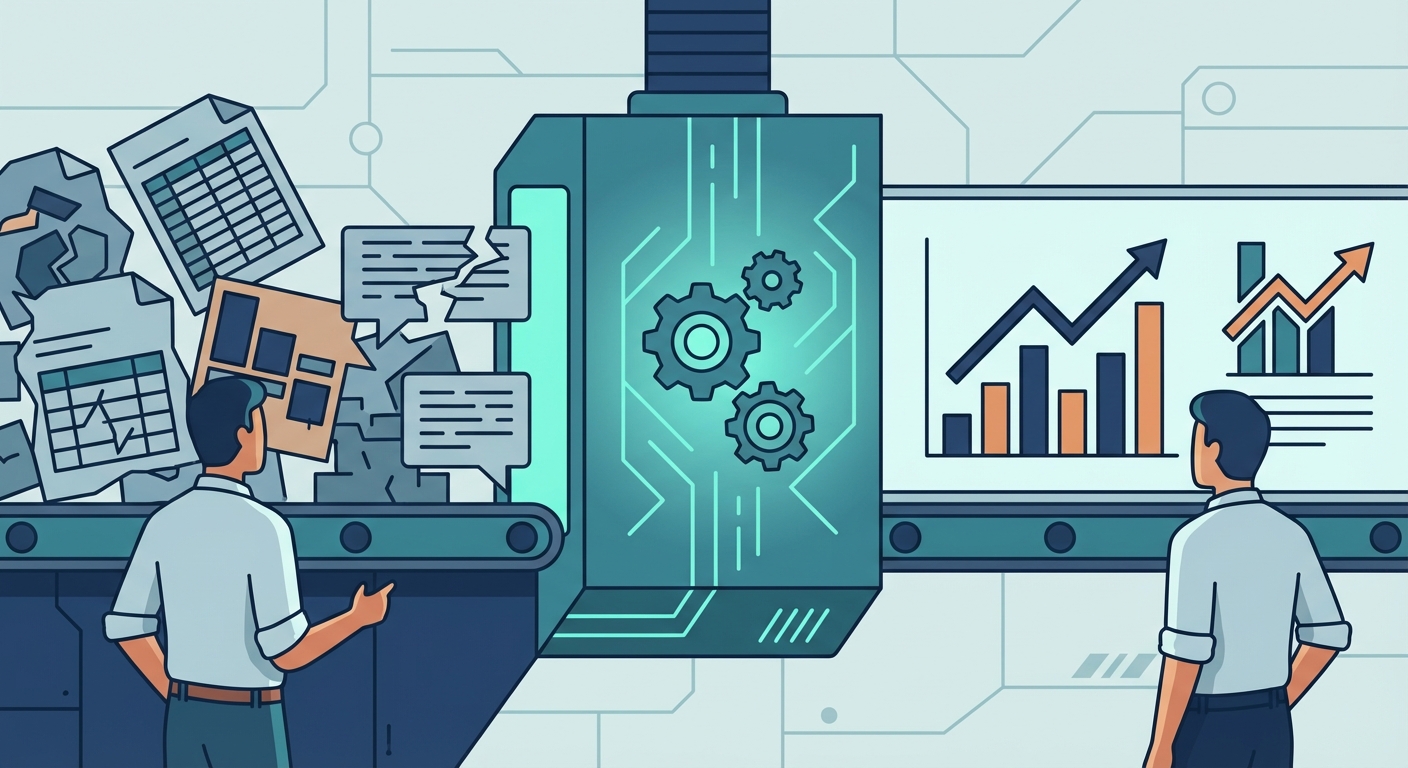
Automated Machine Learning—AutoML, for short—is the machinery that turns raw data into a working model without needing a PhD to babysit every line of code. It’s the entire pipeline, from the messy starting gate of data ingestion to the final, high-stakes sprint of deployment. It’s about killing the friction. It’s about moving from "I have a bunch of spreadsheets" to "Here is a predictive forecast" without drowning in manual engineering overhead. As industry leaders at Snowflake point out, it bridges the gap between raw information and actual business intelligence, effectively handing the keys to data science over to both the hardened experts who want to move faster and the business analysts who need answers, not just raw data.
What Exactly is AutoML?
Think of AutoML as an orchestration layer. A few years back, building a model was an artisanal craft. It was bespoke, slow, and fragile. A data scientist would spend weeks hand-cleaning data, agonizing over features, and tweaking parameters like a watchmaker.
Today? AutoML does the heavy lifting.
For the expert practitioner, this is a massive productivity multiplier. It automates the "grunt work"—the soul-crushing repetition of data normalization and hyperparameter grid searches. It frees up the expert to focus on the big stuff: architectural strategy, business problem framing, and the "why" behind the numbers.
For the business user, it’s a bridge. It’s a guided path where domain knowledge is the primary currency, not Python proficiency. By lowering the barrier to entry, we stop data-backed decision-making from being a guarded secret held by a small team of PhDs. It puts the power in the hands of the people who actually know the business.
Why Is AutoML Essential for the 2026 Enterprise?
The pressure to deliver is relentless. The talent pool for specialized data engineering? It’s a puddle. In 2026, "Time-to-Market" isn’t just a buzzword; it’s the only thing that separates the winners from the dinosaurs. If you’re still hand-coding every single ML use case, you’ve already lost. It’s a bottleneck. It’s an anchor.
Enterprises today are staring down the barrel of a new reality: they need to deploy hundreds of models, not just one or two. Without automation, this is a pipe dream. AutoML lets companies keep pace with volatile markets. It ensures that when data starts to drift—and it always does—the models are retrained and updated instantly, rather than waiting for a manual update cycle that takes months. It’s the engine that turns stagnant data lakes into living, breathing assets.
How Does the AutoML Pipeline Actually Work?
The beauty of AutoML is its structured, iterative nature. It looks simple on the surface, but the backend is doing a mountain of work.
The process kicks off with Data Preprocessing, where the system scrubs the data, fills in the blanks, and sorts out the categories. Then comes Automated Feature Engineering, which digs into the raw inputs to find patterns that human intuition might just overlook. From there, the system evaluates a whole battery of Model Candidates—gradient-boosted trees, deep neural networks, the works—running them through Hyperparameter Optimization to find the exact "sweet spot" for accuracy. Finally, the system picks the winner based on your specific KPIs and pushes it to production. For teams using Azure Machine Learning Automated ML, this cycle is entirely managed, ensuring the transition from an experiment to an enterprise-grade utility is smooth as silk.
Are We Moving from Tools to Agents?
We’re in the middle of a generational shift. AutoML is graduating from being a static "click-and-wait" script generator to becoming a core component of Agentic AI.
In the 2026 landscape, the AutoML process doesn't just clock out when the model hits production. It plugs into autonomous agents that can fix themselves. If an agent notices a model’s performance dipping in the wild, it doesn't wait for a human to send an alert. It triggers an iterative learning cycle on its own, re-evaluating features and retraining the model to keep performance at its peak. This is "Self-Healing MLOps." When you tie these outcomes into AI-Powered Workflow Solutions, you aren't just building models anymore. You’re building autonomous systems that handle complex logic without a human hand-holding them 24/7.
How Can You Optimize Costs with AutoML?
We used to chase "accuracy at all costs." That’s a trap. Today, the only metric that really matters is the Best Cost-to-Performance Ratio. Cloud compute bills can skyrocket if you blindly throw massive, heavy models at tasks that only need a simple, lightweight heuristic.
Modern AutoML is cost-aware by design. It judges models not just by precision, but by inference latency and resource consumption. If a compact, nimble model delivers 95% of the performance of a massive, 100-parameter behemoth, the AutoML platform will lean toward the smaller model to keep your cloud footprint lean. By focusing on efficiency, businesses can hit their predictive targets while keeping their operational costs under control. This is exactly how it helps businesses transform their operations by ensuring that AI stays sustainable as it scales.
The "Human-in-the-Loop" Necessity: Can We Trust the Machine?
The "black box" concern is the biggest hurdle to AI adoption. If a model denies a loan or flags a transaction as fraud, the business needs to know why. This is where Explainable AI (XAI) becomes non-negotiable.
Automation is meant to support human judgment, not replace it. Experts need to supervise the feature engineering phase to make sure proxy variables aren't baking in hidden biases. A machine can find correlations in a dataset, but it doesn't understand the ethical or societal weight of those correlations. A "Human-in-the-Loop" strategy is your safety net. It ensures that while the machine handles the heavy math, the human expert maintains the guardrails to keep the model aligned with corporate values and regulatory requirements.
Manual ML vs. AutoML: When Should You Use Which?
Choosing between a manual approach and an automated one isn't about which is "better"—it's about the context.
| Feature | Manual ML | AutoML |
|---|---|---|
| Complexity | High | Low |
| Data Scale | Custom/Niche | Large/Standardized |
| Required Expertise | Expert Data Scientist | Domain Expert/Analyst |
| ROI (Time) | Long-term | Immediate |
Manual ML is still the gold standard for breakthrough R&D or novel, high-stakes architectures where every single layer of the neural network needs to be hand-crafted and tuned to perfection. But for 90% of business problems—customer churn, demand forecasting, lead scoring—AutoML gives you a much better ROI. It turns weeks of work into hours of execution.
What Does the Future Hold for AutoML?
Looking toward the horizon of 2026, the game is dominated by the integration of LLMOps and the fine-tuning of Small Language Models (SLMs). We’re moving away from the "one-size-fits-all" approach to massive models. Instead, we’re seeing highly specialized, automated pipelines that optimize RAG (Retrieval-Augmented Generation) for specific company knowledge bases. According to recent Machine Learning Trends 2026, AutoML is becoming increasingly multimodal. It’s handling video and unstructured text with the same ease we used to reserve for simple tabular data. As these technologies mature, the goal is simple: make AI as ubiquitous and invisible as electricity. Always on, always optimizing, and completely woven into the fabric of the enterprise.
Frequently Asked Questions
Does AutoML replace the need for data scientists?
No. It shifts their role. Data scientists aren't "coders of models" anymore; they’re "architects of strategy." They focus on defining the right problems, overseeing data integrity, interpreting outputs, and ensuring the business logic holds up while the AutoML engine does the heavy lifting.
What is the biggest risk of using AutoML?
Over-reliance. If you don't understand your underlying data or the mechanics of your models, you’re inviting "garbage in, garbage out." If you skip the human oversight, you run the risk of propagating hidden biases or missing the moment when a model starts to drift away from reality.
Is AutoML only for tabular data?
Not anymore. While it started with rows and columns, the 2026 reality is vastly different. Modern AutoML platforms now automate the fine-tuning of SLMs, process unstructured text for sentiment analysis, interpret image data, and handle complex time-series forecasting. It’s a versatile tool for almost any data-rich environment.
How do I choose the right AutoML platform for my business?
Focus on three things: integration, transparency, and cost-control. Make sure the platform plays nice with your existing data stack, provides robust XAI features so you can actually audit your decisions, and gives you clear metrics on inference costs so you can scale without blowing up your budget.