Exploring the Intersection of Artificial Intelligence and IoT
TL;DR
- Explains the shift from passive data collection to autonomous AIoT ecosystems
- Details how AI acts as the brain for IoT hardware connectivity
- Highlights the necessity of edge computing to prevent global data congestion
- Discusses the transition from cloud-dependent devices to decentralized local intelligence
- Analyzes the role of 5G and ML in real-time industrial automation
Forget everything you knew about "smart" devices from five years ago. Back then, a smart toaster just sent a notification to your phone that your bread was burnt. Big deal.
In 2026, we’ve finally stopped just "collecting data" and started actually using it. We call this AIoT—the marriage of Artificial Intelligence and the Internet of Things. It’s the transition from a world that merely watches to one that thinks, breathes, and acts. We are moving past passive sensors that scream for human help every time a red light blinks. Instead, we’re building autonomous ecosystems where the hardware has its own brain. It makes decisions at the "edge"—right there on the factory floor or in your pocket—without waiting for permission from a cloud server halfway across the world.
This isn't a playground for tech giants anymore. It’s the mandatory backbone of how we build everything from hospitals to highways.
From Connectivity to Cognition: What is AIoT?
For a long time, the Internet of Things was just a massive, expensive exercise in digital eavesdropping. We slapped sensors on everything—jet engines, refrigerators, oil drills—and created a literal flood of raw data. The problem? Most of that data just sat there, rotting in "data lakes" because no human had the time to read it.
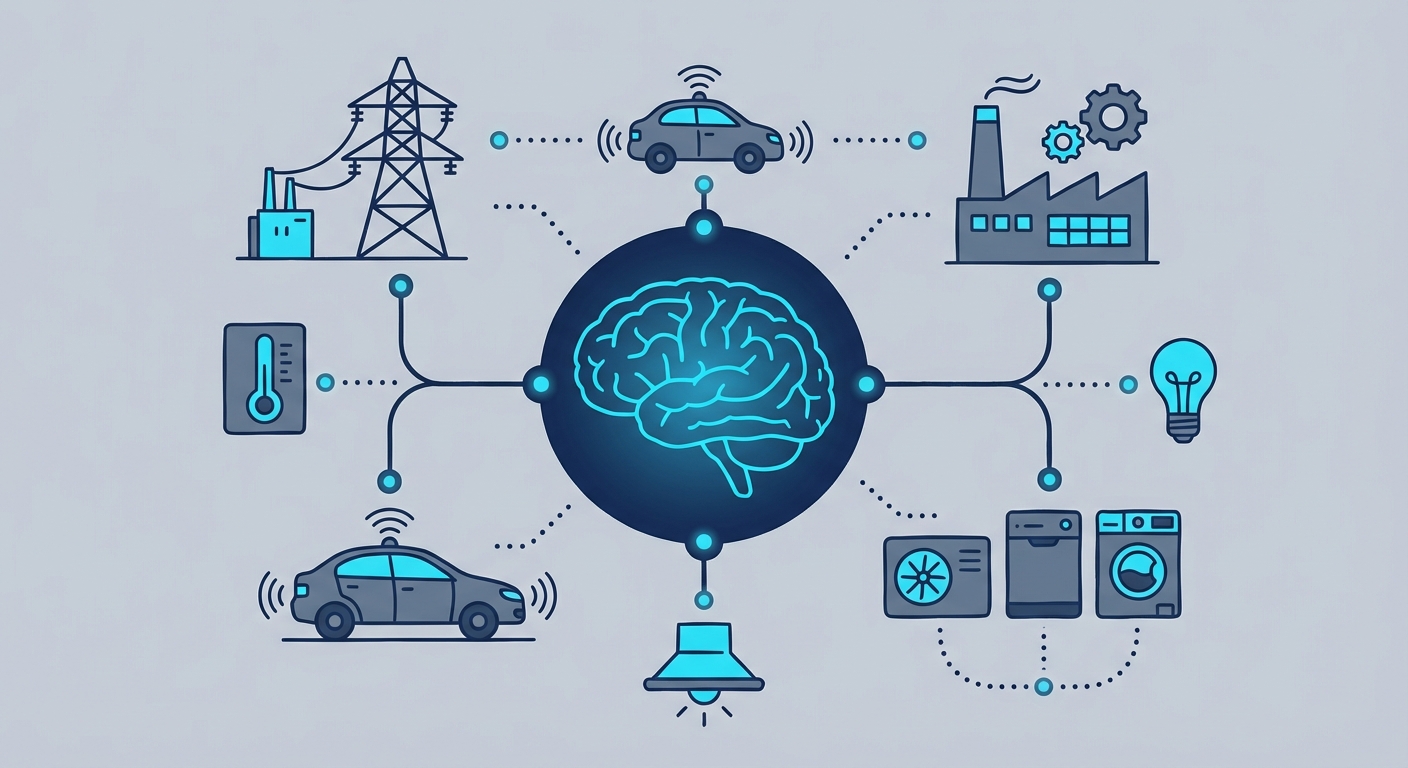
AIoT flips the script. If IoT is the body, AI is the brain.
Traditional IoT is about transmission; Active AIoT is about autonomous action. We’re seeing Machine Learning (ML) act as a nervous system for hardware. Think about it: instead of a sensor simply reporting that a drill bit is getting too hot, an AIoT system feels the vibration, compares it to thousands of hours of failure patterns, and slows the machine down before it snaps. To really wrap your head around this, check out this foundational reference for AIoT models, which shows exactly how we’re turning static, boring datasets into living, self-correcting loops.
Why is the AI-IoT Convergence Accelerating Now?
This didn't happen by accident. We hit a wall.
By 2026, we’re looking at over 75 billion connected devices. If every single one of those gadgets tried to send every bit of raw data to the cloud at once, the internet would effectively melt. Our global infrastructure just can't carry that much luggage.
Yes, 5G (and the early whispers of 6G) helped widen the pipes. But the real savior is decentralization. We stopped sending data on a 4,000-mile round trip to a data center. Now, we process the data where it’s born.
This setup ensures that only the "refined" gold reaches the cloud, while the "reflexes" stay at the device level. It’s the difference between your brain telling your hand to move away from a hot stove versus having to mail a letter to a corporate office to ask for permission to flinch.
How is Edge Intelligence Redefining Industrial Automation?
In high-stakes environments—think deep-sea oil rigs or massive construction zones—a three-second delay isn't just an annoyance. It’s a catastrophe. This is why "Safety-First" local processing is the biggest trend of 2026.
Industry leaders are cutting the cord on cloud dependency. By keeping the AI "at the edge," latency drops from seconds to milliseconds. That’s the speed of thought. For autonomous trucks or robotic arms, that speed is life or death. According to the latest on low-latency requirements in IIoT, AIoT hardware can spot a hazard—like a worker stepping into a blind spot—and shut down the machinery before the human even realizes they’re in danger.
Key AIoT Trends Dominating 2026
The landscape this year is defined by three massive shifts.
1. The "AI-Partner" in Infrastructure
AI isn't just a tool anymore. It’s not a hammer or a spreadsheet. It’s a partner. In modern smart factories, these AI agents manage their own power, schedule their own oil changes, and even "negotiate" with other machines to clear up production bottlenecks. This evolution of AI autonomy suggests that the winners in business won't be the ones with the best IT—it’ll be the ones who treat their AIoT network like a high-performing workforce.
2. Predictive vs. Prescriptive Maintenance
Predicting when something will break is old news. That's table stakes now. The new frontier is prescriptive maintenance. Instead of just saying "The pump will fail in 20 hours," the system now says, "I’ve rerouted the liquid flow and lowered the pressure by 10% to bypass the faulty valve entirely. You don't need to fix it until next Tuesday." It "heals" its own workflow. Downtime is becoming a relic of the past.
3. Hyper-Personalized Consumer Ecosystems
The "Smart Home" finally grew up. We’ve moved past yelling at Alexa to turn on the lights. Now, we have ambient intelligence. If your smartwatch sees your stress levels spiking and your sleep quality tanking, your house reacts. The lights dim, the temperature drops, and white noise kicks in—all without you lifting a finger. It’s not about you controlling a device; it’s about the environment anticipating what your body needs.
Industry Use Cases: AIoT in Action
This isn't just theory. It’s happening on the ground.
- Smart Manufacturing: Computer vision has taken over the assembly line. AIoT cameras spot microscopic cracks in parts moving at 60 miles per hour, toss the bad ones, and automatically order replacements from the supplier before the bin is even empty.
- Healthcare: We’re moving into proactive prevention. AIoT wearables don't just count steps; they use predictive diagnostics to warn a doctor about a potential heart attack days before it happens.
- Sustainable Cities: Smart grids are the only reason we’re hitting green energy targets. They balance energy loads across entire cities with surgical precision, making sure not a single watt of wind or solar power goes to waste.
Trying to keep up with the technical manuals for these evolving systems is a challenge, which is why firms are using AI-powered content generation to keep their documentation alive and updating in real-time as the firmware changes.
What are the Critical Challenges for AIoT in 2026?
It’s not all sunshine and autonomous robots. The "dark side" of having 75 billion connected devices is a massive security headache.
The Security Imperative: Zero Trust
Every smart lightbulb is a potential door for a hacker. In 2026, the old "firewall" strategy is dead. We’ve moved to Zero Trust Architectures. No device is trusted, ever—even if it’s inside the building. Companies are scrambling to use advanced ITSM solutions just to manage the sheer complexity of keeping these networks patched and safe.
Data Privacy and Ethical AI
Sure, processing data at the edge is more private because the data stays on the device. But how do we know the AI is making fair decisions? If a smart city AI has to throttle power during a heatwave, how does it choose which neighborhood stays cool? Ensuring these "black box" decisions are transparent is the next big battle for regulators.
Turning Raw IoT Data into Actionable Intelligence
Here’s the cold, hard truth for 2026: sensor data is a liability until you turn it into intelligence. Storing petabytes of raw data is just an expensive way to hoard digital trash. Extracting one profitable insight from that data? That’s where the money is.
Smart firms are even monetizing their data, using it to create "Digital Twins" of their entire operation to run simulations. Using AI-driven analytics tools allows managers who can't code a single line of Python to turn raw streams into winning strategies. As noted in global IoT market growth strategies, the gap between the leaders and the losers comes down to one thing: how fast can you move from "data captured" to "decision executed"?
Conclusion: Preparing for the Autonomous Future
The jump from the "connected gadgets" of the 2010s to the "autonomous intelligence" of 2026 has been wild. We’ve successfully given the Internet of Things a brain.
As we look toward the end of the decade, owning the most sensors won't win you any prizes. The competitive edge belongs to the person who can apply intelligence to that data with the most speed and accuracy. In the AIoT era, if you can't turn a signal into a solution in the blink of an eye, you’re already behind.
Frequently Asked Questions
What is the difference between IoT and AIoT?
IoT is the hardware—the sensors and cables that collect data. AIoT is the brain. It’s what happens when you add Artificial Intelligence to those sensors so they can actually make decisions instead of just sending alerts.
How does Edge Computing improve AIoT performance in 2026?
It cuts out the middleman. By processing data right on the device (the "edge"), you get rid of the lag time caused by sending data to a distant cloud server. This is vital for things like self-driving cars where every millisecond counts.
What are the biggest security risks at the intersection of AI and IoT?
The more devices you have, the more "doors" hackers have to try. Plus, we’re now seeing adversarial AI, where hackers use their own machine learning to find holes in your security faster than any human could.
Can AIoT help with environmental sustainability?
Absolutely. It’s the secret weapon for "Green Tech." AIoT allows smart grids to balance energy perfectly, helps buildings reduce their carbon footprint automatically, and cuts down on manufacturing waste by catching errors instantly.