AI Email Marketing vs Traditional: Which Wins?

Email marketing remains one of the most effective digital channels. The most-quoted return figure comes from the DMA's Marketer Email Tracker 2019: "ROI from email marketing now stands at just over £42 for every pound spent" — £42.24 per £1, from a January 2019 survey of 197 UK marketers on 2018 data. SOURCED ANALYSIS — that is pounds, not dollars, UK-only, and seven years old; an earlier version of this article rendered it as "$42 for every dollar spent" without naming the publisher. However, the landscape is rapidly evolving with the integration of artificial intelligence. The question many marketers face today is whether AI email marketing truly outperforms traditional methods. Let's dive deep into this comparison to help you make an informed decision for your business.
What is AI Email Marketing?
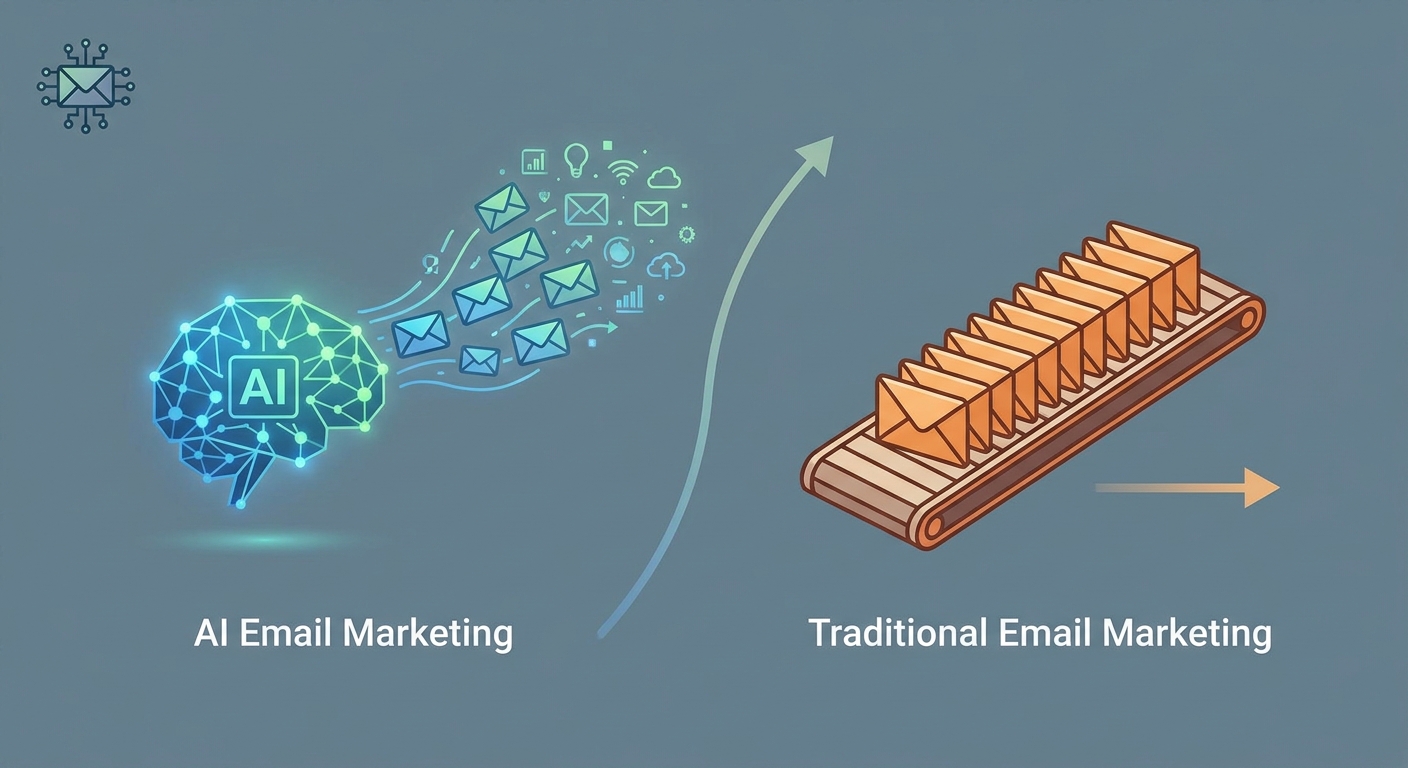
AI email marketing leverages machine learning algorithms and artificial intelligence to automate, personalize, and optimize email campaigns. Unlike traditional email marketing that relies on manual segmentation and static content, AI email marketing uses data-driven insights to deliver highly targeted messages at the optimal time. Key components of AI email marketing include:
Predictive analytics for customer behavior
Automated personalization at scale
Dynamic content optimization
Intelligent send-time optimization
Advanced A/B testing capabilities
Traditional Email Marketing: The Foundation
Traditional email marketing involves manual campaign creation, segmentation based on basic demographics, and scheduled sends. While this approach has served marketers well for decades, it requires significant time investment and often lacks the precision of AI-driven alternatives. Traditional methods typically include:
Manual list segmentation
Static email templates
Scheduled sending times
Basic A/B testing
Generic personalization tokens
AI Email Marketing vs Traditional: Key Differences
Personalization Capabilities
AI Email Marketing: AI email marketing excels in delivering hyper-personalized content. Machine learning algorithms analyze customer behavior, purchase history, and engagement patterns to create individualized experiences. Personalisation has a measurable effect, though the most-cited figure describes something narrower than it is usually made to. Experian found that "personalized promotional mailings have 29 percent higher unique open rates and 41 percent higher unique click rates than nonpersonalized mailings" (Experian, 2013 data, released February 2014, retrieved 2026-09-02). SOURCED ANALYSIS — that is open rate rather than "engagement," and it measured ordinary merge-field personalisation, which is the traditional method this article contrasts against AI. It should not be presented as evidence for machine-learning personalisation. Traditional Email Marketing: Traditional methods offer basic personalization like inserting first names or company details. While effective, this approach lacks the depth and sophistication of AI-driven personalization.
Campaign Optimization
AI Email Marketing: AI continuously learns from campaign performance, automatically adjusting subject lines, content, and send times. This real-time optimization ensures campaigns improve over time without manual intervention. Traditional Email Marketing: Optimization requires manual analysis of campaign reports and implementing changes for future sends. This process is time-consuming and may miss subtle patterns in customer behavior.
Segmentation Accuracy
AI Email Marketing: AI creates dynamic segments based on complex behavioral patterns, purchasing likelihood, and engagement probability. These segments are automatically updated as customer behavior changes. Traditional Email Marketing: Segmentation relies on static criteria like demographics or past purchase behavior. These segments require manual updates and may become outdated quickly.
Benefits of AI Email Marketing
Enhanced ROI and Performance
AI email marketing delivers superior results through intelligent optimization. ANALYSIS — an earlier version of this article stated that "studies show" AI-powered campaigns lift open rates 25% and click-through rates 35%. No study was named and none could be located, so the claim has been removed. Measure the difference on your own list: a holdout test against your current process is the only figure that will describe your audience.
Time and Resource Efficiency
Automation reduces manual workload significantly. Marketers can focus on strategy while AI handles execution, testing, and optimization. This efficiency translates to reduced operational costs and faster campaign deployment.
While AI tools handle most of the hard work in email campaigns, marketers still need good digital setups to manage everything smoothly. Switching between dashboards, editing copy, checking reports, and organizing client feedback can get messy fast. That’s why the browser you use matters more than people think. You can even streamline engagement by incorporating scannable codes directly into your emails using tools like The QR Code Generator (TQRCG), connecting your digital campaigns seamlessly with offline experiences.
A productivity-focused browser helps keep your workspace clean. That way, you spend less time sorting through tabs and more time focusing on strategy. There are browsers built with multitasking in mind.
These browsers offer features like smart tab organization, writing tools powered by AI, and clutter-free layouts that support everything from editing content to tracking performance.
If you're working across email platforms, analytics tools, and research pages, using a browser designed for this kind of workflow can really make a real difference.
Predictive Analytics
AI email marketing platforms can predict customer lifetime value, churn probability, and optimal purchase timing. This predictive capability enables proactive marketing strategies rather than reactive approaches.
Scalability
As your subscriber base grows, AI email marketing scales effortlessly. The technology can handle millions of personalized emails without proportional increases in manual effort.
Advantages of Traditional Email Marketing
Cost Considerations
Traditional email marketing platforms often have lower upfront costs, making them accessible for small businesses with limited budgets. Basic email marketing tools can be surprisingly affordable compared to AI-powered solutions.
Simplicity and Control
Traditional methods offer straightforward campaign creation and complete control over content and timing. This simplicity appeals to marketers who prefer hands-on management of their campaigns.
Established Workflows
Many organizations have well-established processes for traditional email marketing. Switching to AI email marketing requires workflow changes and team training, which some companies prefer to avoid.
Challenges and Limitations
AI Email Marketing Challenges
Despite its advantages, AI email marketing faces several challenges:
Higher implementation costs
Need for sufficient data to train algorithms
Potential over-reliance on automation
Requirement for technical expertise
Traditional Email Marketing Limitations
Traditional methods struggle with:
Manual processes that don't scale
Limited personalization capabilities
Slower optimization cycles
Difficulty in handling complex customer journeys
Which Approach Wins?
The answer depends on your specific business needs, resources, and goals. Here's a framework to help you decide:
Choose AI Email Marketing If:
You have a large subscriber base (1,000+ contacts)
Customer data is readily available
You want to maximize ROI through optimization
Your team can manage AI-powered tools
You need advanced personalization
Choose Traditional Email Marketing If:
You're just starting with email marketing
Budget constraints are a primary concern
You have a small, stable subscriber base
You prefer complete manual control
Your team lacks technical expertise
The Future of Email Marketing
AI email marketing represents the future of digital marketing. As artificial intelligence technology continues to advance, the gap between AI and traditional methods will likely widen. However, the best approach might be a hybrid model that combines AI capabilities with human creativity and strategic thinking.
Making the Right Choice for Your Business
Consider these factors when deciding between AI email marketing and traditional methods: Budget: AI tools typically cost more upfront but deliver better long-term ROI. Data availability: AI requires quality customer data to function effectively. Team expertise: Ensure your team can effectively use whichever approach you choose. Business goals: Align your choice with your specific marketing objectives. Scalability needs: Consider your future growth plans and subscriber base expansion.
Conclusion
While both AI email marketing and traditional methods have their merits, AI email marketing emerges as the clear winner for most businesses looking to maximize their email marketing ROI. The technology's ability to deliver personalized experiences at scale, optimize campaigns automatically, and predict customer behavior provides significant competitive advantages. However, traditional email marketing still has its place, particularly for small businesses or those just beginning their email marketing journey. The key is to choose the approach that best aligns with your current resources, technical capabilities, and business objectives. As the digital marketing landscape continues to evolve, embracing AI email marketing will likely become not just an advantage, but a necessity for staying competitive. The question isn't whether AI will transform email marketing, but how quickly your business will adapt to leverage these powerful capabilities. Ready to explore AI email marketing for your business? Start by evaluating your current email marketing performance and identifying areas where AI could deliver the most significant impact. The future of email marketing is here, and it's powered by artificial intelligence.
Related reading
- SEO vs SEM: AI-Powered Marketing in 2025 – Which Wins?
- How AI Can Boost Your Email Open Rates
- Traditional SEO vs AI SEO: What's Different in 2026?
- 20 Ways to Use AI in Email Marketing Campaign
How This Guide Was Sourced
Written and maintained by the LogicBalls editorial team (logicballs.com). Disclosure: LogicBalls builds AI writing tools, including tools for email copy.
Sources, retrieved 2026-09-02: DMA UK, Marketer Email Tracker 2019 (197 UK marketers, January 2019, 2018 data); Experian Marketing Services (2013 data, released February 2014).
Corrections. The headline ROI figure was given as "$42 for every dollar"; the DMA's finding is £42.24 per pound, UK-only, from 2018 data. A 29% personalisation lift was presented as evidence for AI-driven personalisation, when the study measured basic merge-field personalisation and reported it as an open-rate effect. And a pair of AI performance figures attributed to unnamed "studies" was removed after no source could be found.
Email statistics age badly — much of what circulates dates from 2012–2014 and is still quoted as current. Check the date and the currency before planning against any of it.
No LogicBalls telemetry is used in this guide.