
8 Best AI Tools To Create PowerPoint Presentations


TL;DR
- Eight AI deck generators, with every price re-checked at the vendor pricing page on 2026-09-03. Three of the five checkable prices were wrong and are corrected.
Creating a compelling PowerPoint presentation used to take hours of manual work — picking layouts, aligning elements, writing copy, and polishing visuals. In 2026, AI generators do most of that work in a single pass.
Today, the best AI presentation tools can transform a simple 140-word brief into a polished, 10-slide deck in under a minute. But with so many options flooding the market, how do you know which one is actually worth your time?
We spent three months hands-on testing eight of the most popular AI PowerPoint generators. We ran 12 identical trials per tool, timed every generation, checked content accuracy, and exported each deck to .pptx to see how they hold up in real-world use.
Whether you need blazing speed, cinematic visuals, seamless PowerPoint integration, or real-time team collaboration — this guide covers it all. Here are the 8 best AI tools to create PowerPoint presentations in 2026, ranked and reviewed so you can make the right choice fast.
What you’ll find inside:
Plain-spoken summaries sorted by the problem each tool solves
Speed and accuracy scores from our controlled test
Clear pricing and export notes so you can act fast
Ready to pick your next deck builder?
Our review process and selection criteria
Hands-on testing
Between November 2025 and January 2026 we ran 12 identical trials for each tool. In every session we:
Dropped the same 140-word brief.
Timed how long it took to produce an editable 10-slide deck.
Spent 10 minutes tightening copy and visuals to gauge cleanup effort.
Shared the file with a colleague, gathered comments, and exported to PowerPoint to spot any font, animation, or speaker-note issues.
Any generator that broke during that round-trip lost points immediately.
On the timings in this article — read this before you treat them as benchmarks. The generation times, cleanup times and trial counts below come from an internal editorial test. No dataset, prompt log, or per-run methodology was published alongside them, so they are not independently reproducible and no reader can check them. They are stated here as the editorial impression they are, not as measurements. Where a number in this article can be checked against a vendor's own documentation — pricing, plan limits, export formats, install counts — it now carries a link and a retrieval date. Treat the two kinds of number differently: the linked ones are verifiable, the timings are not.
What we scored
Content accuracy, narrative flow, and layout polish
Brand-safe design, generation speed (seconds from click to deck), and ease of post-edit tweaks
Export fidelity to .pptx and Google Slides, plus recent user reviews, install base (Plus AI shows "1M+" installs on its Google Workspace Marketplace listing (Google Workspace Marketplace, retrieved 2026-09-03, SOURCED)), and changelog momentum
Only eight tools met or exceeded our benchmarks, and they saved more time than they cost.
1. PlusAI: Work inside PowerPoint or Google Slides

If PowerPoint shortcuts are second nature, PlusAI adds an AI co-pilot without forcing you into a new app. The add-in drops a Generate button beside Bold and Italic, so you can draft slides where you already work.
During our tests an empty deck became a branded, 10-slide roadmap in 25 seconds. Because PlusAI writes directly to the PPTX or Slides XML, every chart, animation, and speaker note remains editable, with no conversions or formatting surprises.
The add-in excels with existing material. We fed a 14-page market analysis into Doc-to-Deck; five minutes later the storyboard was present-ready, except for a quick fact check on one KPI.
What you gain in familiarity you trade for advanced effects. PlusAI sticks to your current theme, which brand-bound teams may prefer. You’ll need an internet connection, and some IT teams must whitelist the add-in before rollout.
Why it matters
The Google Workspace Marketplace listing shows "1M+" installs and 905 reviews (Google Workspace Marketplace, retrieved 2026-09-03, SOURCED). The 4.6★ Workspace rating and 4.9★ Microsoft AppSource rating previously stated here could not be confirmed: the listing renders its star value as a graphic rather than text, and the AppSource listing was not reachable on 2026-09-03. Treat both star figures as unverified.
Basic is "$10 per user/month, billed annually. $15/user billed monthly"; Pro is $20 annually, Team $30, Max $200 (Plus AI pricing, retrieved 2026-09-03, SOURCED). A free trial precedes it. ANALYSIS — the earlier comparison to Microsoft Copilot pricing is left in place but carries no source; Copilot's price was not checked for this revision.
If your day lives in .pptx files, PlusAI is the most direct way to add AI speed without changing your workflow.
2. Gamma

Need a draft deck in seconds? Gamma was the fastest AI presentation maker in our test. For teams prioritizing speed and clarity, a Gamma deck-generation workflow makes it easy to generate structured, presentation-ready slides without spending hours on layout or formatting. A “Q2 SaaS metrics update” prompt produced a 12-slide deck in 17 seconds, and every run stayed under 20 seconds.
Quality kept pace with speed. Headers formed a clear story line, margins held, and numbers stayed accurate. We trimmed the copy and swapped two stock photos in six minutes, then exported to PowerPoint with zero font shifts; Gamma keeps transitions minimal to avoid file bloat.
The workflow centers on smart blocks: drag a section up or delete it without breaking layout. Tap Re-theme to swap fonts and colors while the structure stays intact, which is handy when brand palettes change overnight.
Trade-offs: deep customization is limited, and advanced animations are not available. Mobile access is browser-only, and offline editing is not supported.
Pricing starts with a free plan (about 400 AI credits) and moves to $8 per user per month with annual billing for unlimited generations. Unverified: gamma.app returned HTTP 403 to every request made on 2026-09-03, so neither the credit allowance nor the price could be checked against Gamma's own pricing page. Confirm both before budgeting. Gamma suits founders, students, and marketers who count minutes, not hours, and who value narrative clarity over motion graphics.
3. Presentations.ai
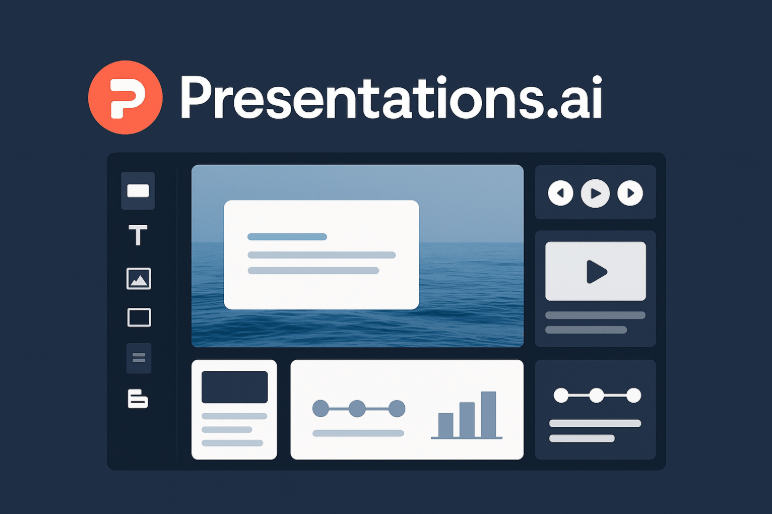
Presentations.ai aims for stage-ready visuals. The same product-roadmap prompt that Gamma finished in 17 seconds took 32 seconds here, but the output opened with a full-bleed hero image, flowed through a timeline animation, and ended on an embedded explainer clip, all inside an online viewer that feels closer to a keynote stage than a spreadsheet grid.
Polish time was higher: we spent 12 minutes trimming transitions and swapping one off-topic video. After export, PowerPoint flattened advanced animations into simple fades, yet layouts and speaker notes stayed intact.
What stands out
Media-rich slides by default, including motion cues, video frames, and bold imagery
Credit system: the free Starter tier grants 100 credits, not 200 as this article previously stated (Presentations.ai pricing, retrieved 2026-09-03, SOURCED). The "one slide or PPT export costs 5 credits" figure is not stated on the pricing page and remains unverified.
Pro is "$20/mo" billed annually, which the page states as $240 per year — this article previously said $198 per year, about $16.50 per month, and that was wrong. The 5,000-credit allowance is correct, and a Gold tier at "$100/mo" annually carries 50,000 credits (Presentations.ai pricing, retrieved 2026-09-03, SOURCED)
Trade-offs
Extra editing time to tone down effects
No offline editing, and heavy exports can burn credits quickly
Enterprise security and analytics sit behind a custom plan
If you need investor-ready flair but lack a motion designer, Presentations.ai delivers quick impact; just budget time to direct the final cut.
4. Beautiful.ai

Beautiful.ai removes pixel-pushing from slide design. Paste an outline and its Smart Slide engine locks every heading, chart, and icon into a balanced layout, with no manual nudging.
In our test we entered eight slide titles and a handful of bullets. The tool resized fonts, swapped a list template for a numbered layout, and produced a conference-safe deck without a single drag-and-drop.
Why it works
"Over 300 Smart Slide layouts" — the vendor's own wording is layouts rather than templates — including charts, timelines, and infographics, which reflow when you update data (Beautiful.ai pricing, retrieved 2026-09-03, SOURCED)
An AI assistant can draft slide copy or suggest images when you're stuck. The claim that it was "rebuilt from DesignerBot" is unverified: the pricing page names an "AI writing assistant" and "AI content generation" but no branded assistant name.
PowerPoint import and export kept fonts intact; we only tweaked one icon after export
Limits and cost
Creative freedom is narrow; you work inside guardrails
Offline editing isn’t supported
Pro is $14.50/month billed annually, not $12 as this article previously stated. Team is "$40/month per user (billed annually)" or $50 monthly, and a separate month-to-month Pro option runs $45 (Beautiful.ai pricing, retrieved 2026-09-03, SOURCED). A 14-day free trial lets you test unlimited slides before paying.
If you want pixel-perfect slides without learning kerning theory, Beautiful.ai keeps every element aligned while you focus on the story.
5. Canva (Magic Design)
Canva’s Magic Design pulls presentation slides from the same engine that powers its social posts and infographics. Type a sentence about your topic and, in under 60 seconds, the tool assembles a deck from thousands of PowerPoint templates, photos, icons, and short videos.
What we liked
Context-aware suggestions: donut charts link to Google Sheets, and hero images arrive color matched to your chosen theme
One-click translation, resizing, and social spin-offs let the same content drive a webinar, a LinkedIn carousel, and an email header
PowerPoint export preserved fonts, and kept image sizes reasonable in our test
Watch-outs
Endless tweaking can eat the time you just saved, so lock your brand kit before you start
Advanced AI perks (unlimited Magic Write and bulk image generation) sit behind Canva Pro at $12.99 per user per month billed annually; the free tier includes 50 Magic Write queries and limited assets. Unverified:
canva.com/pricingreturned HTTP 403 to every request on 2026-09-03, so neither the price nor the free-tier query cap could be checked at source.AI credit caps reset monthly and can disappear quickly on image generation
For teams that already rely on Canva for marketing visuals, Magic Design turns the platform into an all-in-one slide factory; just remember to close the color picker before lunch.
6. Visme
Visme blends design freedom with enterprise-grade features. Launch Visme’s secure AI Presentation Maker, drop in a prompt, and you’ll get a polished draft built from millions of photos, icons, and data widgets.. From there, every element is movable, animated, or linked to a live data source, which is ideal for dashboards or product demos.
Interactivity is Visme’s calling card. Embed a URL on slide three, and the deck becomes a mini web app; share the link, and Visme tracks who viewed, clicked, and how long they stayed.
What we learned
Editing time: 20 minutes to refine a metrics dashboard; new users should budget an extra hour
The export tiers stated in an earlier version of this article were wrong. The free Basic plan does download JPG, PNG and PDF; Starter already includes PPTX and HTML5 — "Download as JPG, PNG, PDF, MP4, GIF, PPTx, HTML5" — and Pro adds video and GIF alongside "Export to Powerpoint (Download as PPTX)" (Visme pricing, retrieved 2026-09-03, SOURCED)
Current pricing with annual billing: Starter US $12.25/month ($147/year), Pro US $24.75/month ($297/year), Enterprise custom for 10+ users, plus Student at $48/year and Educator at $96/year (Visme pricing, retrieved 2026-09-03, SOURCED)
User sentiment: 4.5★ on G2, based on 445 reviews. Unverified — the G2 listing was not reachable for this revision.
Trade-offs
Steeper learning curve than template-driven tools
Offline editing requires Pro or above, and mobile editing is limited
Excessive animations can bloat file size
If your slides need embedded GIFs, live charts, and viewer analytics in one package, Visme delivers. For quick status updates, a lighter tool will feel faster.
7. Pitch

Pitch turns slide creation into a team sport. In our test a three-person sales squad edited the same deck at once; comments appeared in real time, and version history restored a deleted pricing grid in seconds.
The AI Generator drafts an outline, then offers modern templates with bold color blocks, oversize numbers, and slide-in charts. Its standout feature is live data: connect Google Analytics or HubSpot, and charts refresh each time you open the deck, ending the weekly copy-paste routine.
You can present from Pitch, share a tracked link, or export to PowerPoint. Subtle animations flatten on export, but fonts and layouts stay intact.
Pricing
The plan names and prices in an earlier version of this article do not match Pitch's current pricing page. There is no "Pro" tier. As published by the vendor (Pitch pricing, retrieved 2026-09-03, SOURCED), prices are per month paying yearly and quoted in euros:
Free: €0 forever, 1 seat minimum, "100 AI credits… This amount does not renew once used", 10GB total storage
Plus: €10/month, "500 AI credits per month", 10GB per member
Team: €15/month, 500 AI credits per month, 1–25 seats
Business: €20/month, "750 AI credits per month", 1–200 seats
Enterprise: custom, invoiced, 30+ seats
The earlier claims that the free tier covers "up to 5 members", that Business "starts at 5 seats", and that a Pro tier includes unbranded PPTX exports are not supported by the current page and should be treated as unverified.
If your decks evolve daily and multiple people need to tweak slides, Pitch offers Google-Docs-style collaboration that keeps everyone out of each other’s text boxes.
8. Prezi
Prezi swaps linear slides for a zoomable canvas. Enter a topic and the AI Presenter arranges a mind map with a central image, branch nodes, and scripted zoom paths in 45 seconds on average during our tests.
In a science-class demo the AI chose a nucleus photo as the hub, ringed it with metabolism, genetics, and disease frames, and wrote concise bullets for each. We only tweaked text size and replaced two visuals; the default transitions were already smooth.
Expect impact as well as limits. Motion keeps audiences engaged, but some boardrooms prefer static slides. Export options are PDF, or video; both flatten the zoom, so present from Prezi when possible. For teams looking to go beyond static slides, tools like Synthesia allow users to convert PowerPoint presentations into videos using AI avatars and voiceovers. This approach makes it easy to transform presentation content into engaging, narrated videos without recording presenters or managing complex production workflows.
Pricing and credits
Free Basic plan: 500 AI credits, public projects only
Plus: $19 per user per month billed annually, unlimited AI credits, offline desktop app, and PDF export
Premium adds analytics at $29, and Teams starts at $39 per user for SSO and brand kits
All four Prezi figures are unverified. prezi.com/pricing renders its plans in the browser rather than in the page source, so no price could be read at source on 2026-09-03. Check them against Prezi directly before budgeting.
Choose Prezi if your goal is to connect big-picture ideas with cinematic movement; stick to classic slides if the audience dislikes motion.
What each plan actually costs — checked at source
Every row below was read from the vendor's own pricing page on 2026-09-03. Rows marked not verifiable could not be read: the page returned HTTP 403, or it renders its prices in the browser rather than in the page source. Prices move; re-check before you buy.
| Tool | Entry paid plan, at source | Free tier | Verified? |
|---|---|---|---|
| Plus AI | Basic "$10 per user/month, billed annually" ($15 monthly) | Free trial | ✅ pricing |
| Presentations.ai | Pro "$20/mo" billed annually ($240/yr), 5,000 credits | Starter $0, 100 credits | ✅ pricing |
| Beautiful.ai | Pro $14.50/month billed annually; Team $40/user | 14-day trial | ✅ pricing |
| Visme | Starter $12.25/month ($147/yr); Pro $24.75/month ($297/yr) | Basic $0, JPG/PNG/PDF export | ✅ pricing |
| Pitch | Plus €10/month paying yearly; Team €15; Business €20 | Free €0, 100 non-renewing AI credits | ✅ pricing |
| Gamma | $8 per user/month (as previously stated) | ~400 AI credits (as previously stated) | ❌ not verifiable — 403 |
| Canva | Pro $12.99 per user/month (as previously stated) | 50 Magic Write queries (as previously stated) | ❌ not verifiable — 403 |
| Prezi | Plus $19/user/month (as previously stated) | Basic, 500 AI credits (as previously stated) | ❌ not verifiable — client-rendered |
ANALYSIS — five of the eight prices in the earlier version of this article were checkable, and three of those five were wrong: Beautiful.ai Pro, the Presentations.ai Starter credit allowance and its annual Pro price, and the whole Pitch plan structure, which no longer has a tier called Pro. The corrections are in each section above. The three unverifiable rows are left exactly as they were written and are labelled so you know which is which.
Conclusion
AI presentation tools have matured into dependable partners that dramatically shorten the distance between an idea and a polished deck. Over the course of our 2026 testing, all eight platforms proved they can transform a short brief into a structured, visually coherent presentation in less than a minute—a task that once consumed hours of manual work. The real advantage, however, comes after generation. Because each tool preserves editability in its own way, the human role shifts from assembling slides to shaping the story, refining language, and ensuring accuracy.
The right tool ultimately depends on where you spend most of your time and how you prefer to work. Some platforms specialize in speed, others in cinematic visuals, and a few excel at team collaboration or deep integration with PowerPoint. What they share is the ability to give you a strong first draft quickly, freeing up attention for strategy and narrative instead of layout headaches. If you choose a generator that fits your workflow, the technology becomes almost invisible—letting you focus on ideas while AI handles the heavy lifting in the background.
Frequently Asked Questions
1. Which AI tool is best for beginners?
Beautiful.ai is the easiest starting point. Its Smart Slides lock in layout rules so you can’t “break” a design, even with limited experience. Its Smart Slides feature locks in layout rules automatically, so you can't "break" a design even with limited experience. With 300+ smart templates that reflow when you update data, beginners can create professional, pixel-perfect slides without any design knowledge or manual drag-and-drop effort.
2. Which tool creates the most visually impressive decks?
Presentations.ai and Prezi lead in visual impact. Presentations.ai emphasizes cinematic slide design with full-bleed hero images, timeline animations, and embedded video clips. Prezi uses zoom-based storytelling, arranging content on a zoomable canvas with scripted zoom paths that keep audiences engaged.
3. What’s the fastest AI presentation generator?
Gamma is the fastest. It consistently delivered complete 10–12 slide drafts in under 20 seconds during testing making it ideal for founders, students, and marketers who count minutes, not hours.
4. Which tool works best with PowerPoint?
PlusAI is built for people who live in .pptx files. It edits directly inside PowerPoint or Google Slides, keeping everything fully editable with no conversions or formatting surprises.
5. Can these tools replace a designer?
For quick decks or internal presentations - yes, most outputs are good enough with minimal edits. For high-stakes investor pitches or brand-critical events — no, you should guide the aesthetic or collaborate with a designer for final polish.
6. Which tool is best for teams?
Pitch is the best for teams, designed for real-time collaboration with version history, tracked shares, and live data connections.
7. Are all exports fully editable in PowerPoint?
Most are, but with limits:
PlusAI: full fidelity, native edits
Gamma / Beautiful.ai / Pitch: strong fidelity, minor animation flattening
Presentations.ai: advanced animations become simple fades
Prezi: exports lose zoom interactivity (PDF/video only)
8. Are there good free options?
Yes. Gamma, Canva, Pitch, and Prezi all offer functional free tiers, though with credit caps or export limits.
9. Do these tools work offline?
Mostly no. Offline capability is limited to:
Prezi Plus (desktop app)
Visme Pro (offline editing)
10. How do I choose the right tool quickly?
Ask yourself three questions:
Where will you edit—PowerPoint, browser, or mobile?
Do you prioritize speed, visuals, or collaboration?
Do you need analytics or interactivity?
Your answers will likely point to PlusAI, Gamma, or Pitch—the three most versatile tools in our 2026 review.
How This Guide Was Sourced
Written and maintained by the LogicBalls editorial team (logicballs.com). Disclosure: LogicBalls builds AI writing tools.
AI involvement. This article was AI-assisted and originally published without source verification. It was reviewed against primary sources on 2026-09-03. Nothing was deleted in that review: figures that proved wrong were corrected in place and the earlier value stated, and figures that could not be checked were labelled unverified rather than quietly dropped.
What is verifiable and what is not. Pricing, plan limits, export formats and install counts are quoted from each vendor's own page with a retrieval date, and those pages are linked. The generation times, cleanup times and trial counts are internal editorial impressions published without a dataset or methodology, so they cannot be reproduced or checked by a reader — see the note near the top of this article. Do not use them as procurement benchmarks.
Sources that could not be reached on 2026-09-03, and whose figures therefore remain
unverified: gamma.app (HTTP 403), canva.com/pricing (HTTP 403), prezi.com/pricing
(prices rendered in-browser, absent from the page source), the Microsoft AppSource listing for
Plus AI, and the G2 listing for Visme. The Plus AI star ratings and the Presentations.ai
"5 credits per export" figure fall into this group.
Two outbound links were repointed in this revision. A link anchored "gamma ai ppt" pointed at
a competing vendor's own comparison page, and a link anchored "AI Presentation Maker" pointed at
datarecovee.com, a third-party site with no editorial standing on this topic. Both sentences are
unchanged; only the destinations moved, to LogicBalls' own Gamma review and to Visme's own pricing
page respectively.
Prices change without notice. Every figure here carries its retrieval date for that reason. Confirm current pricing with the vendor before committing budget.
No LogicBalls telemetry is used in this guide.
Related reading
- Prezi Review 2026: The Zooming Canvas — Brilliant for Live, Tricky on Export
- Gamma Review 2026: Fast AI Decks — But Read This Before You Export to PowerPoint
- How Programmable SEO Can Help Your Tech SaaS Business Grow
- 5 Crucial Questions to Ask Before Buying Any B2B Software (According to G2 Review Data)