Content Creation & Marketing: How AI Software is Redefining the Creative Process

TL;DR
- ✓ Transition from basic autocomplete tools to autonomous multi-agent creative workflows.
- ✓ Use Retrieval-Augmented Generation to ground AI in your unique brand data.
- ✓ Scale one-to-one marketing precision through automated content atomization and strategy.
- ✓ Build unified technology ecosystems to eliminate siloed software and boost creative output.
We’re living through the biggest shake-up in creative work since the web went mainstream. Forget the "AI as a fancy typewriter" phase. We’ve moved past simple text generation into the era of Agentic AI.
This isn't about software that waits for a prompt to spit out a paragraph. We’re talking about collaborative partners—autonomous systems that manage, execute, and iterate on complex workflows. It’s a total restructuring of how marketing teams build influence, scale output, and keep their brand voice from getting lost in the digital noise.
How AI Shifted from "Tool" to "Teammate"
For years, we treated AI like a glorified autocomplete. It was a way to shave ten minutes off a first draft, nothing more. That era is dead.
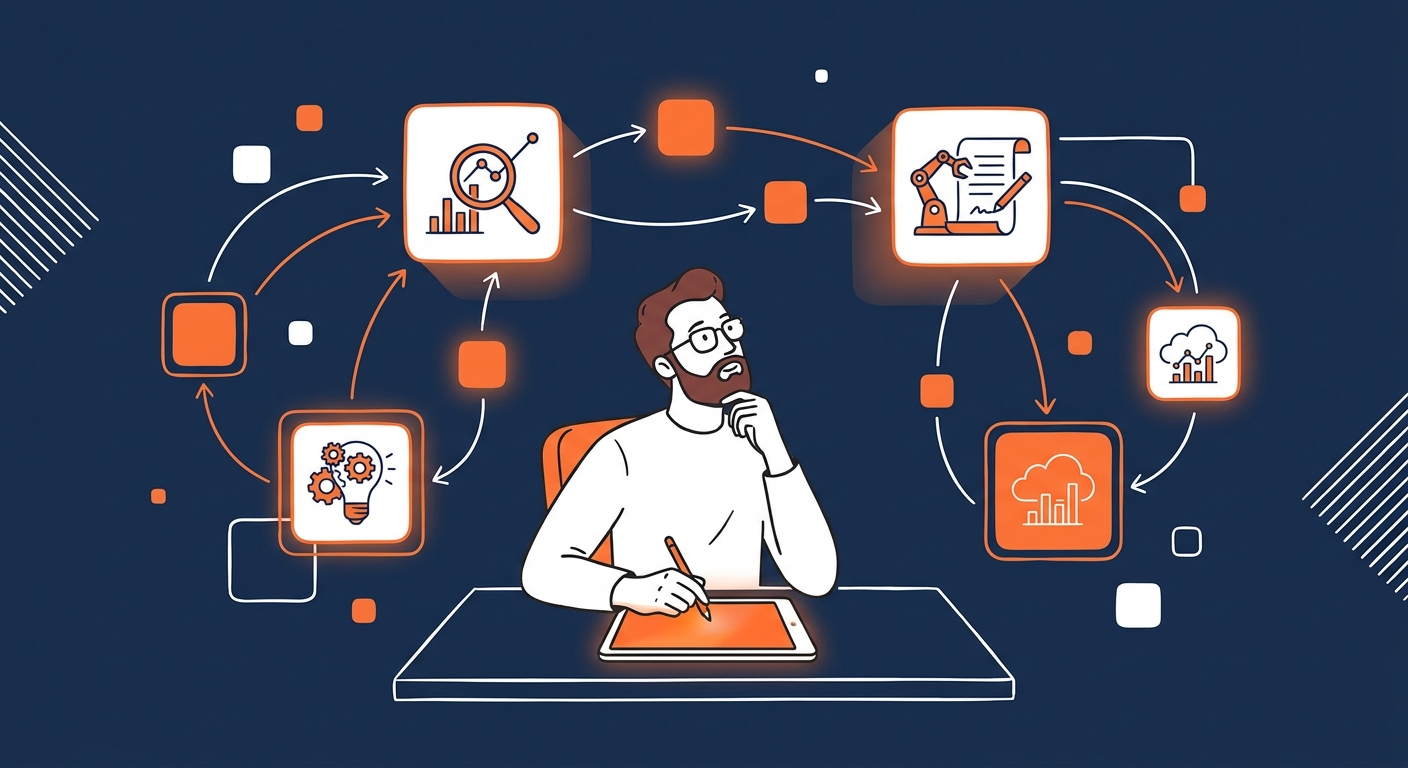
Now, we’re using autonomous agents that can research, draft, edit, and optimize based on high-level strategy. You don’t have to hold the machine's hand through every single step anymore. These systems can spot gaps in their own logic, pull from internal data, and tweak their tone before you even glance at the draft.
This is the jump from mere productivity—doing things faster—to creative acceleration. We’re finally capable of launching initiatives we used to kill because we didn't have the headcount. When you use advanced AI Content Tools, you aren't just churning out words. You're deploying an engine that actually understands your brand’s history and the pulse of your audience.
The Modern Creative Stack
If you want to win today, you need a stack that actually talks to itself. The secret sauce? Retrieval-Augmented Generation (RAG).
Stop letting models guess what your brand sounds like. Ground those LLMs in your actual proprietary data—your style guides, your best-performing case studies, and your customer feedback. If you don't anchor the AI in your own reality, you’re just going to get generic, "average" internet sludge.
According to the Adobe Digital Trends 2026 Report, the winners are the ones ditching siloed software. They’re building unified ecosystems where analytics, synthetic media, and drafting agents share a brain. Your data shouldn't just be a report of what happened last month; it should be the fuel for tomorrow’s content strategy.
Hyper-Personalization: The New Marketing Baseline
Marketers have spent decades chasing the "holy grail" of one-to-one communication. The problem was always the operational tax—you couldn't create thousands of bespoke assets without breaking the bank.
AI just tore that barrier down.
We’re shifting from "one-to-many" broadcasting to "one-to-segment" precision. You take one core campaign theme and atomize it. One segment of your audience gets a technical, deep-dive white paper; another gets a punchy, emotional narrative. You aren't just swapping out a first name in an email template. You’re adjusting the entire rhetorical approach, the visuals, and the CTA to match exactly where that person is in their journey.
The "Bland" Trap: Why Your Brand Authority is at Risk
Here’s the "Creativity Paradox": If everyone has access to the same powerful AI, how do you stand out?
The answer is simple: your input. If you feed a model generic prompts, you get generic results. It’s the average of the entire internet, and let's be honest—human beings are getting really good at sniffing out "AI-sounding" content.
To keep your authority, you have to lean into your own proprietary insights. The AI isn't your source of truth; it’s the conduit for your unique perspective. If you’re struggling to make your AI content feel like yours, you might need to look toward specialized Content Marketing Services to help bridge the gap between AI speed and human-led brand strategy.
Building a "Human-in-the-Loop" (HITL) Workflow
The biggest mistake teams make? Treating AI like a "set it and forget it" appliance.
That’s a recipe for disaster. The best teams are built on a "Curator" model. Your creative team shouldn't be wasting time on the drudgery of first drafts. They should be the architects. They manage the strategy, define the parameters, and handle the final, critical polish that gives the content its soul.
As noted by Harvard DCE in their analysis of AI in Marketing, the real value of the human isn't the labor—it’s the judgment. The machine can’t replicate your ethical compass or your strategic intuition. You’re the editor-in-chief, not the keyboard operator.
Setting Your Ethical Guardrails
When you automate, the responsibility for the output rests entirely on your shoulders. You need a governance framework that isn't just window dressing.
- Transparency: If it’s AI, own it. Especially in high-stakes communications, don't hide the machine.
- Data Sovereignty: Keep your proprietary data safe. Use RAG to ground your models, but make sure your internal knowledge isn't leaking into the public training pool.
- Bias Mitigation: Audit your agents. Regularly. If your AI starts echoing harmful stereotypes, that’s on you.
Governance isn't "nice-to-have." It’s foundational. If you don't have a policy for checking AI accuracy and copyright, you’re playing a dangerous game.
The Marketer of Tomorrow is an Orchestrator
The skill set is changing. Forget "prompt engineering." That’s a temporary trick. The future belongs to the "AI Orchestrator."
As Huble notes in their outlook on the future of AI in marketing, the ability to synthesize complex data, hold a long-term vision, and apply a sharp editorial eye is the new gold standard. Learn how to build systems. Learn how to break a big business objective into the discrete steps a fleet of agents can execute.
The goal isn't to be the fastest writer. It’s to be the architect who directs the technology to create high-value, human-verified content that actually moves the needle.
Frequently Asked Questions
Will AI eventually replace human creative professionals?
AI is great at pattern recognition and speed. It is terrible at empathy, context, and taking strategic risks. It will replace the tasks that are boring and low-value, but it won't replace the creatives who can inject original insight and emotional resonance into their work.
How do I maintain a unique brand voice when using AI?
Build a "Brand Bible." Document your tone, your vocabulary, and your hard "no-go" zones. Use that as your system prompt and ground your agents in your past high-performing content. If you feed the AI your best work, it will learn to sound like you, not like a generic internet bot.
Is AI-generated content bad for SEO in 2026?
Google cares about E-E-A-T: Experience, Expertise, Authoritativeness, and Trustworthiness. They don't hate AI; they hate low-value, repetitive junk. If your AI-assisted content provides real, original research and actual value, it will rank just fine.
What is the most important skill for a marketer in the age of AI?
"AI Orchestration." It’s the ability to act as the curator and the strategy lead. You’re the one directing the AI to fulfill a vision, and you’re the one applying the final judgment to ensure the work actually connects with a human audience.