
Automated Machine Learning—AutoML—is no longer just a shiny toy for junior developers. It’s the backbone of the modern enterprise. Think of it as the industrial revolution of data science. Instead of hand-crafting every single bolt and gear, you’re using a factory line to churn out models that actually work.
At its core, AutoML is about ending the drudgery. No more spending three weeks on hyperparameter tuning or agonizing over feature selection. It shifts your focus from "How do I build this?" to "What problem am I actually trying to solve?" If you’re still fuzzy on the basics, what is AI gives you the necessary context on the broader evolution of the field. By 2026, AutoML has become the bridge between technical complexity and the raw speed required to stay alive in a market that demands instant, data-backed answers.
What Exactly is AutoML and How Does It Work?
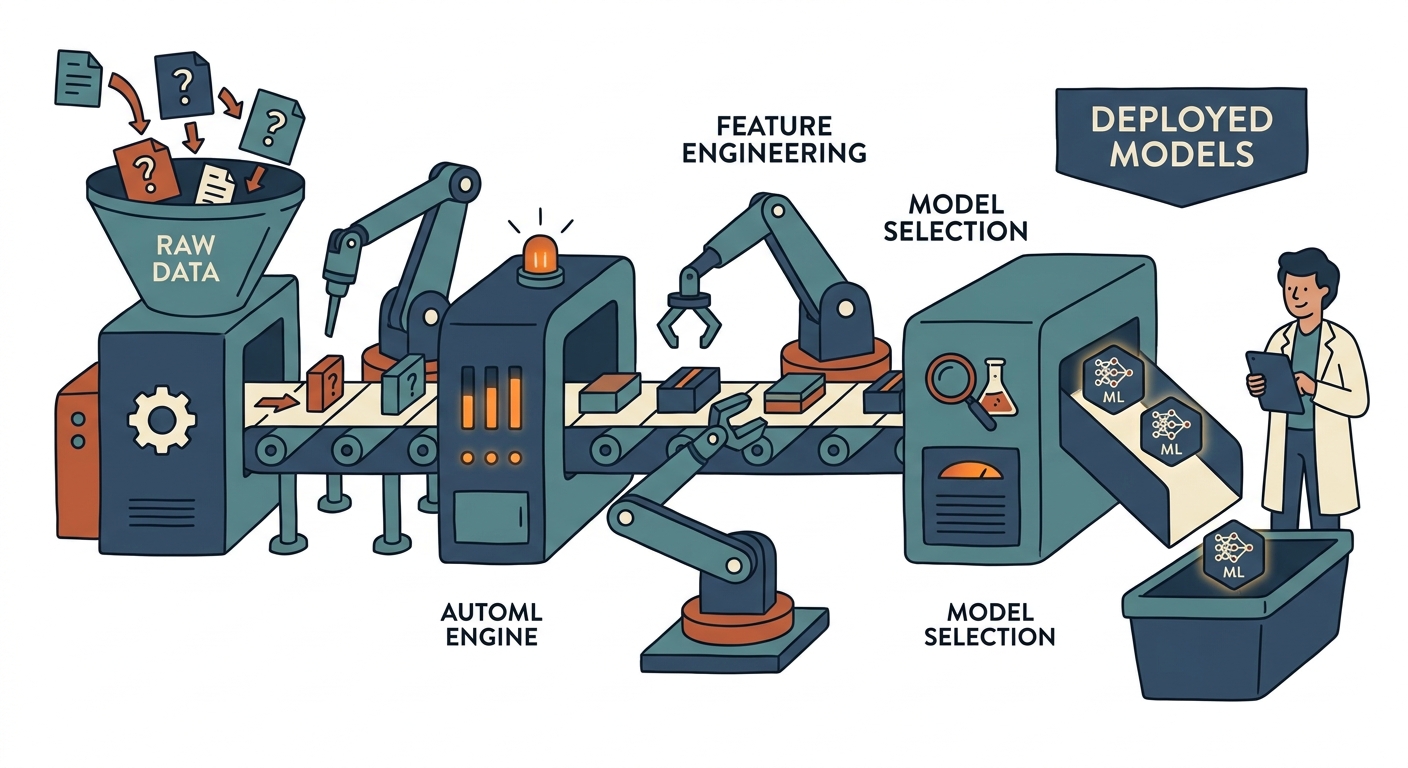
Stop thinking of AutoML as one magic algorithm. It’s not. It’s a framework—a systematic way to run the entire machine learning lifecycle with as little human meddling as possible. Early versions were glorified calculators for parameter optimization. Today’s standard, often called "end-to-end AutoMLOps," is a beast that handles everything from raw data to production deployment.
The process usually follows a five-stage pipeline:
This pipeline is a game-changer. It takes raw, messy, "I-don't-know-what-to-do-with-this" data and spits out a production-ready model. You don't need a team of ten PhDs anymore.
The secret sauce? Automated feature engineering. The system looks at your inputs, spots patterns, and synthesizes new variables that even a seasoned analyst might miss. Then, it runs a "tournament." It pits gradient-boosted trees against deep neural networks, testing them relentlessly until the winner emerges. It’s brutal, efficient, and largely automated.
Why Is AutoML Becoming a Business Imperative in 2026?
Let’s be real: talent is expensive and scarce. The biggest bottleneck in AI adoption used to be the sheer army of engineers needed to keep a model breathing. Today, AutoML lets you scale predictive analytics without inflating your payroll. You’re trading "grunt work"—the cleaning, the testing, the endless tuning—for speed. We’re talking models deployed in days, not months.
This is fundamentally changing the economics of data science. According to the latest KDnuggets AutoML Trends 2026, the hype has shifted toward "Self-Healing Pipelines." These systems don't just build models; they watch them. When they detect model drift, they trigger a re-training cycle automatically. It’s like having a mechanic that fixes the car while you’re driving at 100mph.
How Are Modern Organizations Using AutoML for Generative AI?
The big pivot in 2026 is the move from simple predictive models to the messy, high-stakes world of Large Language Models (LLMs). Implementing an enterprise-grade LLM is like playing with fire. You’ve got hallucinations, latency spikes, and costs that can burn through a budget in an afternoon.
AutoML is the fire extinguisher.
Modern platforms now automate the fine-tuning of these models. Instead of manually wrestling with thousands of parameters, these tools use reinforcement learning to find the "sweet spot" for your proprietary data. They adjust the temperature, the prompt structure, and the weights to keep the model grounded. It’s not just about convenience; it’s about making Generative AI safe enough to actually use in a boardroom. It ensures your proprietary data stays relevant and your model doesn't start hallucinating facts that don't exist.
The "Human-in-the-Loop": Is AutoML Replacing Data Scientists?
There’s this tired, persistent myth that AutoML is here to put data scientists out of a job. That’s nonsense. If anything, it’s a force multiplier.
When you strip away the repetitive, mind-numbing code-writing, you liberate the data scientist. Now, they can actually do the high-level work: architectural oversight, ethical auditing, and strategy.
In a "Collaborative AI" environment, the machine does the heavy lifting, but the human provides the guardrails. A machine might hit 99% accuracy, but a human expert knows if that model is cheating by using a "leak" in the data. For firms navigating these choppy waters, professional guidance is still non-negotiable, which is why many lean on Data Science Services to ensure their automated pipelines align with real-world goals. The data scientist isn't disappearing; they’re evolving into an architect.
When Should You Use AutoML vs. Manual ML?
The choice is usually simple: What’s your deadline, and what’s the complexity?
| Use Case | Recommended Approach | Why? |
|---|---|---|
| Standard Churn Prediction | AutoML | High-volume, repeatable, well-structured data. |
| Customer Lifetime Value | AutoML | Can be quickly prototyped and iterated upon. |
| Novel Research Architecture | Manual ML | Requires deep, non-standard mathematical tweaks. |
| Edge Case Computer Vision | Manual ML | Needs custom layers and specialized optimization. |
If you’re dealing with standard tabular data or a classification problem, just use AutoML. It’ll get you to 90% performance in a fraction of the time. But if you’re trying to invent something that’s never been done before, or you’re squeezing out that final 1% of performance for a bespoke neural network, put the AutoML down and get your hands dirty with manual code.
What Are the Real-World Limitations of AutoML?
AutoML is powerful, but it’s not a magic wand. The biggest hurdle? The "Black Box" problem. If you can’t explain how your model reached a decision, you’re in trouble—especially if you’re in finance or healthcare.
Then there’s the "Garbage In, Garbage Out" rule. AutoML is a genius at finding patterns, but it can’t tell the difference between gold and trash. If your data is biased or riddled with errors, the machine will just give you a very fast, very expensive way to reach the wrong conclusion. As the Azure Machine Learning Concept Guide points out, the burden of data integrity remains squarely on your shoulders. You still have to curate your datasets with rigor.
Getting Started: A Brief Look at the Landscape
The market is crowded. But the winners are the ones that play nice with the cloud infrastructure you’re already using. Platforms like Google Cloud AutoML have set the bar by making the interface intuitive enough that you aren't fighting the tool to get results.
Whether you’re on AWS, Azure, or Google Cloud, pick a platform that integrates into your existing MLOps workflow. Don't try to boil the ocean. Pick one low-risk problem, run it through the pipeline, and see if it beats your current baseline. You’ll be surprised at how fast you can move.
Frequently Asked Questions
Does AutoML replace the need for a Data Scientist?
No, it acts as a force multiplier, automating repetitive tasks so experts can focus on complex problem-solving and high-level strategy.
Is AutoML suitable for small businesses?
Yes, it significantly lowers the barrier to entry by reducing the need for large, expensive in-house ML engineering teams, allowing small teams to deploy models quickly.
What are the biggest risks of using AutoML?
The primary risks include the "Black Box" problem (difficulty understanding how the model reaches specific decisions) and the risk of "garbage in, garbage out" if the training data is biased or low-quality.
How does AutoML help with Generative AI?
In 2026, AutoML is increasingly used to automate the fine-tuning of Large Language Models (LLMs), helping businesses adapt existing models to their specific data without manual coding or extensive infrastructure overhead.