Understanding Artificial Intelligence in Scribing and Language Processing

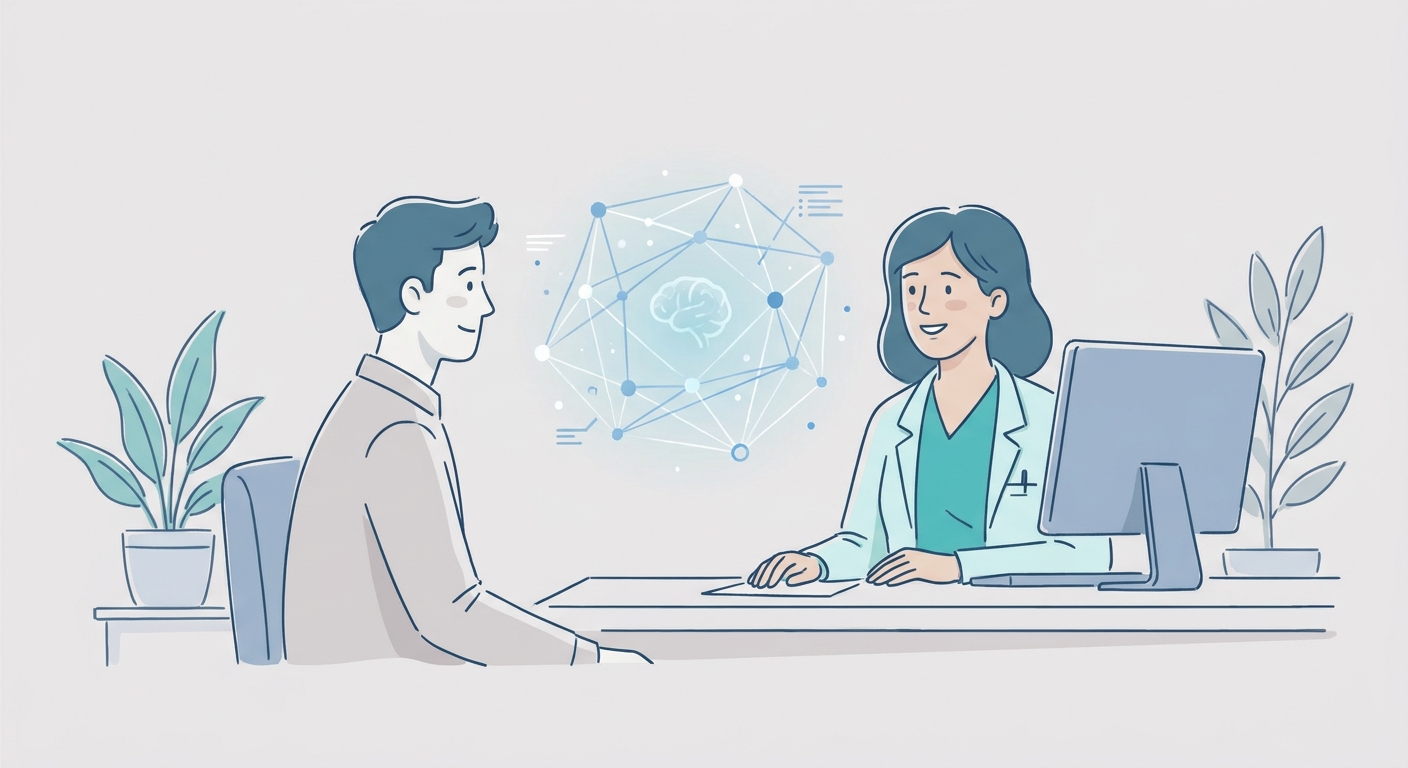
Let’s be honest: the exam room is broken.
If you’re a clinician, you know the drill. You spend your day ping-ponging between a patient’s eyes and your glowing monitor. You’re not a healer; you’re a data-entry clerk in a white coat. With the average doctor burning through 10 hours a week just wrestling with the EHR, it’s no wonder burnout is the silent pandemic of our generation.
We’re tired of being tethered to a keyboard.
That’s why ambient clinical intelligence is finally taking off. It isn't just another tech trend you can ignore. It’s a complete shift in how we practice medicine. By streamlining clinical documentation, these tools aren't just digitizing notes—they’re handing us back our most valuable asset: our attention. It’s time to stop typing and start listening again.
Scribes vs. Dictation: What’s the Real Difference?
To get where we’re going, we have to stop confusing "active" and "passive" tech.
Old-school dictation? It’s a glorified typist. You have to stop your flow, bark commands at a piece of software, and manually massage your thoughts into a rigid box. It’s convenient, sure, but it’s a massive cognitive drain. You’re still focused on the machine, not the person.
Ambient scribing is different. It’s a background player. Using advanced Natural Language Processing (NLP), it listens to the natural, messy flow of a real conversation. It knows how to filter out the small talk about the patient’s grandkids and lock onto the clinical intent. It knows the difference between a casual mention of a weekend hike and a specific description of crushing chest pain.
By the time you reach for the door handle to leave, the AI has already drafted a structured SOAP note. It’s not just tech; it’s a silent partner.
The Anatomy of the Workflow
The magic happens in a few high-speed steps. It starts with audio capture, moves to the cloud, and gets parsed by Large Language Models (LLMs) that actually "get" medicine.
Look at that "Physician Audit" step. That is the safety net. Never forget: the machine is a tool, not a colleague. You are the final authority. If the AI suggests something that doesn't track, you catch it. That’s not a bug; it’s a requirement for safe medicine.
The Math of Reclaiming Your Life
The promise isn't just theoretical fluff. A JAMA Network study confirmed that ambient AI can shave 13 to 16 minutes off your EHR time per encounter.
Do the math. That’s hours every week. That’s time you get back to actually study a complex case, grab a coffee, or—heaven forbid—get home in time for dinner.
But the real win? It’s the vibe in the room. When you aren't forced to turn your back on a patient to hunt and peck at a keyboard, the dynamic shifts. You’re looking at them. They feel heard. You feel like a doctor again. It’s the best anti-burnout medicine we’ve found in decades.
The "Human-in-the-Loop" Reality Check
Look, I’m not here to sell you a miracle. There is no "set it and forget it" button in healthcare.
The Medical Economics analysis on the AI Scribe Era is clear: AI is brilliant, but it’s not infallible. It can hallucinate. It might invent a dosage that was never mentioned or lose a detail from a physical exam.
Then there’s the bias problem. If a model was trained on a narrow slice of data, it might stumble over regional accents or diverse patient populations. That’s why you cannot—absolutely cannot—skip the audit. An AI note is a draft. It’s a rough sketch. Your signature on the chart is a legal and ethical endorsement of its accuracy. If you don't check it, you own the error. Period.
Choosing Your Tech: Don't Get Fooled by the Pitch
How do you pick a vendor without getting sold a bill of goods?
- Integration is Everything: Does it have a native API that shoves data right into your EHR? Or are you stuck copy-pasting from a browser extension? Go for native. It’s faster, cleaner, and less prone to user error.
- Data Privacy is Non-Negotiable: Check the HIPAA Journal guidelines on AI compliance. If a vendor gets cagey about how they store your data or—worse—uses your patient notes to train their global models, show them the door. You want enterprise-grade privacy where your data stays yours.
- Audit the Contract: If you’re ready to stop guessing and start implementing, contact us for a consultation. We can help you navigate the noise.
The Bottom Line: Can We Still Call it Medicine?
We’ve moved past the "should we use AI?" phase. As Terry Fletcher recently pointed out, the question now is "how do we do this responsibly?" With the market for this tech exploding toward a $5 billion valuation, it’s coming whether you’re ready or not.
The future of the exam room isn't about robots replacing doctors. It’s about technology becoming so seamless that it disappears. It’s about the machine doing the heavy lifting so you can focus on the person sitting in front of you.
It requires caution. It requires oversight. But more than anything, it requires a commitment to keeping the human connection at the center of the room. Keep your eyes on the patient, let the AI handle the paperwork, and get back to the art of medicine.
Frequently Asked Questions
Does an AI scribe replace the need for a human medical scribe?
Not entirely. While AI handles the heavy lifting of drafting and formatting, a hybrid model is often superior. AI provides the speed and consistency, while human oversight ensures that the nuance, context, and clinical judgment—the "art" of medicine—remain accurate and complete.
Is patient data used to train AI models in these scribing tools?
This depends on the provider. Reputable, enterprise-grade tools use "zero-retention" or "private-instance" configurations where your patient data is processed but never used to train the underlying models. Always verify that your contract explicitly prohibits the use of your data for model training.
How do AI scribes handle complex medical terminology and regional accents?
Modern NLP models are trained on massive datasets of medical literature and diverse speech patterns. They are designed to parse clinical jargon, recognize anatomical structures, and filter out background noise, effectively distinguishing between a casual conversation and a clinical directive.
Will my EHR integrate with these AI tools automatically?
It varies. Native API integrations provide a seamless, two-way sync where the AI populates fields directly within your EHR. Browser-based extensions are common for smaller, more agile tools but often require a manual "copy-paste" step, which introduces a slight friction point in the workflow.
What happens if the AI misses a critical clinical detail?
This is exactly why the "Human-in-the-Loop" workflow is the industry standard. The AI acts as an assistant, not a clinician. If a detail is missed, the physician is responsible for catching and correcting it during the mandatory audit phase before the note is finalized and saved to the patient’s record.
Related reading
- The Future of AI in Medical Scribing
- Understanding the Concept of Artificial Intelligence in IoT
- Innovations in AI Scribing Technology
- Understanding the Basics of AI in Email Marketing
- Google Translate Launches AI-Powered Language Learning Features to Rival Duolingo
- The 10 best online payment processing services in 2025