Exploring Sludge Content in Digital Media
TL;DR
- Sludge content uses multi-sensory split-screens to bypass the brain's boredom switch.
- The 'Brainrot' economy prioritizes constant occupation over meaningful storytelling or information.
- Creators use satisfying 'visual anchors' like gameplay to keep viewers from scrolling.
- This format acts as a copyright-bypass tactic that rewires how audiences process media.
- High engagement comes at the cost of a significant cognitive tax on users.
Let’s be honest: your attention span isn't just "short." It’s being hijacked.
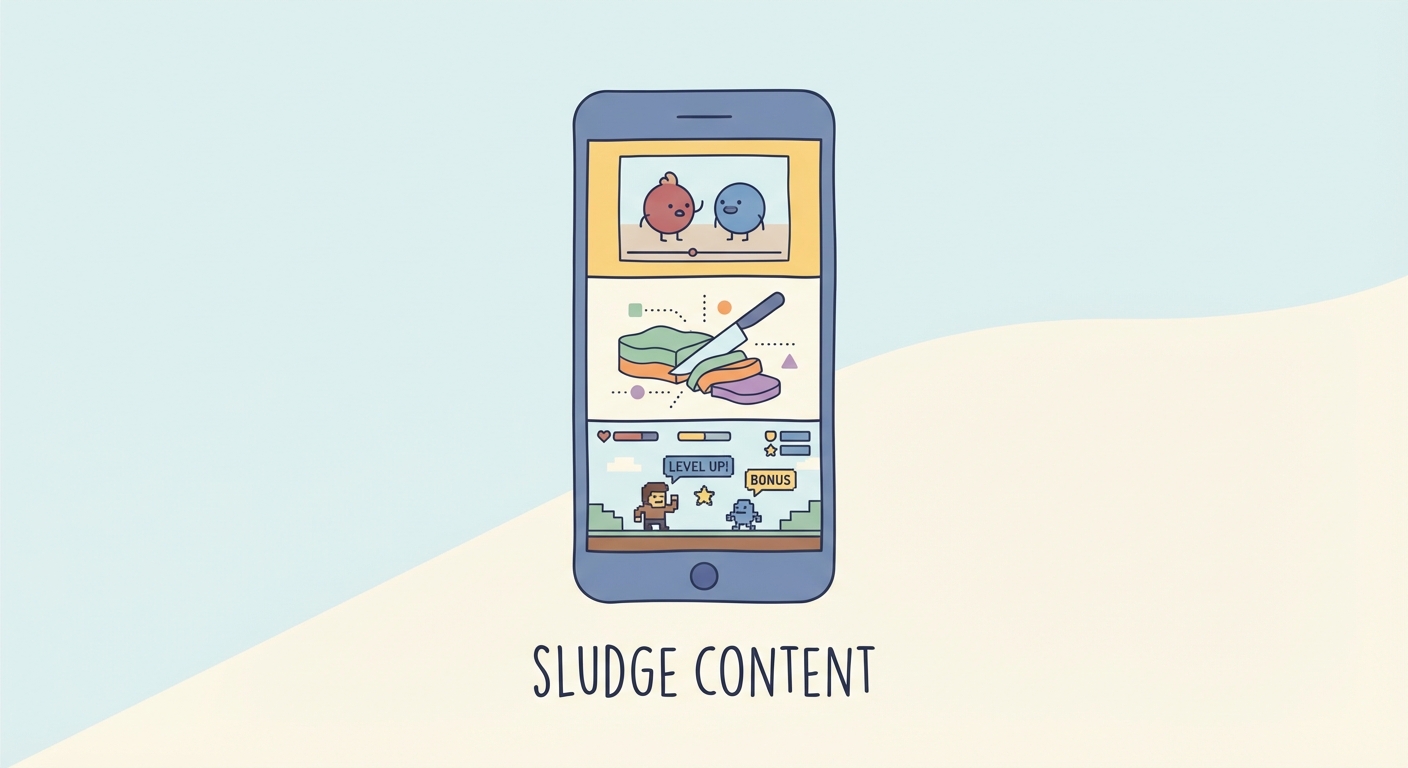
If you’ve spent any time on TikTok or Reels lately, you’ve seen it. It’s that weird, chaotic split-screen video where a clip of South Park sits on top of someone playing Subway Surfers, while the middle is filled with a hydraulic press crushing a Barbie doll. It’s loud, it’s messy, and for some reason, you can’t look away.
Welcome to the world of Sludge Content.
This isn't just a weird internet trend. It’s the backbone of the "Brainrot" economy—a calculated, multi-sensory assault designed to keep your eyes glued to the screen by any means necessary. By stacking unrelated videos into one vertical frame, creators aren't trying to tell a story. They’re trying to bypass your brain’s natural "boredom" switch. If the cartoon gets dull, your eyes drop to the gameplay. If the gameplay slows down, you watch the soap cutting.
It’s a trap. And it’s working.
The Split-Screen Paradox: Why We’re All Zoning Out
Imagine you’re scrolling. You stop on a video. The top half is a pirated snippet of Family Guy. The bottom half is a high-def recording of a power washer cleaning a driveway. Somewhere in the mix, a small window shows someone silently slicing kinetic sand.
You didn’t plan to watch this. You don't even like kinetic sand. Yet, three minutes later, you’re still there. You’ve entered a state of cognitive suspension. You aren't thinking; you’re just... absorbing.
This is the "Sludge" experience. It is the definitive aesthetic of 2026. The goal isn't to inform you or even really to entertain you. It’s simply to occupy you. According to the Digital 2026 Global Overview Report, our habits have shifted toward these hyper-compressed, layered formats. We’ve become a society that needs "background noise" for our own thoughts.
Sure, it pumps up engagement numbers for creators. But for the rest of us? It’s a heavy "cognitive tax" that is fundamentally rewiring how we process the world.
Anatomy of an Attention Trap: The "Brainrot" Aesthetic
Sludge isn't just "busy" video. It’s an architectural feat of distraction. If you pull apart a typical sludge video, you’ll find a very specific formula:
- The Hook: This is the narrative. Usually, it’s high-energy dialogue from a sitcom, a controversial podcast clip, or a "storytime" Reddit post read by a robot.
- The Visual Anchor: This is the "satisfying" stuff. Subway Surfers gameplay, carpet cleaning, or those weird ASMR videos of people eating sponges. It gives your eyes something low-stakes to follow.
- The Tertiary Layer: This is the "originality" shield. Maybe it’s an AI-generated reaction face or a thin filter. It’s mostly there to trick copyright bots so the creator doesn't get banned for stealing footage.
This didn't happen by accident. What started as a sneaky way to bypass TikTok’s copyright filters has turned into a massive industry known as "AI Slop." It’s fragmented piracy. We’re now consuming entire seasons of TV in ninety-second, multi-layered chunks. In this world, the plot of the show is secondary to the rhythmic thud of a digital character jumping over trains.
The Science of the "8-Second Reset"
Why does our hardware—the human brain—fail so miserably when faced with a Minecraft parkour run and a clip of The Office?
It’s all about the "8-second barrier." As attention spans have cratered, creators realized they could "reset" your attention clock by providing constant novelty within the same frame.
The moment your brain gets even slightly bored of the dialogue in the top video, the bright colors and predictable physics of the bottom video trigger a tiny hit of dopamine. It’s a loop. You never get a chance to swipe away because there's always something "new" happening three inches away from the thing you were just looking at.
Saif Shahin, a researcher in digital culture, calls this a sensory deprivation tank in reverse. Instead of removing noise to find peace, it overloads you until you go numb. It’s highway hypnosis for the smartphone age. This neurological grip is real; research from Scientific American regarding sludge videos and the brain suggests this level of stimulation is genuinely addictive. It makes single-stream media—like a book or a movie—feel agonizingly slow and "boring."
Inside the Sludge Economy: Follow the Money
The rise of sludge isn't just a creative choice; it’s an economic survival tactic. Platforms like TikTok, Reels, and YouTube Shorts live and die by "Watch Time." If you finish a video, the algorithm thinks that video is gold.
The logic is simple:
This feedback loop has created the "AI Slop Factory." By 2026, the "Brainrot" economy is estimated to be worth over $117 million in annual ad revenue. We now have automated tools that scrape viral audio, pair it with stock footage, and upload thousands of videos daily. No human ever clicks "render." As noted in the Deloitte 2025 Digital Media Trends, social platforms are winning because they provide a low-friction, high-stimulation environment that requires exactly zero intellectual effort.
The Numbing Effect: Is Your Brain Okay?
The long-term effects of "sludging" are starting to surface, and they aren't pretty. A 2025 study on high schoolers showed a massive decline in deep reading comprehension. When your brain is habituated to receiving information in fragmented, overstimulated bursts, it loses the ability to focus on long, linear narratives.
We’ve moved from being active participants in media—choosing what we watch—to being passive vessels for "slop."
To fight back, experts are calling for "Digital Hygiene." This means performing sludge audits as recommended by the OECD. We have to identify where this mindless overstimulation is creeping in and intentionally choose "friction-heavy" content. Read a book. Watch a documentary without a phone in your hand. Reclaim your focus.
The Creator’s Dilemma: Sell Out or Starve?
If you’re a creator, the temptation to make sludge is massive. It’s soul-crushing to watch a low-effort split-screen video get five million views while your carefully edited project sits at five hundred. Many creators feel like they have to use these "brainrot" tactics just to survive the algorithm.
But there is a better way. The goal shouldn’t be to delete AI or ignore modern editing; it should be to use them to make things better, not noisier. Using an AI-powered content creation guide can help you find that middle ground. You can use tech to handle the boring stuff (transcribing, color grading, formatting) while keeping the "soul" of your work intact.
Sludge is a commodity. It’s replaceable. It’s forgettable. High-value content that actually makes someone feel something is what builds a real community.
Using AI Without Losing Your Soul
AI doesn't have to be a "slop" generator. In the right hands, it’s a tool for depth. Instead of using automation to stack stolen clips, smart creators are using AI for deep research and high-end production that used to be impossible for a one-person team.
The trick is changing your mindset. Instead of asking "How can I keep them from swiping?" ask "How can I provide so much value that they don't want to swipe?"
Utilizing essential AI tools for the future allows you to focus on the creative vision while the software handles the technical hurdles. If you’re stuck, there are AI tools that spark creativity by helping you find unique angles for your stories, rather than just distracting someone with a video of a lawnmower.
The Future: The "Slow Media" Revolution
We’re reaching a breaking point. Just like the rise of fast food eventually led to the "slow food" movement, the era of sludge is paving the way for a "Slow Media" revolution.
People are getting burned out. They’re tired of the noise. They’re starting to crave depth, silence, and stories that allow them to actually think.
The future doesn't belong to the person who can stack four videos in a single frame. It belongs to the creator who can command deep, undivided attention in a world that has forgotten how to focus. 2026 is the year we decide: are we going to be the masters of our tools, or just another piece of data in the slop factory?
Frequently Asked Questions
What is the purpose of sludge content?
It’s all about "Watch Time." By giving you three things to look at once, creators ensure that if you get bored of one, your eyes just move to another part of the screen. This keeps you from swiping away, which tells the algorithm the video is "good."
Is sludge content actually bad for my brain?
It’s not going to melt your brain overnight, but it does reinforce "passive consumption." It trains your brain to expect constant, high-speed stimulation. This makes "slow" activities—like reading or watching a movie—feel frustrating and difficult.
How do I get this stuff off my feed?
Retrain your algorithm. It’s called a "sludge audit." When you see these videos, don't just swipe—long-press and hit "Not Interested." Then, find some long-form content you actually like and watch it all the way through.
Can AI create sludge content automatically?
Absolutely. By 2026, entire "Slop" channels are run by bots. They scrape audio, pair it with "satisfying" stock footage, and upload thousands of clips a day without a human ever being involved in the process.