
Picture this: You’re in a boardroom. Your technical lead is shouting about "AI," while your data architect is deep in the weeds talking about "Machine Learning." You nod along, hoping it all means the same thing.
It doesn't.
Confusing these two isn't just a minor slip-up in vocabulary. It’s a strategic blind spot. It leads to wasted budgets, pilot projects that go nowhere, and a fundamental misunderstanding of what your company is actually building.
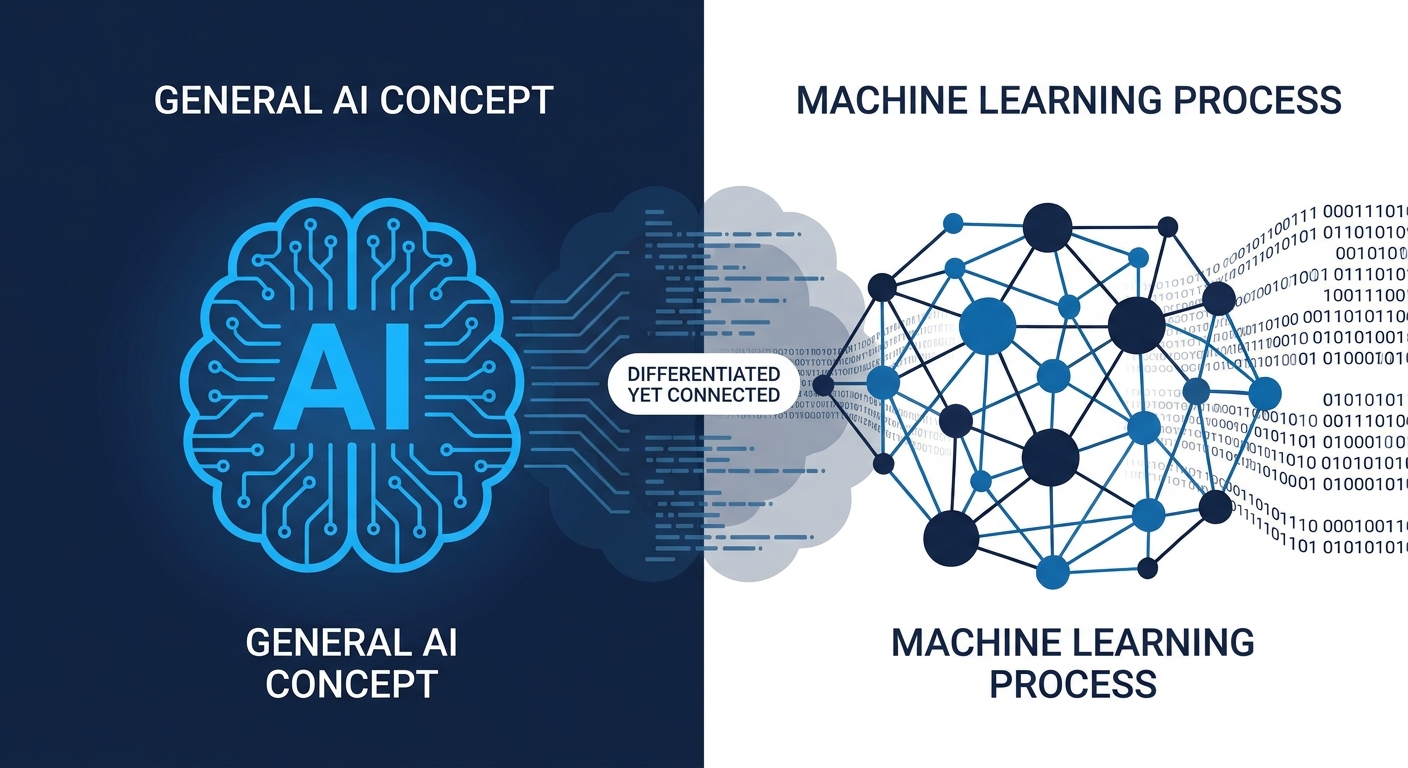
Think of it this way: Artificial Intelligence is the grand ambition—the quest to build systems that act like they have a brain. Machine Learning? That’s the statistical engine that actually makes the car move. As we push into 2026, moving past basic automation into "cognitive augmentation," knowing the difference is the only way to cut through the marketing fluff and find real, tangible business value.
What is the "AI Umbrella" in 2026?
At its simplest, Artificial Intelligence is the umbrella for everything "smart" in computing. It isn’t one piece of software you buy off a shelf. It’s a field of study—a massive tent dedicated to building systems that handle tasks that usually require a human: reasoning, solving problems, and understanding language.
The ecosystem has a hierarchy. At the top, you have AI (the parent). Nested inside is Machine Learning (the method for improving through data). Dig deeper into ML, and you hit Deep Learning—which uses massive, layered neural networks to crunch messy, unstructured data. Finally, we have the current star of the show: Generative AI, which uses those deep architectures to create new stuff, rather than just analyzing old stuff.
It’s crucial to remember that almost everything we interact with today is Artificial Narrow Intelligence (ANI). These systems are absolute monsters at specific tasks—like predicting customer churn or summarizing a legal brief—but they don't have the broad, context-aware reasoning of a human. We’re still chasing the dream of Artificial General Intelligence (AGI), where a machine can handle any intellectual task a human can, but for now, we’re living in a world of specialized, high-performance tools.
What is Machine Learning and How Does it Actually "Learn"?
If AI is the vision, Machine Learning is the labor. As defined by AWS in their technical overview of the field, Machine Learning is the science of teaching computers to act without being explicitly told what to do.
Forget rigid "if-then" rules. Instead of coding every possible scenario, developers feed the system mountains of data. The algorithm hunts for patterns, correlations, and weird anomalies.
Think of it like training an apprentice. You don’t hand an apprentice a 5,000-page manual on how to handle every single customer complaint. You show them 10,000 examples of how to resolve them successfully. Over time, the system "learns" the underlying statistical rhythm. When a new, unseen input hits the system, it makes a prediction based on what it’s seen before.
This is why data quality is the lifeblood of any ML project. If you feed a model biased, garbage data, the "learning" process will be warped. You end up with predictions that aren't just wrong—they’re dangerous to your business.
How Do AI and Machine Learning Work Together?
They’re partners. AI provides the strategy—the "what" and the "why"—while Machine Learning provides the "how."
You can’t just flip a switch and expect an intelligent agent to run your company if your data is siloed, messy, or non-existent. For many, the road to maturity starts with a brutal audit. As detailed in our approach to data strategy, the ability to use machine learning hinges entirely on your infrastructure. If you can’t clean, categorize, and store information in a way an algorithm can digest, you’re stuck. Once that foundation is solid, AI acts as the translator, turning raw ML predictions into actual business strategy—converting a probability score into a concrete customer retention plan.
The Key Differences: A Strategic Comparison
Keep this table handy for your next budget review. It clears the fog.
| Feature | Artificial Intelligence | Machine Learning |
|---|---|---|
| Scope | Broad (Umbrella) | Narrow (Subset) |
| Primary Goal | Mimic human intelligence | Learn from patterns in data |
| Data Requirement | Varies (Rules or Data) | High (Requires datasets) |
| Autonomy Level | High (Decision making) | Medium (Prediction/Optimization) |
While AI tries to simulate human reasoning, ML is just a math-heavy process for getting better at a specific task. You might use AI to build a customer support bot, but that bot is "powered" by ML models that analyze the sentiment and intent behind the customer’s words.
Beyond the Hype: Where Does Generative AI Fit?
"Generative AI" is the buzzword of 2026. Let’s be clear: it isn't some magic technology that sits outside the AI/ML hierarchy. It’s just a subset of AI that uses complex Deep Learning to synthesize new outputs—whether that's text, code, or images. As IBM notes in their deep dive on the topic, Generative AI feels "smarter" because it learns the structure of data well enough to create something original, rather than just labeling what’s already there.
But don't be fooled by the human-like fluency. These systems are still built on the same statistical bedrock as traditional ML. They are still just calculating probabilities to guess the next word in a sentence or the next pixel in an image. The leap in capability is massive, but the mechanics? It’s still just pattern recognition.
Which One Does Your Business Need?
Stop asking "Do I need AI or Machine Learning?" and start asking, "What problem am I trying to solve?"
If you just need to automate a routine administrative task, you don't need to build a custom machine learning model from scratch. Most businesses hit their stride by integrating pre-trained AI-enabled APIs—services that have already been trained on massive datasets—to handle things like translation, sentiment analysis, or document extraction.
Building custom Machine Learning pipelines is an investment in proprietary advantage. You do this when your problem is so unique that off-the-shelf tools just don't cut it. If your company relies on specific, proprietary data—think unique manufacturing diagnostics or specialized financial risk—then you’re in the territory of custom ML. For a deeper look at how to navigate these choices, you can explore our AI solutions for business or consult this comparative guide from Google Cloud to understand where you sit on the maturity curve.
Myth-Busting: What AI is Not
We have to address the elephant in the room: the myth of sentience.
Despite the way the media talks about these tools, AI is not "thinking." It doesn't have desires, it doesn't have beliefs, and it doesn't have a soul. When a model gives you an answer, it’s just running a high-speed, incredibly sophisticated probability calculation.
It is a massive mistake to attribute "intent" to an AI system when it screws up. AI is a tool. Its output is a reflection of its design, its training data, and the parameters set by the engineers. Treating AI like a "black box" that possesses its own logic is a fast track to management failure. Treat it like a probabilistic engine: powerful, transformative, but only as good as the data and the architecture you provide.
Conclusion: Moving From Confusion to Execution
The difference between AI and Machine Learning is the difference between having a destination and having a roadmap. AI is your destination—a more intelligent, automated business. Machine Learning is the engine that gets you there.
Stop getting bogged down in the labels. If you’re spending your time debating whether a tool is "AI" or "ML," you’re missing the point. Focus on the problem. If you need better predictions based on historical patterns, you’re looking for Machine Learning. If you need a system that mimics cognitive performance to interact with humans, you’re looking for the broader applications of AI.
Clean up your vocabulary. Focus on your data maturity. Start building. The technology is already here; the only variable left is how effectively you use it.
Frequently Asked Questions
Is AI just a fancy name for Machine Learning?
No. Think of AI as the broad category of "smart" technology. Machine Learning is a specific sub-field within AI that focuses on teaching computers to learn from data rather than following explicit, hard-coded instructions.
Does my business need AI or Machine Learning to get started?
Most businesses should start by leveraging existing AI-enabled tools and APIs to solve immediate problems. Building custom Machine Learning pipelines is a higher-maturity activity that requires a significant investment in data infrastructure and specialized talent.
Will AI eventually replace Machine Learning?
No. They are not in competition. AI is the goal—the pursuit of intelligent systems—and Machine Learning is the primary method we use to achieve that goal. They are complementary, not mutually exclusive.
How does Generative AI fit into this distinction?
Generative AI is a specialized subset of AI that uses advanced Machine Learning and Deep Learning architectures. While traditional ML is excellent at analyzing and categorizing data, Generative AI uses those same patterns to synthesize brand-new content, making it a powerful evolution of the technology.