
Where human support meets AI: Call center outsourcing partners for tech leaders

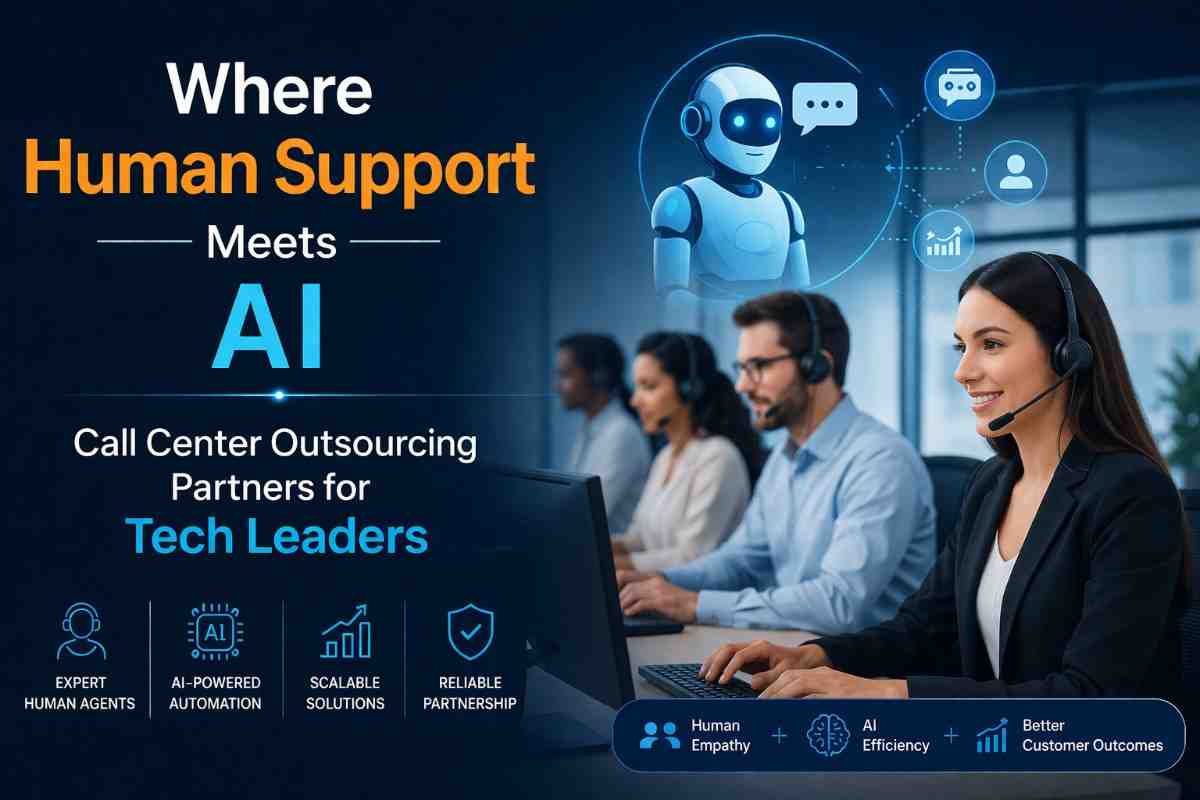
ANALYSIS — an earlier version of this article opened with two market figures, one from a research firm's press release and one from a 2022 Gartner forecast presented as current. Neither publisher's page was retrievable to verify, so both have been removed rather than repeated. Worth knowing regardless: Gartner has since published a 2026 prediction that half of companies cutting customer-service staff because of AI will rehire by 2027 — the direction of expert opinion has moved, and a 2022 cost-reduction forecast should not be quoted as the current view. For tech leaders, those numbers aren't just market context. They represent a real operating question: which outsourcing partners actually know how to blend AI efficiency with the human judgment that complex, product-led support demands?
This article compares five call center outsourcing companies actively deploying AI-augmented operations for technology companies in 2026. You'll find honest breakdowns on operational depth, AI integration maturity, pricing models, and the cultural fit that determines whether a BPO relationship lasts two years or ten. Our call center outsourcing services page covers what to look for before you sign. Read on to see how the five providers compare.
Top 5 call center outsourcing companies for tech leaders at a glance
Here is how the five providers stack up at a high level before we go deeper on each one.
Company | Founded | Team size | Languages | Best for |
|---|---|---|---|---|
Helpware CX | 2015 | 4,000+ | 45+ | Mid-market to enterprise tech, SaaS, and healthcare |
Teleperformance | 1978 | 410,000+ | 300+ | Global enterprises needing massive multilingual scale |
TTEC | 1982 | 40,000+ | 50+ | Tech-enabled managed services with digital consulting |
Concentrix | 1983 | 450,000+ | 70+ | Enterprise transformation with AI-powered analytics |
TaskUs | 2008 | 60,400 | Multiple | Digital-native tech brands and high-growth startups |
Company overviews
#1 Helpware CX
What separates Helpware CX from the pack isn't raw headcount. The vendor reports 90% CSAT and 2.8% monthly attrition across its locations. ANALYSIS — these are self-reported and unaudited, and an earlier version of this article compared them against a "6 to 8% monthly" industry benchmark that no industry body publishes. That baseline would imply 72–96% annual turnover, well above the 30–45% range usually discussed, and it flattered the comparison. Ask any vendor for the definition and measurement window behind an attrition figure before comparing it to anything. Founded in 2015 in Lexington, Kentucky, Helpware CX has grown to serve 400+ clients across healthcare, SaaS, fintech, and e-commerce by treating every engagement as a long-term strategic relationship rather than a staffable headcount contract. Their call center operations span inbound and outbound voice support, technical helpdesk, appointment scheduling, customer care, and sales support, delivered through a flexible hub-and-spoke model across the Americas, Europe, Asia-Pacific, and Africa.
Where most BPOs run monthly attrition of 6 to 8%, Helpware CX holds consistently at 2.8%. That isn't a rounding error. It reflects deliberate investment in employee experience, and it directly translates to the quality of every interaction your customers receive. Their SaaS and software customer support practice is built for the complexity that product-led companies face: multi-tier technical queries, onboarding flows for rapidly iterating products, and real-time quality assurance tied to CSAT targets rather than call volume alone. Their CX technology integration services connect outsourced operations to clients' existing stacks, from CRM platforms to ticketing systems, without requiring an infrastructure overhaul.
Helpware states support across "three continents and over 25 languages" from "19 locations worldwide" (Helpware, retrieved 2026-09-02). SOURCED An earlier version of this article said 45+ languages across four continents, which overstates the vendor's own claim. Compliance certifications should be requested directly as current attestations. Their operating model applies across industries, but it's particularly well-matched to technology companies that view customer experience as a retention driver rather than a cost line.
Why we picked it
Helpware CX earns the top spot because it operates at the scale that matches the mid-market and growing enterprise sweet spot most technology companies occupy. It doesn't bring the standardized, one-size-fits-all approach that comes with mega-providers. Their 5-year average client partnership speaks louder than any pitch deck. Businesses that start with Helpware CX tend to stay and expand. The combination of 90% CSAT, 86% employee satisfaction, and 2.8% monthly attrition creates a compounding quality advantage that high-volume commodity providers simply don't match.
Services offered: Inbound and outbound call center support, technical support (L1, L2, L3), customer care, sales support, appointment scheduling, helpdesk, omnichannel customer experience across voice, email, chat, and social, CX consulting.
Pros: 90% CSAT scores across client base, 2.8% monthly attrition vs. industry average of 6 to 8%, 45+ languages with native speakers, 19 locations across 4 continents, 5-year average client partnerships, SOC 2, HIPAA, GDPR, and PCI DSS certified.
Cons: Premium pricing relative to offshore-only providers, consultative sales process takes longer than transactional vendors.
Industry expertise: SaaS and software, healthcare and telehealth, e-commerce, fintech, gaming, logistics, public sector.
Best for: Mid-market to enterprise technology companies seeking a long-term strategic partner with deep industry expertise rather than a transactional, high-volume vendor.
Pricing: $8 to $15 per hour. Three flexible pricing plans available: HW.Talent, HW.Team, and HW.Hub. Contact vendor for quotes.
Rating: 5.0 ★ (Clutch), 4.9 ★ (Gartner), 4.8 ★ (G2)
Year established: 2015
Location: Lexington, Kentucky (HQ); USA, Mexico, Philippines, Ukraine, Georgia, Puerto Rico, Poland, Germany, Albania, South Africa, Uganda.
#2 Teleperformance
Teleperformance, rebranded as TP in 2025, is the largest pure-play call center outsourcing company in the world by headcount. Founded in France in 1978, TP operates across 91 countries with more than 410,000 employees, serving clients in over 300 languages and 170 markets. For tech leaders managing global footprints and multi-regional customer bases, TP's coverage is genuinely unmatched. The company unveiled its "Future Forward" strategic plan in June 2025, committing to becoming a next-generation AI-enabled business, and launched TP.ai FAB: a proprietary platform designed to orchestrate AI, human agents, and technology at scale.
TP has invested aggressively in AI capabilities throughout 2025, forming partnerships with Sanas for real-time speech understanding, Ema and Parloa for agentic AI orchestration, and Carnegie Mellon University for applied AI research. That investment program targets up to €100 million in 2025 alone. What TP brings that smaller providers don't is the ability to activate in dozens of countries simultaneously and absorb massive interaction volumes without quality degradation. The trade-off is standardization: TP's model excels at high-volume, multi-country operations where consistent processes create efficiency. Highly bespoke or complex product support often requires a more flexible provider.
Why we picked it
TP belongs on this list because no other provider matches its global language coverage or geographic footprint. Tech companies launching in new markets or supporting customers across dozens of countries need a partner who can activate quickly and maintain quality at scale. TP's 46 years of operating history gives it compliance frameworks, redundancy infrastructure, and talent pipelines that newer providers are still building.
Services offered: Customer care, technical support, back-office operations, AI data services, content moderation, trust and safety, multilingual omnichannel support across voice, chat, and digital channels.
Pros: 410,000+ agents across 91 countries, 300+ language coverage, TP.ai FAB AI orchestration platform, top 10 World's Best Workplaces (Great Place To Work, 2025), 46 years of operating history.
Cons: Standardized processes can limit customization for niche products, better suited to high-volume enterprise operations than bespoke product-specific support.
Industry expertise: Technology, telecommunications, financial services, healthcare, e-commerce, retail, media, gaming, government.
Best for: Large enterprises and multinationals requiring multilingual, multi-country call center coverage at high volume and scale.
Pricing: Custom pricing. Contact vendor for quotes.
Year established: 1978
Location: Paris, France (HQ); global presence across 91 countries.
#3 TTEC
TTEC has built its reputation at the intersection of consulting and managed call center services. Founded in 1982 and now headquartered in Austin, Texas, TTEC operates across 6 continents with 80+ delivery centers and more than 40,000 employees supporting clients in 50 languages. What distinguishes TTEC from standard BPO providers is its two-segment structure: TTEC Engage handles outsourced contact center operations, while TTEC Digital builds and deploys the AI and technology layer on top. This means clients get CX consulting, technology implementation, and managed operations from one provider rather than stitching together separate vendors.
For tech leaders, TTEC's AI practice rewards a closer look. TTEC Digital achieved the 2025-2026 Microsoft AI Business Solutions Inner Circle award, reflecting meaningful integration work with Copilot and Azure AI tools. Their Humanify® cloud platform connects voice, chat, SMS, and digital channels into a unified engagement layer. In one telecom client engagement, TTEC reports that "the program resulted in a material reduction in time and costs by up to 85% in some cases" (TTEC client story, retrieved 2026-09-02). SOURCED Note the vendor's own hedge — "in some cases," on selected processes in a single engagement, not a general capability. It's the dual structure that allows organizations to start with consulting, prove the model, and then move into long-term managed operations, which reduces the risk of committing to a large outsourcing contract before the approach is validated.
Why we picked it
Tech leaders evaluating AI-augmented operations need a provider that brings its own technology layer rather than simply hosting agents on client-owned tools. TTEC's consulting-first, operations-second approach fits technology companies that want strategic CX design before the headcount scales. Only when both sides are aligned on the technology model does the managed services layer fully deliver its value.
Services offered: Inbound and outbound call center outsourcing, CX strategy consulting, AI-powered customer experience design, chat and digital support, technical support, sales, trust and safety, back-office operations, RPA and automation.
Pros: Dual consulting and managed services structure, 80+ delivery centers on 6 continents, Humanify® omnichannel platform, Microsoft AI Business Solutions Inner Circle partner (2025-2026), 40+ years of operating experience.
Cons: Larger minimum engagement sizes suit established operators, better matched to companies already committed to digital transformation than early-stage startups.
Industry expertise: Technology, healthcare, financial services, retail, travel, government, media and entertainment, logistics.
Best for: Technology companies seeking an outsourcing partner that combines CX strategy consulting with managed contact center operations and its own proprietary AI technology layer.
Pricing: Custom pricing. Contact vendor for quotes.
Year established: 1982
Location: Austin, Texas (HQ); global operations across 6 continents.
#4 Concentrix
Concentrix is one of the largest call center outsourcing providers in the world. Founded in 1983 and headquartered in Newark, California, Concentrix went public in 2020 and reached Fortune 500 status (#426) by 2025, with approximately 450,000 employees, 2,000+ clients, and operations spanning 70+ markets globally. The company's 2023 acquisition of Webhelp, a $4.8 billion transaction, significantly expanded its European footprint and multilingual service capacity. Concentrix differentiates through its Concentrix Solv™ platform, which integrates automated and live support into one unified system, and through generative AI deployments including multimodal customer-facing assistants and an agentic AI application with real-time insights.
Rarely do BPO providers combine Fortune 500-grade scale with the kind of AI analytics capability Concentrix has developed. For enterprise technology companies, that scale means the ability to deploy large agent teams across multiple geographies quickly while analytics-driven quality oversight tracks performance in real time. The honest trade-off is that at 450,000+ employees, Concentrix operates best at volume. Startup-stage or highly bespoke product support programs are not the natural fit for a provider built around standardized enterprise-scale operations.
Why we picked it
Concentrix earns its place here because it brings the kind of end-to-end digital transformation capability that enterprise technology companies often need alongside the managed services contract. Their investment in generative AI assistants and customer analytics means the outsourced operations layer also generates insight about customer behavior rather than just handling volume, which is valuable for product and CX teams that want data from support interactions.
Services offered: Omnichannel customer support across voice, chat, email, and social, technical support, sales support, AI-powered digital assistants, customer analytics and business intelligence, CX transformation consulting, content moderation.
Pros: 450,000+ agents in 70+ markets, 2,000+ clients including Fortune Global 500 brands, Concentrix Solv™ unified platform, generative AI virtual assistant capabilities, Fortune 500 company (NASDAQ: CNXC), 70+ languages.
Cons: Better suited to large enterprises than startups or early-stage operators, minimum engagement sizes exclude smaller technology companies.
Industry expertise: Technology, banking and financial services, healthcare, e-commerce, telecommunications, automotive, retail, media.
Best for: Enterprise technology companies and Fortune 500 brands that need global scale, advanced analytics, and AI-powered customer experience transformation across multiple markets.
Pricing: Custom pricing. Contact vendor for quotes.
Year established: 1983
Location: Newark, California (HQ); operations in 70+ markets globally.
#5 TaskUs
TaskUs was built differently from traditional call center providers. Founded in 2008 in Santa Monica, California, the company started as a virtual assistant platform for startups before evolving into a full-service BPO for the world's most disruptive technology brands. As of 30 June 2025, TaskUs reported "a worldwide headcount of approximately 60,400 people across 30 locations in 13 countries" (TaskUs Q2 2025 results, retrieved 2026-09-02). SOURCED Clients include social media platforms, streaming services, and high-growth technology companies that need partners who understand the pace, product complexity, and trust and safety requirements unique to digital-native industries.
TaskUs launched an Agentic AI Consulting practice in February 2025, designed to help clients integrate AI-powered automation into support workflows rather than simply layering AI on top of existing processes. Their proprietary AssistAI tool supports agent productivity through real-time coaching and sentiment analysis. Not every technology company needs a mega-provider. What high-growth startups and digital-native brands often need is a partner who grew up in the same environment, who already works with companies like theirs, and who can flex from 100 agents this quarter to 500 next without the operational friction that comes with rigid enterprise-scale contracts.
Why we picked it
TaskUs fills a gap that the four larger providers on this list don't naturally occupy: agile, digital-native BPO with proven trust and safety capability and an AI practice designed for the agentic era. Their Everest Group Leader recognition in Trust and Safety Services (2024) reflects genuine operational depth in a category that many tech companies underestimate until a content or fraud incident forces the issue.
Services offered: Digital customer experience, trust and safety, AI data services, agentic AI consulting, financial crime and compliance, sales outsourcing, learning as a service.
Pros: 61,400+ employees across 30 locations in 13 countries, proven client base including major social media and streaming brands, Agentic AI Consulting practice launched 2025, AssistAI agent productivity tool, Everest Group Leader in Trust and Safety (2024).
Cons: Smaller language coverage compared to mega-providers, trust and safety specialization may not align with purely transactional inbound support needs.
Industry expertise: Social media, gaming, streaming, e-commerce, food delivery, ride-sharing, fintech, healthcare.
Best for: Digital-native tech companies, high-growth startups, and social media platforms needing a BPO partner with deep experience in trust and safety, AI operations, and fast-scaling customer support.
Pricing: Custom pricing. Contact vendor for quotes.
Year established: 2008
Location: New Braunfels, Texas (HQ); 30 locations across 13 countries.
The call center outsourcing market has changed faster in the past two years than in the previous decade. AI is no longer a future consideration; it's a current operating decision. But tech leaders who navigate this well aren't chasing the most AI-heavy vendor on the market. They're choosing partners whose AI integration actually improves call resolution rates, agent effectiveness, and CSAT scores rather than simply reducing headcount on a spreadsheet. Each of the five providers in this comparison approaches that balance differently. Teleperformance and Concentrix bring global scale and enterprise-grade AI platforms. TTEC bridges consulting and managed operations through its dual-segment structure. TaskUs is built for the digital-native world. Helpware CX focuses on the operational depth and relationship model that consistently produces industry-leading retention metrics. The right choice depends on your scale, your markets, and what great customer experience actually means in the context of your product.
Frequently asked questions
What should tech companies look for in a call center outsourcing partner?
Beyond cost and coverage, tech companies should evaluate three things: AI integration maturity (does the provider's AI layer actually enhance agent quality, or just reduce headcount?), industry familiarity (do they understand product-led support, SaaS churn dynamics, and technical escalation paths?), and attrition rates. Agent turnover directly affects service quality. Providers with sub-3% monthly attrition tend to outperform on CSAT over time, because experienced agents resolve issues faster and with more accuracy than newly trained ones.
How do I choose between a large BPO and a mid-sized specialist for tech support outsourcing?
Large BPOs offer geographic scale, established compliance frameworks, and rapid deployment for high-volume operations. Mid-sized specialists typically deliver deeper industry expertise, more customized onboarding, and faster responsiveness when your product or support model changes. If your support tickets involve real product complexity and frequent updates, specialists often outperform at scale. If your primary requirement is coverage across dozens of countries simultaneously, larger providers hold the structural advantage. Most technology companies find the answer in the complexity of their product and the geographic diversity of their customer base.
Is AI replacing human agents in outsourced call centers?
Not in the way often assumed. The more accurate picture is that AI handles tier-1 and repetitive interactions while human agents focus on complex, emotionally nuanced, or technically demanding conversations. The providers with the strongest performance metrics aren't automating their way to lower headcount. They're using AI to make their agents more effective. Agent assist tools, real-time sentiment analysis, and post-call summarization are changing how agents work, not eliminating the role. What this means for buyers: ask how the AI layer affects agent quality metrics, not just cost-per-interaction figures.
What compliance certifications should I require from a call center outsourcing partner?
For technology companies handling customer data, the baseline requirement is SOC 2 Type II certification. If your product touches healthcare, HIPAA compliance is mandatory. If you serve European markets, GDPR compliance is required. For any payment processing in your support flows, PCI DSS certification matters. Providers with all four cover the regulatory landscape that most technology companies operate within. Ask for third-party audit documentation rather than accepting self-certification claims, and confirm that certifications cover the specific delivery locations serving your accounts.
How do I evaluate the AI capabilities of a BPO provider before committing?
Ask for specifics rather than accepting general claims. Which AI tools are in active production today, not in pilots? What percentage of interactions does AI handle end-to-end versus route to human agents? What measurable CSAT impact has the AI implementation produced in comparable client engagements? Providers with genuine AI integration maturity answer these questions with data. Those still in pilot mode tend to respond with product roadmaps and capability presentations. The distinction matters because roadmap promises don't show up in your CSAT scores.
What is the typical cost of call center outsourcing for tech companies?
Pricing varies significantly by geography, service complexity, channel mix, and volume commitments. Rates vary widely by geography, service complexity, channel mix and volume commitment, and no analyst or industry body publishes reliable public bands — an earlier version of this article printed specific hourly ranges with no source, which a reader could have anchored a procurement budget on. Get quotes across all three delivery models for your actual volumes. Offshore operations in the Philippines, India, and Africa often run $8 to $15. Beyond hourly rates, factor in setup and onboarding costs, technology fees for AI tools and platform integrations, and minimum volume commitments. The true cost of outsourcing reflects quality outcomes over the contract lifetime, not just the rate on page one of the proposal.
How long does it take to launch an outsourced call center operation?
Timeline depends on complexity. Simple, single-channel operations with established scripts can go live in four to six weeks. Multi-channel, multi-language deployments with custom AI integrations typically require three to six months for a fully stable launch. Providers who quote faster timelines for complex engagements often underestimate the training time, QA calibration, and system integration work required to reach consistent quality at scale. Asking for detailed implementation plans and references from comparable engagements is the most reliable way to pressure-test any launch timeline estimate.
Related reading
- Got a Tax Notice? Here’s How One Call with TaxBuddy Solves It
- How to Make Smarter Calls with Phone Calling Tech
- The AI Revolution: How B2B Leaders Are Transforming Business Productivity in 2026
- Flexible Collaboration Models- Choosing Between In-House, Outsourcing, and Team Extension
How This Guide Was Sourced
Written and maintained by the LogicBalls editorial team (logicballs.com).
Disclosure: this article links to a LogicBalls outsourcing services page while ranking vendors. Read the ranking with that in mind.
Sources, retrieved 2026-09-02: Helpware, TaskUs Q2 2025 results, TTEC client story, Concentrix/Webhelp announcement.
Corrections. Vendor language capability and continent count were overstated beyond the vendor's own claim; a headcount figure was 1,000 too high against the company's published results; an industry attrition benchmark with no published source was removed, as were hourly pricing bands that no analyst publishes. Two market-size and cost-saving forecasts were removed after their publishers' pages could not be retrieved.
Every vendor performance metric here is self-reported and unaudited. Ask for the measurement definition behind any figure before comparing vendors on it.
No LogicBalls telemetry is used in this guide.