Beyond ChatGPT: Specialized AI Tools & Software for Niche Business Growth
The "productivity experiment" is officially over. For the past two years, most businesses treated AI like a parlor trick—a shiny toy for drafting emails or summarizing meetings. If you’re still running your entire operation out of a browser tab pinned to ChatGPT, you aren’t building a business. You’re performing manual labor masquerading as innovation.
True growth in 2026? It doesn't come from clever prompts. It comes from embedding specialized, vertical AI directly into your tech stack. It’s time to move from "playing" with AI to building an automated infrastructure.
The Ceiling: Why General-Purpose AI is Holding You Back
"Prompt Fatigue" is real. If your team spends their day copy-pasting data between your CRM and a chatbot, you haven’t built a solution—you’ve built a bottleneck.
General models are impressive, sure. But they don't know your business. They don’t understand your specific supply chain snags, your unique customer acquisition cost (CAC) benchmarks, or the subtle, gritty nuance of your brand voice. When you rely on manual prompting, you’re creating a fragmented, fragile workflow. You’re a hobbyist, not a high-growth enterprise. Architecture is the difference.

The Selection Framework: How to Spot a Winner
The market is flooded with "AI-powered" wrappers—software that’s just a pretty skin over an API call. To avoid technical debt and vendor lock-in, judge every potential tool against these three non-negotiables:
- Implementation Speed: If it takes six months to onboard, it’s a liability. You need ROI in four weeks, tops. Check G2 2026 Software Reviews to see if real users are actually deploying these tools or just fighting with the setup.
- Data Interoperability: If your AI doesn't talk to your CRM, it’s just a glorified spreadsheet. Demand API-first architecture. If the tool can’t pull context from your silos and push insights back into your workflow, it will be forgotten within a month.
- Functional Scalability: Does it break at scale? A tool that works for ten leads but crashes at five hundred is useless. Test it against your growth projections, not just your current state.
The "Plug-and-Play" Mandate: Stop Buying Paperweights
Stop buying standalone apps. You want an ecosystem, not a digital junk drawer. The goal is to integrate AI into existing environments. Don't make your staff learn a new interface; make the AI live where they already work. This is where our AI automation services usually step in—we help teams ditch the manual tab-switching for custom, API-connected stacks that handle the heavy lifting behind the scenes.
Categorized AI Solutions: Move the Needle, Don't Just Type
To see real impact, categorize your investments by function.
- Sales & Revenue: Stop using AI to write "polite" follow-up emails. That’s low-hanging fruit. Invest in conversation intelligence that analyzes your sales calls to provide predictive lead scoring. These systems learn from your top closers and tell the rest of the team the next best move. If you’re figuring out how this fits into your CRM, the Salesforce AI for Small Business Guide is a solid place to start mapping out your pipeline.
- Marketing & Content: Generic copy is a commodity. It’s cheap, and it sounds like it. Efficient content engines rely on brand-aligned, data-driven generation. If you want to scale, you need to learn how to build an AI content strategy where your internal brand guidelines are the primary input, not an afterthought.
- Operations & Logistics: This is the "quiet" engine of growth. By automating supply chain management with niche AI, you stop reacting to stockouts and start predicting them.
Quick Comparison: The 2026 Niche AI Snapshot
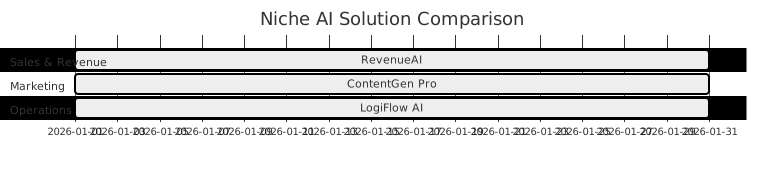
When mapping your needs, use the Capterra AI Software Directory to filter by your specific industry. Below is a snapshot of how top-performing firms are currently grouping their AI investments:
The "Hidden Cost" Analysis: What Your CFO Will Ask
Software subscriptions are just the tip of the iceberg. Audit your spend for the "maintenance trap." High-performing AI requires periodic fine-tuning on your own data. If your team spends more time fixing the AI’s output than they would have spent doing the work manually, your ROI is underwater.
Calculate the true cost: (API fees + Subscription costs + Implementation time) / (Hours saved × Hourly rate). If that number doesn't show a clear path to profit in 90 days, cut it loose.
Case Study: From Chaos to Connection
Consider a mid-sized logistics firm. They used to use ChatGPT to manually draft shipping updates. It was slow, error-prone, and required a human to babysit every single report.
They shifted to a vertically integrated solution that pulled real-time tracking data directly from their ERP. The result? They eliminated the manual drafting phase entirely. They reduced task time by 75% and error rates by 90%. Their staff stopped being data entry clerks and started being process auditors. That’s the goal.
Conclusion: Building an AI-Ready Future
Specialized AI isn’t here to replace your talent; it’s here to unchain them. It’s about removing the friction that keeps your best people from doing their best work. Start small. Find one high-volume, soul-crushing process and replace it with an integrated tool. Once that clicks, scale it.
If you’re drowning in options or just don't know where to start, contact us for an AI tech stack audit. We help businesses cut the noise and build infrastructure that actually moves the needle.
Frequently Asked Questions
How do I know if I need a specialized AI tool or if ChatGPT is enough?
If your task requires deep integration with your internal databases, strict adherence to proprietary data, or high-volume automation without manual intervention, ChatGPT is insufficient. If the task is purely creative or exploratory, a general model is likely all you need.
What are the biggest risks when integrating new AI software into my company's data?
The primary risks are data leakage, model hallucination in sensitive workflows, and vendor lock-in. Always prioritize tools that offer private, secure environments and ensure your vendor agreements explicitly state that your data is not used to train their public models.
How do I balance "AI-powered" tools with human creativity in my business?
Adopt a "Human-in-the-loop" (HITL) model. Use AI for the heavy lifting—data processing, pattern recognition, and rote drafting—and reserve human bandwidth for strategic oversight, empathetic client communication, and final quality assurance.
How do I calculate the actual ROI of an AI software subscription?
Use this formula: (Time Saved per Task × Hourly Rate) - (Subscription Cost + Implementation Maintenance). If the result is positive and the time saved allows for high-value strategic work, the investment is sound.