New Industry Report Forecasts Generative AI Enterprise Adoption and Market Growth Through 2034

The AI Gold Rush: Why Enterprise Adoption is Hitting Warp Speed Through 2034
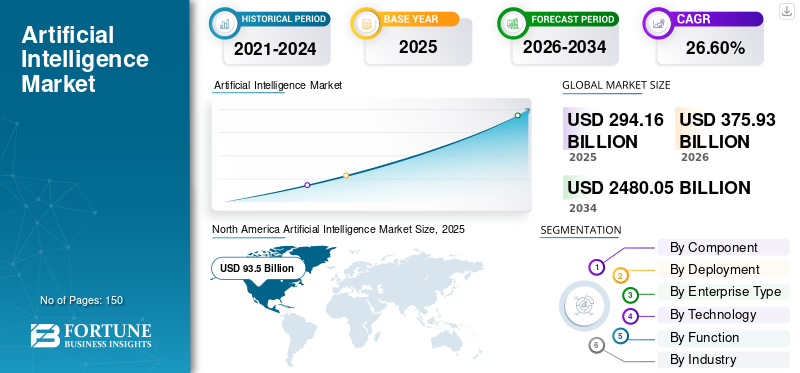
The global artificial intelligence market isn't just growing; it’s exploding. If you look at the latest industry data, we’re staring down a trajectory that hits a staggering USD 2,480.05 billion by 2034. We’re talking about a compound annual growth rate (CAGR) of 26.60%. What’s fueling this? It’s no longer just hype. Generative AI has moved from the sandbox into the boardroom, becoming the backbone of modern enterprise strategy.
Companies are done playing around. The experimental phase is dead. Today, large language models and automated workflows are the primary levers for survival. If you aren't using them, you’re losing ground. Research shows that roughly 35% of businesses have already woven AI into their core operations, and an incredible nine out of ten organizations are leaning on these tools to secure a competitive edge.
The Money Trail: Where the Capital is Flowing
Back in 2025, the AI market was valued at USD 294.16 billion. Fast forward, and the momentum hasn't slowed. By the end of 2025, global AI investments were projected to hit USD 200 billion. It’s a massive influx of cash, and the venture capital world is obsessed. In 2024 alone, over 2,000 AI companies snagged funding. The United States remains the undisputed heavyweight champion of this capital, hosting more than half of those funded entities.
According to the global artificial intelligence market report, North America is sitting pretty with a 31.80% market share as of 2025. When you zoom in on generative AI specifically, that dominance is even more pronounced—the region claims 45% of the global market. It’s the epicenter for both the brains behind the code and the businesses hungry to deploy it.
Generative AI: The Billion-Dollar Acceleration
While general AI is a broad ocean, the generative AI sector is a speedboat. Data from Global Market Insights Inc. paints a wild picture: a market valued at USD 53.7 billion in 2025 is on track to hit nearly USD 1 trillion by 2035. That’s a 31.6% CAGR. The ingredients for this growth? Better hardware, smarter enterprise automation, and the rise of multimodal models that can juggle text, images, and audio all at once.
But here’s the catch: the market is top-heavy. In 2025, five players—OpenAI, Anthropic, NVIDIA, Adobe, and Microsoft—held a combined 58.1% of the market. OpenAI alone held nearly a quarter of the pie. It’s a high-stakes game where a handful of giants dictate the pace of innovation.
| Metric | 2025 Value | 2035 Projection |
|---|---|---|
| Global Generative AI Market | USD 53.7 Billion | USD 988.4 Billion |
| Primary CAGR | 31.6% | N/A |
| Top 5 Market Concentration | 58.1% | N/A |
Regional Shifts and Industry Integration
North America might hold the crown, but keep an eye on the Asia-Pacific region. It’s currently the fastest-growing territory. As reported by Market Research Future, the region holds a 20% share and is scaling fast as local enterprises double down on machine learning.
This isn't just a tech-bro phenomenon. Healthcare, finance, and entertainment are all being transformed. We’re looking at a 19.74% CAGR for specialized generative AI applications over the next decade, with the sector set to reach USD 50.04 billion by 2035.
What’s actually driving this?
- Enterprise Automation: Replacing the drudgery of repetitive tasks with AI to slash overhead.
- Multimodal Development: Moving beyond simple text to models that understand the messy, complex reality of business data.
- Consolidation of Power: Giants like Google, IBM, Meta, and Amazon are pouring billions into R&D, making it very difficult for smaller players to keep pace.
- Infrastructure Investment: Everything relies on the silicon. NVIDIA and other chipmakers are the unsung heroes providing the muscle for these massive models.
The Long-Term Economic Ripple
We are witnessing a fundamental shift in how global business functions. As the generative AI market matures, the conversation is shifting from "What is this?" to "How do we optimize this for our specific bottom line?"
The data is clear: AI is no longer a "nice-to-have" experiment. It is a central pillar of corporate strategy. While the market is becoming saturated in high-tech hubs, the ripple effect is just beginning in emerging sectors. Will the barrier to entry drop as computational costs stabilize? Maybe. But for now, we are living in an era defined by high-level funding, massive regional expansion, and a concentration of power that is reshaping the global economy one model at a time. Through 2034, the only constant will be the pace of change itself.