
How to Generate SEO Keywords for Any Niche (AI Method)

TL;DR
- ✓ Abandon traditional high-volume keyword chasing for semantic AI-driven intent mapping.
- ✓ Use AI to explode broad seed terms into targeted long-tail keyword clusters.
- ✓ Implement the Golden Answer strategy to become the primary source for AI search engines.
- ✓ Build topical authority through a semantic cocoon that connects user pain points.
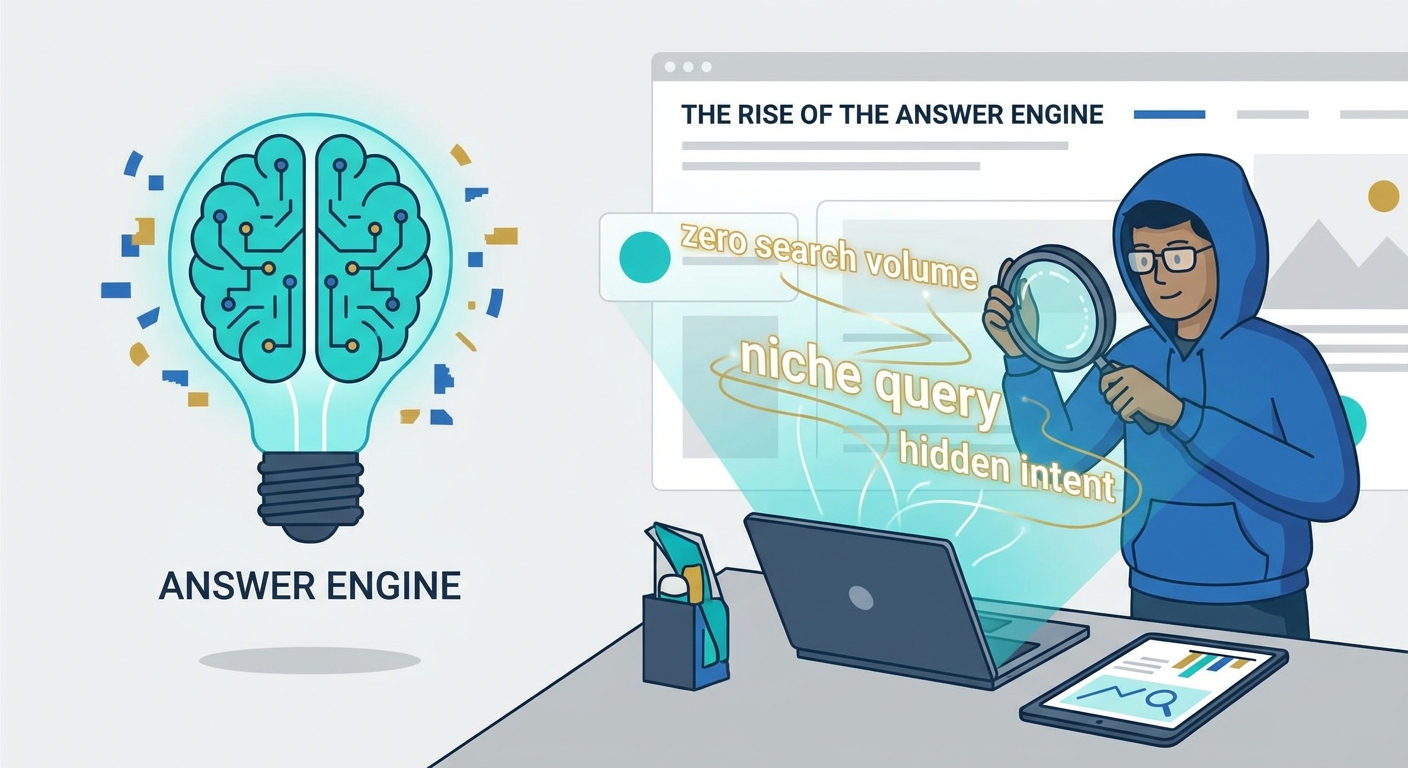
Forget everything you know about chasing high-volume keywords. In 2026, hunting for "high search volume" is like trying to win a race by looking in the rearview mirror. While everyone else is fighting over the same tired terms, the real winners are capturing the "Zero Search Volume" (ZSV) queries—the questions that define the market before anyone else notices.
To win today, you have to stop thinking like an SEO technician and start acting like an Answer Engine. It’s not about blue links anymore; it’s about becoming the primary source for AI-driven search.
Why Traditional Keyword Research is Hitting a Wall
If you’re still basing your content calendar on legacy tools, you’re playing a rigged game. Those tools rely on historical data—stuff that happened months, or even years, ago. By the time a keyword shows up as "high volume" in your dashboard, the ship has sailed. The opportunity is saturated.
Even worse, these tools are obsessed with exact matches. They don't realize that "best running shoes" and "top-rated sneakers for marathon training" are the same thing. If you’re ready to stop spinning your wheels, you need to upgrade your workflow with AI SEO Tools.
True authority isn't about keywords; it’s about topical dominance. You want Google and AI models to think of you whenever your niche comes up.
How AI Changes the Game
Think of AI as a semantic brain, not a database. A standard tool stores data; an LLM understands intent. It knows how a person feels when they search, what their problems are, and what they need to hear to click "buy."
By using AI, you’re uncovering the "hidden" questions your audience is whispering. These aren't just keywords; they’re pain points.
Step 1: Kill the "Head Term"
Starting your research with a broad term like "digital marketing" is a one-way ticket to obscurity. It’s too big, too competitive, and too vague.
Instead, use AI to explode those seeds into a thousand long-tail possibilities. Try this prompt: "Analyze the following niche [Insert Niche] and provide 20 long-tail keyword clusters based on specific user pain points, excluding broad head terms."
Once you have your clusters, use the "Golden Answer" strategy. For every H2 heading, give a direct, 40-word answer to the query immediately. AI models are hungry for this. If you give them the answer in a clean, concise bite, they’ll cite you as the source. You don't just climb the rankings; you bypass them.
Step 2: Build a "Semantic Cocoon"
Topical authority is built by connecting the dots. Every post you write should act as a bridge to another, more specific post. You’re building a web of relevance. If this feels like too much to manage, you might want to learn about our Content Optimization Services to help structure your site’s architecture.
Sort your keywords into these three buckets:
- Informational: The "How-to" and "Why." This is your funnel’s top.
- Transactional: The "Best X for Y." This is your sales engine.
- Navigational: The brand-specific searches.
When you link these together, you create a narrative. You pull the user in with a problem, guide them with a comparison, and close them with a solution.
Step 3: The "Page 2" Gold Mine
The easiest way to grow is to look at what you’ve already got. Log into Google Search Console and implement Google Search Console Regex filters to find keywords where you’re stuck in positions 11 to 20.
You’re already on the radar, but you’re missing the "secret sauce." Feed those keywords into an AI, ask it to identify missing sub-topics, and fill the gaps. It’s the fastest way to jump to the first page.
Step 4: Go Where the People Are
Search volume is just a proxy for interest. Real intent lives in the wild. Use SparkToro to find out what podcasts your audience listens to and what they’re arguing about on Reddit.
If you see someone asking the same question on a Discord server three times in a week, that’s not "zero volume"—that’s a hot lead. Finally, benchmark your content against Perplexity AI. Check the "Related Questions" it spits out. That’s your roadmap for your next twenty articles.
The Hybrid Workflow: A Blueprint
Stop choosing between human nuance and AI speed. You need both.
- AI Ideation: Let the machine handle the brainstorming.
- Contextual Mapping: Organize the chaos into a hub.
- Traditional Tool Validation: Sanity-check the volume so you aren't writing into a void.
- Content Publication: Write like a human, format like an answer engine.
Case Study: Breaking the Page 2 Curse
I worked with a SaaS client who was obsessed with "big" keywords. They spent years hitting a wall. We flipped the script. We stopped chasing the giants and started answering every single question their users had about their product. Six months later? Traffic up 300%. They weren't just ranking; they were the local expert.
The "Copy-Paste" Prompt Library
- For Long-Tail Expansion: "I am writing about [Topic]. Provide 15 long-tail, intent-based questions that a beginner might ask, focusing on the specific challenges of [Target Audience]."
- For Intent Classification: "Categorize the following list of keywords into Informational, Transactional, and Navigational buckets: [Insert Keywords]."
- For "Golden Answer" Drafting: "Based on the query '[Insert Keyword]', write a 40-word, direct, and authoritative response that is optimized to be cited as a primary source in an AI search overview."
Frequently Asked Questions
Does AI keyword research replace tools like Ahrefs or Semrush?
Not at all. AI is for the "what" and the "why." Ahrefs and Semrush are for the "how much" and the "how hard." You need the data to back up the strategy.
How do I find keywords that have zero search volume?
Look where people actually talk. Customer support tickets, Reddit, Discord, and the "Related Questions" sections in AI search results. If people are asking, the volume will follow.
How do I optimize for AI Overviews?
Be the direct source. Use the "Golden Answer" format—clear, punchy, and under 40 words—right at the start of your sections. Make it easy for the AI to pick you up and quote you.
What is the most important factor for SEO in 2026?
Topical authority. Stop writing "articles" and start building "ecosystems." If you can answer every question a user has within your niche, you’ve won.