Adaptive Q\&A Systems
Introduction to Adaptive Q&A Systems
Adaptive Q&A systems? Sounds kinda sci-fi, right? But trust me, it's more practical than you think, and it is changing how we interact with information.
At its core, a q&a system is designed to do one thing: answer questions. But not just any question; we're talking complex inquiries that go beyond simple keyword matching. Think of it as a souped-up search engine that actually understands what you're asking. These systems come in a few flavors:
- Rule-based systems: These rely on predefined rules to answer questions. Think of a decision tree, where each answer leads you down a specific path. Great for structured data; not so great for nuanced queries.
- Information retrieval-based systems: These systems search for relevant documents and extract answers. They are like a smart librarian who knows where every piece of information is stored.
- Knowledge-based systems: These use a knowledge graph to understand relationships between entities. Imagine a network of interconnected facts; the system navigates this network to find answers.
To make this all work, Q&A systems typically have components like natural language processing (nlp) for understanding the question, a knowledge base or data source, and a reasoning engine to generate the answer.

Traditional q&a systems, while useful, often fall short. They can be rigid, struggle with ambiguity, and provide generic answers that don't quite hit the mark. That's where adaptivity comes in. An adaptive q&a system learns from user interactions, adjusts its responses based on context, and personalizes the experience. This is important because no two users are exactly alike, and their information needs evolve. An adaptive system can improve accuracy, boost user satisfaction, and increase efficiency. (An adaptive feedback system for the improvement of learners - PMC)
So, what makes a q&a system adaptive? A few key features stand out:
- User modeling: Creating a profile of each user to tailor responses to individual needs.
- Context awareness: Understanding the situation in which the question is asked, like location or time of day.
- Learning capabilities: The ability to learn from new data and user feedback.
- Personalization: Delivering answers that are tailored to the individual user and their specific needs.
Adaptive Q&A is truly a game changer. Next up, we'll explore the various techniques used to make these systems adaptive.
Components of an Adaptive Q&A System
Adaptive Q&A systems aren't just about spitting out answers; it's about how they do it. Think of it like this: a regular search engine gives the same result to everyone, but an adaptive system? It's like having a conversation tailored just for you.
So, what's under the hood? Let's break down the core components that make these systems tick.
-
Knowledge Base: This is the brain of the operation. It's where all the information lives, but it's gotta be organized! We're talking ontologies, semantic networks—fancy ways of structuring knowledge so the system can actually understand relationships between things. Think of it like a meticulously organized library, where everything is cross-referenced and easy to find. This isn't just a database; it's a web of interconnected concepts. For example, in healthcare, it might link symptoms to diseases, treatments, and patient profiles.

-
Question Analysis Module: This is where nlp comes into play. It's not enough to just see keywords; the system needs to understand what the user really means. That involves parsing the question, figuring out the intent, extracting entities (like names or dates), and identifying relationships between them. Like, if someone asks "What's the return policy on a cloudflare Pro plan?", the system needs to know "cloudflare" is an entity, "return policy" is the intent, and "Pro plan" is a specific attribute.
-
Answer Generation Module: Once the system understands the question, it needs to find the right information and present it in a way that makes sense. This involves retrieving relevant data from the knowledge base, synthesizing an answer, ranking potential answers by relevance, and even generating an explanation of why that's the answer. It ain't just about finding info; it's about crafting a response that's both accurate and understandable.
-
Adaptation Engine: This is where the "adaptive" magic happens. The engine uses user modeling techniques to learn about individual users, employing algorithms like reinforcement learning or collaborative filtering to improve over time. Adaptation strategies might include adjusting the level of detail in answers, suggesting related topics, or even changing the tone of the response.
Imagine a financial advisor using an adaptive Q&A system. A new client asks, "What are some low-risk investment options?". The question analysis module parses the query. The system then consults it's knowledge base, which is packed with info on stocks, bonds, and other assets. The adaptation engine will then tweak its response based on the client's risk tolerance and investment goals.
Next up, we'll explore the various techniques used to make these systems adaptive.
Adaptation Techniques in Q&A Systems
Adaptive Q&A systems are more than just fancy search engines; they're like having a conversation with a super-smart, ever-learning friend. How do they actually adapt though? That's the million-dollar question, isn't it?
Here's the lowdown on some of the key adaptation techniques:
-
User Modeling: It's all about building a profile. We're talking about capturing user preferences, their current knowledge level, and even their goals.
- How do we get this data? We use explicit feedback (like asking "Was this helpful?") and implicit feedback (analyzing their search history or how long they spend on a page).
- Imagine a healthcare app. It might track a user's history of looking up information on diabetes. The system then tailors answers about diet and exercise to that specific condition.
- Keeping these models up-to-date is crucial. People change, their knowledge grows, and their goals shift.
-
Contextual Adaptation: Context is king, y'know? It's not just what you ask, but where you are, when you ask it, and even what device you're using.
- A retail chatbot, for instance, might give different answers based on the user's location. If you're in a cold climate, it'll push winter coats; if you're somewhere tropical, it'll suggest swimwear.
- Handling ambiguity is crucial here. If someone asks "What's the best phone?", the system needs to consider their past purchases, their location (for carrier compatibility), and even the time of year (new phone releases).
-
Learning from User Interactions: This is where the ai really shines. The system learns from every interaction, getting smarter over time.
- Reinforcement learning is a big player here. The system gets "rewards" for giving good answers and "penalties" for bad ones, constantly tweaking its answer selection.
- Collaborative filtering is another technique. It's like saying, "Users who liked this answer also liked that one." This helps the system recommend relevant info.
- And all that feedback? It's not just for show. It's used to improve the knowledge base itself, fixing errors and adding new information.
Contextual adaptation is so important, it's worth diving into a bit deeper. Imagine a user asking a q&a system "what is love?" If the system only considers the literal query, it might return a definition from a dictionary.
But what if the system knew the user was listening to 80's music? Or that they were browsing dating sites? Suddenly, the system could provide a very different answer, maybe a song lyric or a suggestion to visit a relationship advice forum.
To visualize this, consider the following diagram:
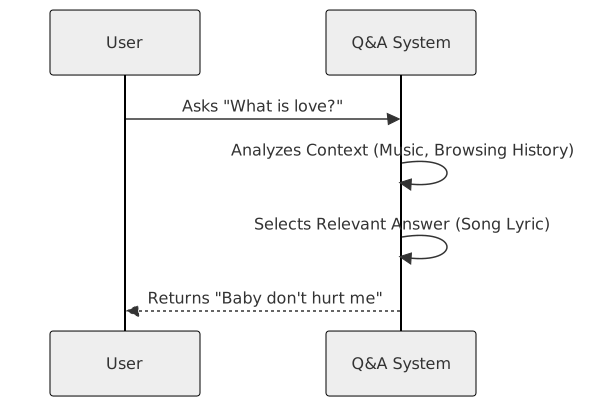
The point is, context can completely change the meaning of a question and the appropriateness of an answer. Figuring out what that context is, is the challenge.
So, adaptive Q&A systems are constantly evolving, learning, and tailoring their responses to provide the best possible experience. It's like having a personal ai assistant that actually gets you.
Next up, we'll look at some real-world examples of where this tech is being used.
Real-World Applications of Adaptive Q&A Systems
Adaptive Q&A systems aren't just a futuristic concept; they're already here, quietly revolutionizing various industries. From education to healthcare, these systems are making information more accessible and personalized.
Here's a look at some real-world applications:
-
E-learning and Education: Forget one-size-fits-all lectures. Adaptive Q&A systems are creating personalized tutoring experiences. For example, platforms like Khan Academy use these systems to assess a student's knowledge gaps and tailor the curriculum accordingly. Adaptive assessments provide immediate feedback, guiding students towards mastery.
-
Customer Support: Chatbots are evolving beyond simple keyword recognition. Adaptive q&a-powered chatbots, like those used by intercomm, can understand complex queries, provide personalized recommendations, and resolve issues more efficiently. It's about moving away from generic responses and towards truly helpful interactions.
-
Healthcare: Imagine a system that can assist doctors in making more accurate diagnoses. Adaptive Q&A systems, such as IBM Watson Health, can analyze patient data, research medical literature, and provide personalized treatment recommendations. This not only improves patient outcomes but also reduces the burden on healthcare professionals.
-
Enterprise Knowledge Management: Companies are drowning in data, but adaptive Q&A systems can help them make sense of it all. Tools like Bloomfire create internal knowledge bases that are easily searchable and personalized to each employee's role. Adaptive information retrieval ensures that employees can find the information they need quickly and efficiently, boosting productivity and collaboration.
In retail, an adaptive q&a system might analyze a customer's past purchases and browsing history to recommend products they're likely to be interested in. Or, in finance, it could provide personalized investment advice based on a user's risk tolerance and financial goals.
What's next for adaptive Q&A? Let's delve into the challenges and future trends of these systems.
Challenges and Future Trends
Adaptive Q&A systems: sounds great, right? But like any tech, it's not all sunshine and rainbows; there are some real challenges, and some interesting trends on the horizon.
-
Data sparsity: adaptive Q&A systems thrive on data, but what happens when there's not enough? It's like trying to bake a cake with only half the ingredients. One way to tackle this is with synthetic data generation, creating artificial data points to fill in the gaps. Another is transfer learning, where you leverage data from similar domains to bootstrap the system.
-
Cold start problem: Brand new users are a tough nut to crack. The system knows nothing about them! This is where those initial user surveys or questionnaires come in handy, even if they are a little annoying. Progressive profiling, where you gradually gather information over time, is another approach.
-
Maintaining user privacy: Personalization is great, but not at the expense of privacy, y'know? Differential privacy techniques can add noise to the data while still preserving its utility. Anonymization and data aggregation are also crucial. It's a tricky balance to strike, but essential for building trust.
-
Scalability: As user bases grow, adaptive Q&A systems need to scale accordingly. This means optimizing the underlying infrastructure, using distributed computing frameworks, and employing efficient indexing techniques. Cloud-based solutions can offer the elasticity needed to handle fluctuating demand.
-
Integration with large language models (llms): LLMs like gpt-4 are game changers. Integrating them into adaptive Q&A systems can unlock new levels of natural language understanding and answer generation. Think of it as giving your system a super-powered brain.
-
Multi-modal Q&A systems: Why limit yourself to text? Future systems will incorporate images, audio, and video. Imagine asking a system "How do I fix this leaky faucet?" and it responds with a video tutorial tailored to your specific faucet model.
-
Explainable ai (xai) for Q&A: Users want to know why a system gave a particular answer. Xai techniques can provide insights into the reasoning process, increasing trust and transparency. This is especially important in sensitive domains like healthcare or finance.
-
Personalized and proactive information delivery: Instead of waiting for users to ask questions, future systems will proactively deliver information based on their needs and interests. Imagine a system that automatically notifies you of relevant news articles or upcoming events.
Adaptive Q&A systems aren't immune to ethical concerns. Algorithmic bias, for example, can lead to unfair or discriminatory outcomes. Transparency and accountability are crucial for building trust. Ensuring fairness requires careful attention to data collection, model training, and evaluation. It's not enough to just build a system that works; you also have to build one that's ethical.
So, where does this leave us? Adaptive Q&A is powerful but requires thoughtful development, deployment, and ongoing maintenance.